Table of Contents
Skin Purging vs Acne Breakout: What Is the Difference?
Have you recently started a new skincare product and suddenly noticed more pimples, bumps, or clogged pores? You may be wondering whether your skin is purging or experiencing an actual acne breakout.
Although skin purging and acne breakouts can look similar, they are not the same thing. Skin purging can occur when certain active ingredients speed up skin-cell turnover, causing existing clogged pores to surface faster. On the other hand, a typical acne breakout may happen because of clogged pores, excess oil, inflammation, hormonal changes, irritating products, or other triggers.
Knowing the difference is important because continuing an irritating product when you are actually breaking out can make your skin worse.
If you are experiencing persistent acne or unexplained breakouts, consulting a qualified dermatologist can help identify the underlying cause and create a treatment plan suited to your skin.
At Dermedico Clinic in Defence Colony, South Delhi, dermatology and cosmetic skin treatments are provided under the supervision of Dr. Pallavi Chandna Rohatgi, MD Dermatologist.
What Is Skin Purging?
Skin purging refers to a temporary increase in breakouts that may happen after introducing certain skincare ingredients that accelerate skin-cell turnover.
It is most commonly associated with active ingredients such as:
- Retinoids and retinol
- Certain exfoliating acids
- Salicylic acid
- Glycolic acid and other AHAs
- Other products designed to increase cell turnover
When cell turnover increases, existing microcomedones or clogged pores may come to the surface more quickly. Cleveland Clinic notes that skin purging can occur after introducing facial acids and may last for a few weeks.
However, not every breakout after a new skincare product is purging. Irritation, allergy, pore-clogging ingredients, or an unsuitable skincare routine can also cause new pimples.
What Is an Acne Breakout?
An acne breakout occurs when pores become clogged with oil, dead skin cells and other debris, followed by inflammation in some cases.
Acne can appear as:
- Blackheads
- Whiteheads
- Small red bumps
- Pustules
- Nodules
- Cysts
Inflammatory acne can cause redness, swelling, tenderness and painful lesions. More severe forms, such as cystic acne, can develop deeper in the skin and may increase the risk of scarring.
Acne may be influenced by several factors, including hormones, genetics, skincare products, environmental factors and inflammation. Therefore, simply assuming every new pimple is “purging” can delay appropriate treatment.
Skin Purging vs Acne Breakout: 7 Key Differences
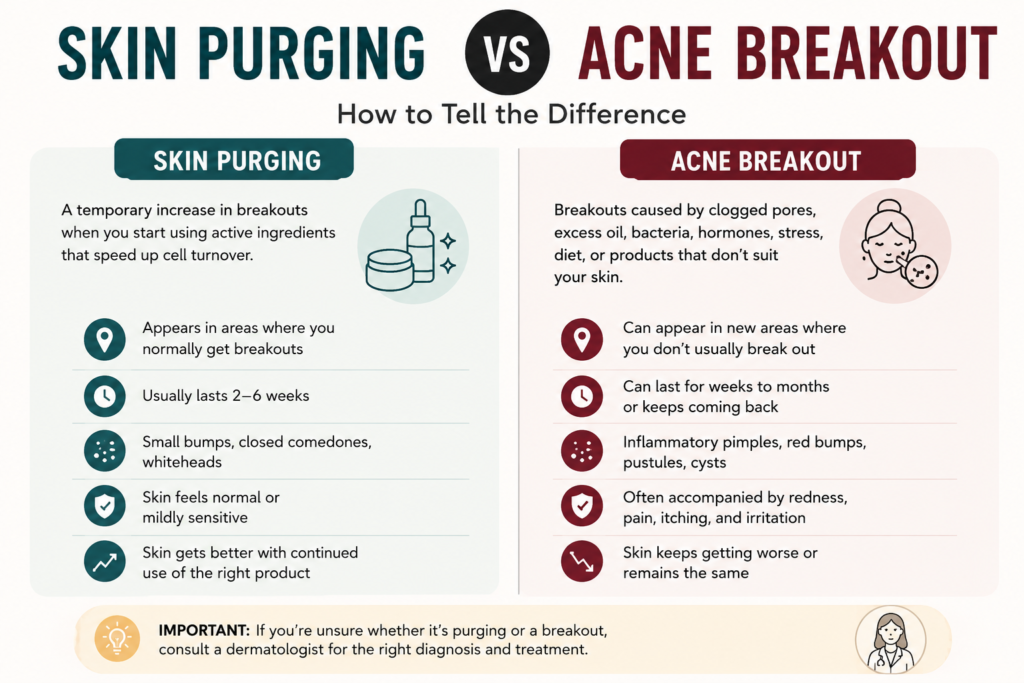
Understanding the pattern of your skin can provide useful clues.
1. When Did the Breakout Start?
If pimples appear soon after introducing a product containing an ingredient that increases cell turnover, purging may be possible.
For example, someone beginning a retinoid or exfoliating acid may initially notice more congestion.
However, timing alone cannot confirm purging.
If a breakout appears after introducing a completely new moisturizer, makeup, sunscreen or other product that does not typically accelerate cell turnover, it may be more likely to represent irritation or acne rather than classic purging.
2. Where Are the Pimples Appearing?
Location can be another useful clue.
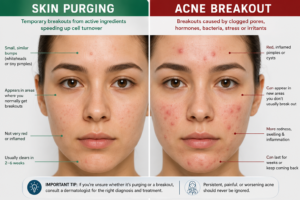
During purging, breakouts generally appear in areas where you already tend to experience congestion or acne.
If you suddenly develop pimples in areas where you normally do not break out, consider whether a product could be irritating or clogging your pores.
Acne can occur on different areas of the face and body, and the underlying triggers can vary.
3. How Long Does It Last?
One of the biggest questions people ask is:
“How long does skin purging last?”
There is no single timeline that applies to everyone. A temporary adjustment period can occur after introducing certain active ingredients, but persistent or progressively worsening acne should not automatically be labelled as purging.
If your skin continues to deteriorate, becomes increasingly inflamed, or does not seem to be settling, it is sensible to consult a dermatologist.
4. Does Your Skin Feel Irritated?
Purging does not necessarily mean your skin should feel severely uncomfortable.
If you experience significant:
- Burning
- Stinging
- Intense itching
- Excessive redness
- Swelling
- Severe dryness
- Cracking
you should reconsider the product and seek professional advice.
Cleveland Clinic specifically notes that significant irritation, including considerable stinging, itching or redness, can indicate that something other than normal purging may be occurring.
5. What Type of Bumps Are You Getting?
Purging may involve the types of small clogged pores and pimples you commonly experience.
A typical acne breakout, however, can include different types of lesions, from blackheads and whiteheads to inflammatory papules, pustules and deeper nodules.
Deep, painful or cyst-like lesions deserve particular attention because they may increase the risk of acne scarring.
6. Is Your Skin Getting Better or Worse?
A temporary adjustment should eventually settle.
If your skin is continuously getting worse, new areas are becoming affected, or painful acne is increasing, don’t simply assume that your skin is “detoxing.”
There is actually no need to tolerate severe acne in the hope that it will eventually disappear.
A dermatologist can determine whether you are dealing with acne, irritation, contact dermatitis, rosacea or another condition that may resemble acne. The American Academy of Dermatology points out that several skin conditions can look like acne.
Quick Comparison: Skin Purging vs Acne Breakout
| Feature | Skin Purging | Acne Breakout |
|---|---|---|
| Common trigger | Cell-turnover-boosting active ingredients | Hormones, clogged pores, inflammation, products and other triggers |
| Location | Often areas already prone to congestion | Can occur in familiar or new areas |
| Duration | Usually temporary | Can persist or repeatedly return |
| Irritation | Usually limited | May involve inflammation and tenderness |
| Pattern | Often linked to starting an active | Can happen independently of a new active |
| Deep painful acne | Less typical | Can occur |
| What to do | Monitor and avoid over-irritating the skin | Identify the cause and consider dermatological treatment |
Important: This table is a general guide, not a diagnostic test. A dermatologist should evaluate persistent or severe breakouts.
Why Does Skin Purging Happen After Retinol or Acids?
Ingredients such as retinoids and exfoliating acids can influence how quickly skin cells move through the skin’s renewal process.
For example, retinoids can help unclog pores and prevent new acne lesions. The American Academy of Dermatology also lists retinoids, benzoyl peroxide and salicylic acid among commonly used acne-treatment ingredients.
However, these ingredients can also irritate the skin, particularly when introduced too quickly or combined with several other active products.
That is why more active ingredients do not automatically mean better skin.
A simple routine containing a gentle cleanser, suitable moisturizer and daily sunscreen may be preferable while the skin adjusts to an acne treatment.
Can Skin Purging Cause Acne Scars?
Purging itself should not be an excuse to ignore worsening acne.
Inflammatory acne can increase the risk of post-acne marks and scars, particularly when pimples are picked or squeezed. The American Academy of Dermatology recommends treating acne early to help reduce the risk of dark spots and scarring.
If you are dealing with persistent acne scars after the active acne has been controlled, a dermatologist can also assess whether procedures such as Dermaroller or Derma Genesis may be appropriate.
Dermedico Clinic lists Derma Genesis and Dermaroller among its skin treatments, including treatments aimed at acne scars and skin rejuvenation.
What Should You Do If You Think You Are Purging?
If you have recently introduced an active ingredient and notice mild, temporary breakouts, consider the following:
Keep Your Routine Simple
Avoid adding multiple new active ingredients simultaneously.
Using several exfoliating products at once can make it difficult to determine which product is responsible for your reaction.
Use a Gentle Cleanser
Avoid aggressive scrubbing or frequent washing.
The American Academy of Dermatology recommends gentle cleansing and non-comedogenic skincare to help reduce irritation and clogged pores.
Moisturise Your Skin
A suitable moisturizer can help support the skin barrier, particularly when using potentially irritating acne treatments.
Wear Sunscreen
Daily broad-spectrum sunscreen is an important part of any skincare routine, especially when using active ingredients that may increase irritation or sensitivity.
Don’t Pick Your Pimples
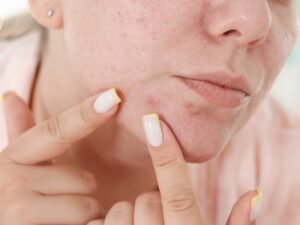
Picking or squeezing pimples can increase inflammation and the risk of scarring.
When Should You See a Dermatologist in South Delhi?
You should consider professional dermatological advice if:
- Your acne is becoming painful or severe.
- Breakouts are spreading to new areas.
- You develop deep nodules or cysts.
- Your skin is burning, swelling or severely irritated.
- You are developing persistent dark spots or acne scars.
- Your breakouts continue despite changing your skincare routine.
- You are unsure whether you are purging or breaking out.
- You suspect that another skin condition may be causing acne-like bumps.
Persistent acne isn’t always simply acne. Conditions such as perioral dermatitis and rosacea can sometimes resemble acne, making professional diagnosis important.
Acne Treatment in South Delhi: Why Professional Diagnosis Matters
If you are searching for acne treatment in South Delhi, it is important to understand that there is no universal treatment that works for every patient.
A dermatologist may consider:
- Your skin type
- Type of acne
- Duration of symptoms
- Previous treatments
- Current skincare products
- Hormonal factors
- Acne scars or pigmentation
- Skin sensitivity
At Dermedico Clinic, Dr. Pallavi Chandna Rohatgi is an MD Dermatologist, Cosmetologist and Laser Surgeon with experience in dermatology, acne scars, pigmentation, rosacea and skin rejuvenation.
Depending on the individual concern, dermatological care may involve topical medication, oral medication, skincare adjustments or professionally supervised procedures.
For example, Dermedico lists medical-grade chemical peels, including salicylic and glycolic acid-based options, among its treatments.
Can Chemical Peels Help Acne-Prone Skin?
Chemical peels can be used for selected skin concerns, including acne and pigmentation.
Dermedico Clinic offers medically supervised chemical peel treatments using ingredients such as glycolic, salicylic, lactic acid and TCA, depending on the treatment plan.
However, a peel should not be selected simply because your skin is breaking out. The right treatment depends on the condition of your skin and the type and severity of acne.
A dermatologist can determine whether a chemical peel is appropriate for you.
Skin Purging vs Breakout: The Bottom Line
The easiest way to remember the difference is this:
Purging is generally associated with ingredients that accelerate skin turnover and tends to be temporary, while an acne breakout can have many different causes and may persist or worsen without appropriate treatment.
If your skin is mildly breaking out after introducing a suitable active ingredient, give your routine time and avoid overwhelming your skin with additional products.
But if you experience persistent, painful, spreading or severely irritated acne, don’t simply call it purging and wait indefinitely.
Professional evaluation can help identify what is actually happening and prevent unnecessary skin damage.
Frequently Asked Questions
1. How can I tell if my skin is purging or breaking out?
Look at the timing, location, type of blemishes and how your skin feels. Purging is generally linked to ingredients that increase cell turnover, whereas breakouts can result from multiple triggers. A dermatologist can provide a more reliable diagnosis.
2. Is skin purging a good sign?
Skin purging can occur as the skin adjusts to certain active ingredients. However, severe irritation, burning, swelling or persistent worsening should not automatically be considered a normal purge.
3. How long does skin purging last?
There is no universal duration. It should generally be temporary. If your acne continues to worsen or does not settle, consult a dermatologist rather than assuming it is purging.
4. Can retinol cause purging?
Retinoids can increase skin-cell turnover and may be associated with an initial adjustment period. They can also cause irritation, especially when used too frequently or combined with other irritating products.
5. Should I stop skincare if my skin is purging?
Not necessarily. The right approach depends on the product, severity of symptoms and your individual skin. If you have significant irritation or worsening acne, seek professional advice.
6. Can purging happen with salicylic acid?
It can happen with active exfoliating ingredients, but not every breakout after salicylic acid is purging. Irritation or an unsuitable product can also cause problems.
7. Does purging happen in areas where I normally get acne?
It is more consistent with purging when breakouts occur in areas that are already prone to congestion. New or unusual breakout locations may warrant closer evaluation.
8. When should I see a dermatologist for acne?
See a dermatologist if acne is painful, persistent, severe, scarring, rapidly worsening or difficult to distinguish from another skin condition.
9. Can acne cause dark spots?
Yes. Acne can leave post-inflammatory dark marks, particularly in deeper skin tones. Treating acne early can help reduce the risk of long-lasting marks.
10. Where can I get acne and skin consultation in South Delhi?
Dermedico Clinic is located at D-95, Defence Colony, New Delhi, and provides dermatology and cosmetic skin treatments under qualified medical supervision.
Book a Dermatologist Consultation in South Delhi
If you’re unsure whether you’re experiencing skin purging vs acne breakout, don’t experiment with multiple products at once.
A professional skin assessment can help determine the cause of your breakouts and identify an appropriate treatment strategy.
Dermedico Clinic
D-95, Defence Colony, New Delhi
Monday–Saturday: 10:00 AM–6:00 PM
Dr. Pallavi Chandna Rohatgi, MD Dermatologist
For more information about available skin and cosmetic treatments, visit the Dermedico Clinic treatment section.