Table of Contents
Chemical Peel vs Laser Treatment
Pigmentation is a common skin concern that can affect people of different ages and skin types. Dark spots, uneven skin tone, melasma, sunspots and post-acne marks can make the complexion appear uneven. If topical skincare products have not provided the desired improvement, you may be considering professional treatments.
Two commonly discussed options are chemical peels and laser treatments. But when it comes to chemical peel vs laser treatment for pigmentation, which is better?
The answer depends on the cause of pigmentation, the depth of the pigment, your skin type, previous treatments and the possibility of post-inflammatory hyperpigmentation. Both treatments may help selected pigmentation concerns, but neither is suitable for every individual.
In this guide, we compare chemical peels and laser treatments, explain their benefits and limitations, and discuss how to choose an appropriate pigmentation treatment with a qualified dermatologist.
What Causes Skin Pigmentation?
Skin pigmentation occurs when the skin produces too much melanin or distributes it unevenly. Melanin gives skin its natural colour. Several factors can trigger excess pigmentation, including:
- Sun exposure and ultraviolet radiation
- Hormonal changes associated with melasma
- Acne and the dark marks left after breakouts
- Skin irritation, inflammation or injury
- Certain medications or underlying skin conditions
- Genetic factors and an individual’s tendency to develop pigmentation
The appearance of pigmentation alone does not always reveal its cause. For example, melasma may produce brown patches across the cheeks, forehead or upper lip, while post-inflammatory hyperpigmentation often appears where acne or inflammation previously occurred.
Identifying the type of pigmentation is an important first step because different conditions require different treatment approaches.
What Is a Chemical Peel for Pigmentation?
A chemical peel is a professional skin treatment that uses a carefully selected chemical solution to exfoliate the outer layers of the skin. Depending on the formula and treatment depth, it can improve uneven skin tone, reduce certain dark spots, fade acne-related pigmentation and refine skin texture.
Common peeling agents include glycolic acid, lactic acid, salicylic acid and mandelic acid. The appropriate agent, concentration and treatment depth depend on the patient’s skin condition and medical assessment.
Benefits of Chemical Peels
1. May improve superficial pigmentation
Selected superficial peels can help reduce the appearance of certain epidermal pigmentation concerns by promoting controlled exfoliation.
2. Can address more than one skin concern
Depending on the peel used, treatment may also help selected cases of acne, rough texture and dull-looking skin.
3. Allows a tailored treatment approach
A dermatologist can adjust the type and strength of the peel according to skin sensitivity, pigmentation and treatment goals.
4. May form part of a combination plan
Dermatologists may combine chemical peels with suitable skincare products and other medical treatments when necessary.
Limitations of Chemical Peels
Chemical peels are not a guaranteed solution for every type of pigmentation. Multiple sessions may be required, and results vary between individuals.
Possible side effects include redness, irritation, dryness, peeling, burns, infection and changes in skin colour. Aggressive or unsuitable peels can worsen pigmentation, particularly in people prone to post-inflammatory hyperpigmentation.
Professional assessment is therefore important, especially for Indian skin tones that may be more susceptible to pigmentation following inflammation.
What Is Laser Treatment for Pigmentation?
Laser treatment uses specific wavelengths of light to target selected structures or pigments in the skin. Depending on the device, laser treatment may be considered for particular pigmented lesions, sunspots or other carefully diagnosed conditions.
Not all lasers work in the same way. Different devices use different wavelengths, pulse durations and energy settings, so the choice of laser depends on the condition being treated.
It is also important to distinguish laser treatment from IPL, or intense pulsed light. IPL uses a broader range of light wavelengths and is not technically the same as a laser.
Benefits of Laser Treatment
1. Targets selected pigmentation concerns
Certain laser systems can target pigment in appropriately diagnosed lesions without treating the entire skin surface in the same way as a peel.
2. May be considered for specific dark spots
A dermatologist may recommend a suitable laser for selected sunspots or other lesions after assessing their nature and depth.
3. Offers different treatment options
Several laser technologies are available, allowing treatment to be tailored to specific indications when appropriate.
4. Can complement other treatments
In selected cases, a laser or light-based procedure may be considered alongside medical skincare and other treatments.
Limitations of Laser Treatment
Laser treatment is not automatically more effective than a chemical peel. It may involve a higher cost, temporary redness, swelling, crusting or downtime, depending on the device and treatment intensity.
More importantly, laser treatment can sometimes cause burns, scarring, lighter patches or post-inflammatory hyperpigmentation. Melasma can also return after an initial improvement.
For this reason, choosing the right device, settings and patient is particularly important for people with darker skin tones.
Chemical Peel vs Laser Treatment for Pigmentation: Key Differences
The following comparison provides a general overview. Actual outcomes depend on the diagnosis, treatment protocol and individual skin characteristics.
| Factor | Chemical Peel | Laser Treatment |
|---|---|---|
| How it works | Uses a chemical solution for controlled exfoliation | Uses selected light wavelengths to target specific structures or pigment |
| Common applications | Selected superficial pigmentation, acne marks and uneven texture | Selected pigmented lesions and other device-specific indications |
| Treatment approach | The solution and depth are chosen for the skin concern | The device, wavelength and settings are chosen for the diagnosis |
| Number of sessions | Often requires a series of sessions | May require one or multiple sessions |
| Downtime | Ranges from minimal to more noticeable peeling and recovery | Ranges from minimal to more substantial recovery |
| Cost | Depends on the peel, provider and number of sessions | Depends on the device, provider and number of sessions |
| Risks | Irritation, burns, scarring and pigmentation changes | Burns, irritation, scarring and pigmentation changes |
| Suitability for Indian skin | Requires careful selection of peel and strength | Requires careful selection of device and settings |
| Melasma | May be considered cautiously in selected cases | May be considered cautiously in selected cases |
| Long-term maintenance | May be needed depending on the condition | May be needed depending on the condition |
Neither option is universally better. A treatment that works well for one type of dark spot may be unsuitable for another.
Chemical Peel vs Laser: Which Is Better for Indian Skin?
Indian skin can have a greater tendency to develop post-inflammatory hyperpigmentation after irritation or injury. This does not mean chemical peels or lasers are always unsuitable. It means the diagnosis, treatment intensity and recovery plan deserve particular attention.
When Might a Chemical Peel Be Considered?
A dermatologist may consider a carefully selected superficial chemical peel when:
- Pigmentation is predominantly superficial.
- Certain acne-related marks or uneven skin tone are present.
- The skin is suitable for controlled exfoliation.
- The expected benefits outweigh the risk of irritation or further pigmentation.
The strongest peel is not necessarily the best peel. A cautious approach may be more appropriate for pigmentation-prone skin.
When Might Laser Treatment Be Considered?
A suitable laser may be considered when:
- The pigmentation has been accurately diagnosed.
- The particular device is appropriate for that type of lesion.
- The patient’s skin tone and history have been considered.
- The expected benefit justifies the risk, cost and recovery period.
Laser treatment requires particular caution for melasma and in patients who have previously developed dark marks following skin irritation.
What About Melasma?
Melasma is a chronic pigmentation condition that can be influenced by sunlight, visible light, hormonal factors and individual predisposition. It can be difficult to manage and may recur even after improvement.
Neither chemical peels nor laser treatment should automatically be considered the first or best option for every melasma patient. A dermatologist may recommend medical skincare and consistent sun protection first, with procedures considered selectively.
For additional information, read the American Academy of Dermatology’s guide to melasma treatment.
Chemical Peel vs Laser Treatment for Acne Marks
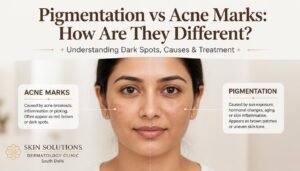
Dark marks that remain after acne are often caused by post-inflammatory hyperpigmentation. They are different from depressed or raised acne scars, which involve changes in skin structure.
A chemical peel may help selected superficial acne marks, particularly when the skin is suitable for the chosen formulation. Certain laser procedures may also be considered for selected pigmentary concerns.
However, active acne should be managed appropriately, and treatment should be chosen according to whether the main problem is pigmentation, textural scarring or both.
Read more about pigmentation vs acne marks to understand the difference.
Which Treatment Gives Faster Results?
There is no universal timeline for improvement with either treatment.
Some selected pigmented lesions may respond relatively quickly to an appropriate procedure, while melasma and post-inflammatory hyperpigmentation may need a longer-term management plan. Chemical peels often require a series of treatments, whereas laser treatment may require one or several sessions depending on the indication.
Initial improvement does not necessarily mean the pigmentation has been permanently removed. Recurrence can occur, especially when the original triggers remain.
A realistic treatment plan should explain the expected timeline, number of sessions, possible side effects and maintenance requirements before the procedure begins.
Chemical Peel vs Laser Treatment: Which Is More Affordable?
The total cost depends on the clinic, treatment area, type and strength of the peel, laser technology, number of sessions and follow-up care.
A chemical peel may have a lower cost per session in some settings, but repeated sessions can increase the overall expense. Laser treatment may cost more per session, depending on the device and treatment requirements.
Rather than choosing solely on price, compare the expected total treatment cost, clinical suitability, safety measures and aftercare. Ask the clinic for a personalised estimate after an assessment.
Can Chemical Peels and Laser Treatments Be Combined?
In selected cases, a dermatologist may recommend more than one treatment as part of a broader pigmentation management plan. However, combining procedures does not automatically improve results and can increase irritation or the risk of pigmentation changes.
The timing, sequence and suitability of each treatment should be determined by a qualified dermatologist. Avoid scheduling peels and laser procedures together without professional guidance.
How to Maintain Results After Pigmentation Treatment
After a chemical peel or laser procedure, appropriate aftercare helps support healing and reduce the risk of additional pigmentation.
1. Use broad-spectrum sunscreen. Choose a suitable sunscreen with SPF 30 or higher, or as advised by your dermatologist. Reapply as directed, particularly when outdoors.
2. Follow the recommended skincare routine. Use gentle cleansing and moisturising products recommended for your skin during recovery.
3. Avoid picking or scrubbing the skin. Peeling, crusting or irritation should not be aggravated by rubbing or removing skin manually.
4. Pause irritating products when advised. Retinoids, exfoliating acids and other active ingredients may need to be temporarily stopped around the procedure.
5. Attend follow-up appointments. Your dermatologist can assess healing and adjust the treatment plan if necessary.
6. Manage the underlying cause. Long-term management may include medical skincare, sun protection and addressing triggers that contribute to recurring pigmentation.
Do not use strong chemical peels at home without appropriate medical supervision. Incorrect use can cause burns and lasting pigmentation changes.
Chemical Peel or Laser Treatment for Pigmentation in South Delhi
If you are exploring pigmentation treatment in South Delhi, Defence Colony or Lajpat Nagar, start with a professional skin assessment rather than choosing a procedure based on online reviews alone.
At Dermedico Clinic, you can explore the clinic’s information about pigmentation treatment in Defence Colony and learn more about the factors that may influence treatment selection.
The appropriate approach depends on your diagnosis, skin tone, medical history and previous response to treatment. A consultation can help determine whether a chemical peel, laser-based procedure, medical skincare or a combination approach is suitable for your needs.
The goal should be safe, realistic improvement rather than promising complete or permanent removal of every dark spot.
Frequently Asked Questions
1. Is a chemical peel better than laser treatment for pigmentation?
Neither treatment is universally better. Chemical peels may help selected superficial pigmentation concerns, while certain lasers may be appropriate for particular diagnosed lesions. A dermatologist should assess the cause and depth of pigmentation before recommending either procedure.
2. Which is safer for Indian skin: chemical peel or laser?
Both treatments can be considered for selected patients, but both can worsen pigmentation if used incorrectly. The peel strength, laser settings, skin tone and history of post-inflammatory pigmentation should guide treatment selection.
3. Can laser treatment permanently remove pigmentation?
Not necessarily. Some selected lesions may improve substantially, but melasma and other pigmentation conditions can recur. Long-term sun protection and appropriate maintenance may be necessary.
4. How many chemical peel sessions are needed for pigmentation?
The number varies according to the type of pigmentation, peel formulation, skin response and treatment plan. Some patients need a series of sessions, while others may not be suitable candidates for a peel.
5. How many laser sessions are required for dark spots?
The number depends on the diagnosis, laser type, depth of pigment and response to treatment. A qualified professional should explain the likely treatment course before starting.
6. Can chemical peels make pigmentation worse?
Yes. Excessive irritation, burns or inflammation from an unsuitable peel can lead to post-inflammatory hyperpigmentation. Appropriate patient selection and treatment strength are important.
7. Can laser treatment worsen melasma?
Yes. Laser and light-based procedures can sometimes aggravate melasma or cause additional pigmentation. They should be considered selectively and performed with appropriate expertise.
8. Which treatment is better for pigmentation after acne?
A chemical peel or a suitable laser may be considered for selected cases, but the best choice depends on the skin condition and whether the marks are pigmentary or structural acne scars. Active acne should also be addressed.
9. Is downtime necessary after pigmentation treatment?
Downtime varies. Superficial peels and some laser procedures may involve limited recovery, while more intensive procedures can cause visible peeling, redness, swelling or crusting. Follow the specific aftercare instructions provided by your clinician.
10. What is the first step before choosing a pigmentation treatment?
Arrange an assessment with a qualified dermatologist. Identifying the type of pigmentation, reviewing previous treatments and understanding the risks can help determine an appropriate treatment plan.
Final Verdict: Chemical Peel vs Laser Treatment for Pigmentation
The better treatment depends on the pigmentation you have, not simply on which procedure sounds more advanced.
A carefully selected chemical peel may be appropriate for certain superficial pigmentation concerns. A suitable laser may be useful for particular diagnosed lesions. Melasma and pigmentation-prone skin require additional caution because either procedure can sometimes worsen the condition.
The most appropriate treatment is the one selected for your diagnosis, skin type and individual risk factors. Professional assessment, realistic expectations, consistent sun protection and a personalised maintenance plan are essential parts of pigmentation care.
If you are considering pigmentation treatment in South Delhi, Defence Colony or Lajpat Nagar, explore Dermedico Clinic’s resources and consult a qualified dermatologist to understand the options appropriate for your skin.