Table of Contents
PRP for Hair Loss: Does It Really Work?
Hair thinning and excessive hair fall can affect both men and women, especially when the problem gradually becomes more noticeable around the hairline, crown, or parting. If shampoos, supplements, and routine hair-care changes are not giving the desired improvement, you may have heard about PRP for hair loss.
But does PRP really work? How many sessions are required? When can you expect results? And is it a suitable treatment for everyone?
Platelet-Rich Plasma (PRP) therapy is a minimally invasive procedure that uses concentrated components of your own blood to support hair follicle activity. Research suggests that PRP can improve hair density in people with androgenetic alopecia, although results can vary depending on the cause and stage of hair loss. A 2024 meta-analysis found a significant increase in hair density with PRP compared with controls, while also noting that the evidence is heterogeneous.
If you are considering PRP treatment for hair loss in South Delhi, understanding the procedure, benefits, limitations, sessions, and realistic results can help you make a better-informed decision.
What Is PRP for Hair Loss?
PRP stands for Platelet-Rich Plasma. It is prepared from a small sample of your own blood.
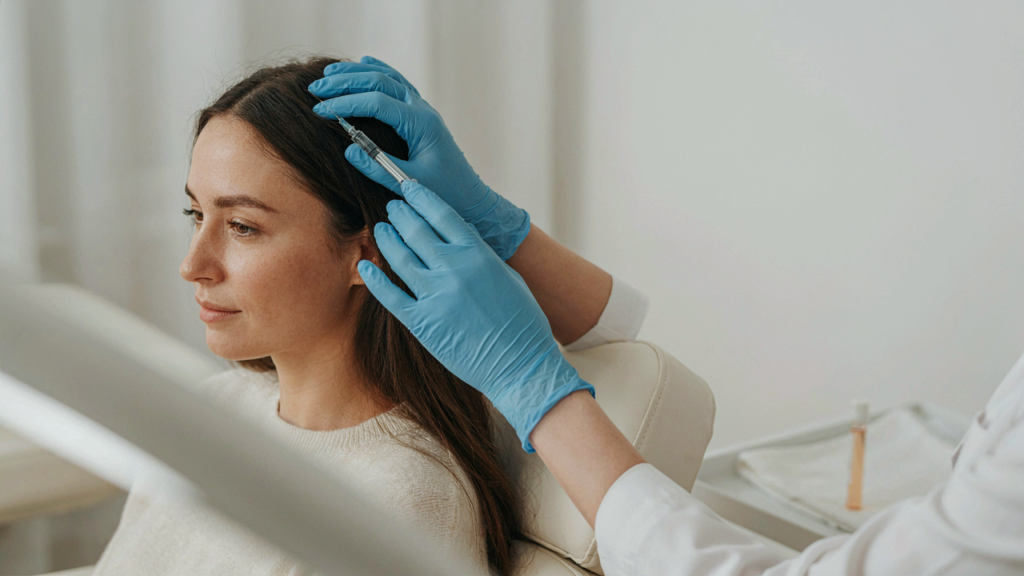
During the procedure, blood is collected and processed in a centrifuge to separate the platelet-rich portion. This concentrated plasma is then injected into areas of the scalp affected by thinning.
Platelets contain growth factors that may support tissue repair and cellular activity. The aim of scalp PRP is to create a favourable environment around weakened hair follicles and potentially improve hair growth and density.
At Dermedico Clinic in Defence Colony, South Delhi, PRP is offered for androgenetic alopecia, diffuse hair thinning, and early pattern hair loss in men and women.
Does PRP for Hair Loss Really Work?
Yes, PRP can work for selected patients, but it is not a guaranteed cure for every type of hair loss.
The strongest clinical interest is in androgenetic alopecia, also called male-pattern or female-pattern hair loss. Several clinical studies and systematic reviews have reported improvements in hair density following PRP treatment.
For example, a meta-analysis published in Aesthetic Plastic Surgery found that PRP significantly increased hair density compared with control treatment. However, it did not find a significant improvement in hair diameter, highlighting that PRP does not necessarily produce the same result for every aspect of hair growth.
A 2024 systematic review also found that most included studies reported improvements in hair density or hair count, but the researchers highlighted limitations such as moderate risk of bias and differences between treatment protocols.
The American Academy of Dermatology notes that PRP can be a safe and effective treatment option for some types of hair loss, while also emphasising that different types of hair loss require different approaches.
The Bottom Line
PRP is best viewed as a hair-growth-supporting treatment, not a permanent cure for baldness.
It may be particularly useful when hair follicles are still present but producing progressively thinner or weaker hairs.
How Does PRP Help Hair Growth?
The exact mechanism is still being studied, but PRP contains concentrated platelets and growth factors that may influence the hair follicle environment.
The treatment may help by:
- Supporting the activity of weakened hair follicles
- Promoting a healthier scalp environment
- Potentially extending the active growth phase of the hair cycle
- Improving hair density in suitable patients
- Helping reduce progressive thinning in some cases
- Supporting thicker-looking hair over time
PRP does not create completely new hair follicles in areas where follicles have been permanently destroyed.
This is why early diagnosis and appropriate patient selection are important.
Who Is a Good Candidate for PRP Hair Treatment?
PRP may be considered for people experiencing:
- Early or moderate androgenetic alopecia
- Male-pattern hair loss
- Female-pattern hair thinning
- Diffuse scalp thinning
- Reduced hair density
- Early-stage hair loss where follicles are still active
However, excessive hair fall can have many causes, including nutritional deficiencies, thyroid problems, hormonal changes, stress, certain medications, scalp disorders, and autoimmune conditions.
Therefore, a dermatologist should identify the underlying cause before starting PRP. The American Academy of Dermatology similarly recommends professional evaluation because treatment depends on the type and cause of hair loss.
Who May Not Benefit as Much From PRP?
PRP may provide limited improvement when:
- Hair loss has progressed to advanced baldness
- Hair follicles have been permanently destroyed
- There is an untreated underlying medical condition
- The cause of hair loss is not appropriate for PRP
- Treatment expectations are unrealistic
- The patient does not follow the recommended treatment schedule
For advanced hair loss, a dermatologist may discuss other options, including medication or hair transplantation, depending on the diagnosis.
What Are the Benefits of PRP for Hair Loss?
1. Uses Your Own Blood
Because PRP is prepared from your own blood, it is an autologous treatment. This makes it different from treatments that introduce a foreign biological material into the body.
2. Minimally Invasive
PRP involves injections into the scalp rather than surgical hair transplantation.
3. May Improve Hair Density
Clinical research suggests that PRP can increase hair density in suitable patients with androgenetic alopecia.
4. Suitable for Men and Women
PRP can be considered for both male- and female-pattern hair thinning, although the strength of evidence and response can vary between patients.
5. Can Be Combined With Other Hair-Loss Treatments
Depending on the diagnosis, a dermatologist may combine PRP with evidence-based medical treatment. A 2024 systematic review found that PRP combined with topical minoxidil showed better hair-density outcomes than minoxidil alone, although the researchers rated the certainty of evidence as low to very low.
This means combination therapy should be personalised rather than automatically recommended to everyone.
How Many PRP Sessions Are Needed for Hair Loss?
There is no single PRP schedule that works for every patient because treatment protocols differ according to the severity and cause of hair loss.
A commonly used initial approach is a series of sessions spaced several weeks apart, followed by maintenance treatments when clinically appropriate.
At Dermedico Clinic, the clinic’s current PRP information states that 3–4 monthly sessions are generally recommended initially, followed by maintenance depending on the patient’s response.
Your dermatologist may modify the number and frequency of sessions after assessing:
- Hair-loss pattern
- Hair density
- Scalp condition
- Age and medical history
- Previous treatments
- Response to earlier PRP sessions
What Happens During a PRP Hair Treatment?
A typical PRP hair-loss session involves several steps.
Step 1: Consultation and Scalp Assessment
The dermatologist evaluates the pattern and severity of hair loss and determines whether PRP is appropriate.
Step 2: Blood Collection
A small amount of blood is drawn from your arm.
Step 3: PRP Preparation
The blood sample is processed in a centrifuge to separate and concentrate the platelet-rich component.
Step 4: Scalp Preparation
The scalp is cleaned and, when appropriate, a numbing agent may be used to improve comfort.
Step 5: PRP Injection
The prepared PRP is carefully injected into areas of thinning hair.
Step 6: Aftercare
Mild redness, tenderness, or sensitivity may occur temporarily after injections. Your dermatologist will provide personalised aftercare instructions.
Cleveland Clinic describes PRP as a procedure in which blood is collected, processed to concentrate platelets, and then injected into the scalp.
When Can You See PRP Hair Results?
One of the biggest mistakes people make is expecting immediate hair growth after their first session.
PRP results take time.
Hair grows in cycles, so improvements generally develop gradually. The American Academy of Dermatology notes that hair-loss treatments can take months before visible results appear.
Depending on the individual, you may notice:
After the first few weeks:
The scalp may feel normal again, but visible regrowth may not yet be apparent.
Around 2–3 months:
Some patients may begin noticing reduced shedding or early changes in hair density.
Around 3–6 months:
Changes in thickness and density may become more noticeable in responsive patients.
Beyond 6 months:
Your dermatologist can assess the overall response and determine whether maintenance treatment is appropriate.
Cleveland Clinic also notes that PRP hair-loss results take time, with improvement generally becoming noticeable after several months.
PRP Hair Treatment: Before and After Expectations
PRP before-and-after results can vary significantly.
A good result may include:
- Reduced hair shedding
- Improved hair density
- Thicker-looking existing hair
- Better scalp coverage
- Slower progression of thinning
However, PRP should not be marketed as a guaranteed way to restore all lost hair.
Your starting hair density, cause of hair loss, follicle health, genetics, age, treatment protocol, and adherence to the treatment plan can all influence the outcome.
Is PRP Painful?
PRP involves multiple small injections, so some patients may experience mild discomfort, pressure, or brief stinging during treatment.
The level of discomfort depends on individual sensitivity and the injection technique used. A topical or local numbing approach may be considered when appropriate.
Cleveland Clinic reports that most patients experience pressure with minimal to no significant pain during PRP treatment, although individual experiences differ.
Is There Any Downtime After PRP?
PRP is generally considered a minimally invasive treatment, and significant downtime is not usually required.
Temporary effects can include:
- Mild redness
- Swelling
- Tenderness
- Minor scalp sensitivity
- Small injection-site marks
The American Academy of Dermatology states that PRP treatment typically does not require downtime.
Your dermatologist should provide specific instructions about washing your hair, exercise, scalp products, and other activities after treatment.
PRP vs Minoxidil for Hair Loss
PRP and minoxidil are not necessarily competing treatments.
Minoxidil is an established medical treatment for certain forms of hair loss, while PRP is a procedure that may be used alone or alongside other treatments.
Research comparing PRP plus minoxidil with minoxidil alone has shown potentially better hair-density outcomes with combination therapy, but the evidence remains limited and of low certainty.
Therefore, instead of asking which treatment is universally “better,” it is more useful to ask:
Which treatment or combination is appropriate for my specific type of hair loss?
A dermatologist can help answer that after evaluating your scalp and medical history.
PRP vs Hair Transplant
PRP and hair transplantation serve different purposes.
Designed to support existing weakened follicles and improve hair density.
Hair transplant:
Moves healthy follicles from a donor area to areas with significant hair loss.
If follicles are permanently absent from an area, PRP cannot simply recreate them. In such situations, a dermatologist may recommend hair transplantation after evaluating the patient’s diagnosis and donor hair availability.
The American Academy of Dermatology notes that hair transplantation can provide permanent, natural-looking results, while PRP is not a permanent solution and may require maintenance treatments.
What Does PRP for Hair Loss Cost in South Delhi?
The cost of PRP varies depending on:
- Clinic and dermatologist
- PRP preparation method
- Number of sessions
- Treatment area
- Combination of PRP with other treatments
- Individual treatment plan
According to Dermedico Clinic’s current published information, hair PRP starts from ₹6,000 per session, with the exact cost determined after consultation.
It is better to compare treatment protocols and dermatologist expertise rather than choosing a clinic solely because it offers the lowest price.
Why Choose Dermedico Clinic for PRP in South Delhi?
If you are looking for PRP for hair loss in South Delhi, Dermedico Clinic is located in Defence Colony and offers scalp PRP for androgenetic alopecia, diffuse thinning, and early pattern hair loss.
The clinic states that PRP procedures are performed by Dr. Pallavi Chandna Rohatgi, MD Dermatologist, and that the clinic uses centrifuge-based PRP preparation.
Dermedico Clinic is located at D-95, Defence Colony, New Delhi, near Lajpat Nagar and other South Delhi neighbourhoods.
You can explore the clinic’s complete treatment options through the Dermedico treatments page or learn more about its PRP Therapy in Delhi.
How to Get Better PRP Hair Results
PRP is only one part of a complete hair-loss strategy.
For better long-term management:
- Get the correct diagnosis before treatment.
- Follow the recommended session schedule.
- Attend follow-up appointments.
- Follow your dermatologist’s scalp-care instructions.
- Discuss nutrition, hormonal factors, medications, or medical conditions that may contribute to hair loss.
- Consider combination treatment if your dermatologist recommends it.
- Take progress photographs under similar lighting to track changes.
Remember that consistency and realistic expectations are important.
Frequently Asked Questions About PRP for Hair Loss
Is PRP really effective for hair loss?
PRP can improve hair density in some patients, particularly those with androgenetic alopecia. However, results vary, and current research has limitations, including differences in PRP preparation and treatment protocols.
How many PRP sessions are needed for hair loss?
Many treatment plans begin with approximately 3–4 sessions spaced about a month apart, followed by maintenance when needed. The exact schedule should be customised by a dermatologist.
How quickly does PRP show results?
PRP does not provide instant results. Early changes may appear after a few months, while more noticeable improvements may take several months of treatment and follow-up.
Can PRP regrow completely bald areas?
PRP is intended to support existing or weakened follicles. It cannot reliably recreate follicles that have been permanently destroyed. Advanced baldness may require discussion of other treatment options.
Is PRP suitable for women?
PRP may be considered for female-pattern hair loss, but evidence is still developing and individual response varies. A dermatologist should first determine the cause of thinning.
Can PRP be combined with minoxidil?
It may be appropriate for some patients. Research suggests PRP combined with topical minoxidil may improve hair-density outcomes compared with minoxidil alone, although the certainty of evidence is currently low to very low.
Is PRP a permanent solution for hair loss?
No. PRP is not considered a permanent cure for pattern hair loss. Maintenance treatment may be recommended depending on the patient’s response and underlying condition.
Where can I get PRP for hair loss in South Delhi?
Dermedico Clinic offers hair PRP in Defence Colony, South Delhi. The clinic lists D-95, Defence Colony, New Delhi as its location.
Final Takeaway: Is PRP Worth Considering for Hair Loss?
PRP for hair loss can be a worthwhile option for carefully selected patients, particularly those with early or moderate androgenetic alopecia and active but weakened hair follicles.
The scientific evidence is encouraging, especially for improving hair density, but it is not strong enough to promise identical results for everyone. Recent systematic reviews have also highlighted variations in treatment protocols and limitations in study quality.
If you are experiencing persistent hair fall or progressive thinning, the first step should be identifying why your hair is falling out. Once the cause is established, a dermatologist can determine whether PRP, medication, combination therapy, or another approach is most appropriate.
For patients considering PRP for hair loss in South Delhi, a consultation at Dermedico Clinic can help assess your hair-loss pattern and create a treatment plan based on your individual needs.