Table of Contents
Hair PRP Treatment in South Delhi
Hair PRP Treatment in South Delhi is becoming an increasingly popular option for people dealing with hair thinning, excessive hair fall, and early-stage pattern hair loss. If you have noticed a widening hair part, receding hairline, reduced hair density, or more hair than usual on your pillow and comb, it is important to understand the cause before choosing a treatment.
One of the treatments dermatologists may consider for suitable patients is Platelet-Rich Plasma (PRP) therapy for hair. PRP uses a concentrated portion of a patient’s own blood to deliver platelets and associated growth factors to the scalp.
At Dermedico Clinic, Defence Colony, South Delhi, PRP therapy is offered as part of a personalised approach to hair and scalp concerns. The clinic is located near Lajpat Nagar and serves patients from Defence Colony, South Extension, Greater Kailash, Hauz Khas, Saket and other parts of South Delhi.
Medical note: PRP can be helpful for selected types of hair loss, but it is not a guaranteed cure for every type of alopecia. A dermatologist should diagnose the underlying cause before treatment.
What Is Hair PRP Treatment?
Hair PRP treatment stands for Platelet-Rich Plasma therapy. It is a procedure in which a small amount of the patient’s blood is collected and processed to separate the platelet-rich plasma from other blood components.
The concentrated plasma is then injected into selected areas of the scalp.
The concept behind PRP is that platelets contain biological mediators and growth factors that may support tissue repair and influence the hair-growth environment.
According to the American Academy of Dermatology, PRP involves drawing a small amount of blood, processing it to separate the plasma, and injecting the plasma into areas affected by hair loss. The AAD also notes that patients generally require multiple treatments rather than a single injection.
Read more: American Academy of Dermatology – Hair Loss Treatment
Why Are People Choosing Hair PRP in South Delhi?
Hair loss can affect both men and women and may become noticeable through:
- Increased hair shedding
- Thinning around the crown
- Receding hairline
- Wider hair parting
- Reduced ponytail volume
- Visible scalp
- Gradual loss of hair density
People searching for hair fall treatment in South Delhi often want a minimally invasive option that does not involve surgery.
A dermatologist may recommend PRP when the hair follicles can still respond to treatment.
However, the correct treatment depends on the cause of hair loss. Hair shedding can occur due to androgenetic alopecia, nutritional deficiencies, hormonal changes, certain illnesses, medications, stress-related shedding and other scalp or medical conditions.
That is why a proper consultation is an important first step.
How Does Hair PRP Treatment Work?
A typical PRP session involves several steps.
1. Scalp and Hair Assessment
The dermatologist first examines the scalp and pattern of hair loss. Depending on the patient’s history and symptoms, additional evaluation may be recommended.
The objective is to determine whether PRP is appropriate and whether another treatment should be used alongside it.
2. Blood Collection
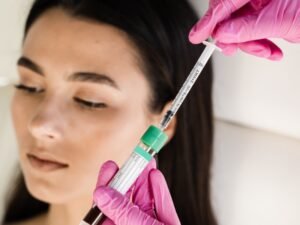
The dermatologist collects a small quantity of blood from the patient.
3. PRP Preparation
The blood is processed using a centrifugation system to separate the platelet-rich component.
The exact preparation method can vary between clinics and studies. This is one reason why PRP research can be difficult to compare directly.
4. Scalp Injection
The prepared PRP is injected into selected areas of the scalp using multiple small injections.
The AAD states that the injection procedure itself can take around 10 minutes, although the total clinic visit can take longer depending on consultation and preparation.
5. Follow-Up
Therefore, it is generally performed as a series rather than as a one-time treatment.
The exact number of sessions and intervals should be decided by the treating dermatologist based on the patient’s diagnosis, hair density, response and treatment goals.
Can PRP Really Help With Hair Loss?
This is one of the most important questions people ask before choosing Hair PRP Treatment in South Delhi.
Research suggests that PRP may improve hair density in some people with androgenetic alopecia, but the evidence is not completely uniform.
A systematic review and meta-analysis published in 2023 included 27 controlled trials involving 1,117 participants. Compared with saline injections, PRP was associated with an increase in hair density over medium-term follow-up, but the researchers rated the overall evidence as low quality because of differences between studies and risk of bias.
A 2024 systematic review focusing on male androgenetic alopecia included eight randomized controlled trials and one cohort study. Several studies reported improvements in hair density or hair count, but the authors also highlighted methodological limitations and heterogeneity.
Another meta-analysis found that PRP treatment increased hair density compared with control groups, while the effect on hair diameter was not statistically significant.
Therefore, a realistic way to describe PRP is:
PRP may help improve hair density and reduce hair loss in appropriately selected patients, but results vary and it should not be promoted as a guaranteed hair-regrowth treatment.
Who May Be a Candidate for Hair PRP?
It may be considered for people experiencing certain forms of non-scarring hair loss, particularly androgenetic alopecia, commonly called male or female pattern hair loss.
A dermatologist may consider PRP when:
- Hair follicles are still present
- Hair thinning is relatively early or moderate
- The patient has androgenetic/pattern hair loss
- The scalp does not have an untreated active infection
- The patient understands that several sessions may be required
- The expected results are realistic
PRP may not be appropriate for every type of hair loss.
For example, sudden or unexplained hair shedding should first be investigated rather than immediately treated with cosmetic procedures.
When Should You See a Dermatologist for Hair Fall?
You should consider a professional evaluation if you notice:
Sudden Hair Loss
If significant hair starts falling rapidly over a short period, the cause should be investigated.
Receding Hairline
A progressively receding hairline can be associated with pattern hair loss.
Crown Thinning
Thinning around the crown is another common sign of androgenetic alopecia.
Wider Hair Part
Women may notice that the central hair part becomes increasingly visible.
Patchy Hair Loss
Round or irregular bald patches may indicate a condition that requires a different treatment approach.
Scalp Symptoms
Hair loss accompanied by itching, scaling, inflammation, pain or lesions should be assessed by a dermatologist.
PRP vs Other Hair Loss Treatments
There is no single hair-loss treatment that works for everyone.
Depending on the diagnosis, a dermatologist may discuss options such as:
- Topical or oral medications
- PRP therapy
- Microneedling
- Hair-focused mesotherapy in selected cases
- Low-level light/laser therapy
- Hair transplantation for appropriate candidates
- Treatment of nutritional or hormonal causes
- Combination treatment
PRP may sometimes be combined with other treatments, but the decision should be individualised.
A 2024 systematic review examining PRP added to topical minoxidil found better hair-density outcomes in combination-treatment groups, but the authors rated the certainty of evidence as low to very low and noted limitations in the available trials.
This is why treatment should be based on diagnosis rather than simply choosing the most popular procedure.
Is Hair PRP Treatment Painful?
PRP involves multiple small scalp injections, so some patients may experience temporary discomfort, tenderness or a mild stinging sensation.
Clinical studies and systematic reviews have generally reported minor temporary adverse effects such as pain, redness, swelling, bleeding or itching around injection sites.
Your dermatologist can explain the available comfort measures before the procedure.
Is There Any Downtime After Hair PRP?
PRP is a minimally invasive procedure, and many patients can return to their normal routine relatively quickly.
However, temporary:
- Redness
- Mild swelling
- Tenderness
- Bruising
- Scalp sensitivity
can occur after injections.
Your dermatologist will provide specific aftercare instructions based on your treatment.
How Many PRP Sessions Are Needed for Hair Loss?
There is no universal PRP schedule that applies to every patient.
The number of sessions depends on:
- Type of hair loss
- Severity of thinning
- Hair density
- Age and overall health
- Response to previous treatment
- PRP preparation protocol
- Whether PRP is being combined with another treatment
The American Academy of Dermatology explains that patients receiving PRP generally need repeated injections, with monthly treatments commonly used during the initial three months followed by maintenance treatments at longer intervals.
Your dermatologist should determine the treatment schedule rather than following a fixed package advertised online.
When Can You Expect Hair PRP Results?
Hair growth takes time, so PRP should not be judged immediately after a session.
The AAD notes that PRP may help lessen hair loss within a few months, with some patients subsequently noticing thicker hair or regrowth.
Results can vary depending on:
- The underlying cause of hair loss
- Stage of hair loss
- Age
- Genetics
- Existing follicle health
- Treatment protocol
- Number of sessions
- Other treatments being used
It is important to understand that PRP does not recreate follicles that have permanently disappeared.
What Makes a Good Hair PRP Clinic in South Delhi?
When searching for Hair PRP Treatment in South Delhi, do not choose a clinic based only on price.
Consider these factors:
Qualified Dermatologist
Hair loss diagnosis should be handled by a qualified medical professional with dermatology expertise.
Proper Diagnosis
A good treatment plan begins with understanding why you are losing hair.
Sterile Procedure
PRP involves blood collection and scalp injections, so proper infection-control practices are essential.
Appropriate Equipment
The PRP preparation process and equipment can influence the final product.
Individualised Treatment
Your PRP protocol should be based on your specific condition rather than a one-size-fits-all package.
Realistic Expectations
A responsible clinic should explain potential benefits, limitations and alternatives.
Hair PRP Treatment in Defence Colony, South Delhi
For people searching for PRP hair treatment near Defence Colony or Lajpat Nagar, Dermedico Clinic is located at D-95, Defence Colony, New Delhi.
The clinic’s PRP service includes hair PRP as well as PRP applications for other cosmetic concerns. Dermedico states that PRP treatment is performed under dermatologist supervision and uses a patient’s own blood-derived platelet-rich plasma.
You can explore the clinic’s PRP Therapy in Delhi page to learn more about the treatment.
For other dermatology and cosmetic concerns, visit the complete list of treatments at Dermedico Clinic.
Hair PRP Treatment Near Lajpat Nagar
Patients searching for hair PRP near Lajpat Nagar may also consider clinics in nearby Defence Colony because of the area’s accessibility.
Dermedico Clinic is situated in Defence Colony and serves patients from nearby South Delhi locations including:
- Lajpat Nagar
- Defence Colony
- South Extension
- Greater Kailash
- Hauz Khas
- Saket
- Kalkaji
- Nehru Place
- Jangpura
- Bhogal
- Lodhi Colony
- Nizamuddin
The clinic’s location information and treatment listings are available on its website.
What Should You Ask Before Getting PRP for Hair?
Before booking your first session, consider asking:
- What is causing my hair loss?
- Am I a suitable candidate for PRP?
- How many sessions may I need?
- What results are realistic in my case?
- Will I need medication alongside PRP?
- What side effects should I expect?
- How long should I wait between sessions?
- What happens if PRP does not work for me?
- Are there alternative treatments?
- How will my progress be monitored?
These questions can help you make a more informed decision.
Frequently Asked Questions About Hair PRP Treatment in South Delhi
Is PRP good for hair loss?
PRP may improve hair density in some patients with androgenetic alopecia. However, evidence quality varies and treatment outcomes are not guaranteed.
Is PRP better than hair transplant?
PRP and hair transplantation are different treatments. PRP is intended to support existing follicles, while a transplant relocates hair follicles from a donor area to areas affected by hair loss. A dermatologist or hair-transplant specialist can advise which option is appropriate.
Can women get PRP for hair loss?
Yes. Women can experience several types of hair loss, and PRP may be considered in selected cases. However, the underlying cause should be diagnosed first.
Can PRP stop hair fall permanently?
PRP should not be described as a permanent cure. Some patients may experience reduced shedding and improved density, but hair loss can continue and maintenance treatment may be required.
How long does PRP take to show results?
Visible improvement generally takes time. The AAD reports that some patients notice reduced hair loss within a few months and later observe thickening or regrowth.
Are PRP results permanent?
PRP results are not necessarily permanent. Hair loss conditions such as androgenetic alopecia are chronic, so ongoing management may be necessary.
Is PRP safe?
PRP is generally considered a relatively safe minimally invasive treatment when appropriately performed. Temporary injection-site pain, redness, swelling or itching can occur.
Does PRP work for bald areas?
PRP works best when viable hair follicles remain. Completely bald areas where follicles have been permanently lost may require other options.
Can PRP be combined with Minoxidil?
A dermatologist may recommend combination therapy in appropriate patients. Research has reported potentially better hair-density outcomes when PRP is added to topical minoxidil, although the certainty of evidence remains limited.
Where can I get Hair PRP Treatment in South Delhi?
Dermedico Clinic offers PRP therapy at its Defence Colony location in South Delhi. You can visit the clinic’s PRP Therapy page for treatment information and consultation details.
Final Thoughts
Hair loss can have many causes, and PRP is only one of several treatment options.
If you are searching for Hair PRP Treatment in South Delhi, the most important first step is not choosing a package—it is getting an accurate diagnosis of your hair loss.
For suitable patients, PRP may help improve hair density and support the appearance of thinning hair. However, scientific evidence continues to evolve, and results can differ from person to person.
A dermatologist can assess your scalp, identify the likely cause of hair loss, explain whether PRP is appropriate and create a treatment plan based on your individual needs.
If you are looking for Hair PRP Treatment near Defence Colony, Lajpat Nagar or South Delhi, you can explore Dermedico Clinic’s PRP Therapy service or view all available dermatology and cosmetic treatments.
Medical References
- American Academy of Dermatology – Hair Loss Treatment
- American Academy of Dermatology – Male Pattern Hair Loss
- PubMed – Systematic Review of PRP for Alopecia
- PubMed – Autologous PRP for Androgenetic Alopecia
- PMC – PRP for Alopecia: Systematic Review & Meta-analysis
- PLOS ONE – PRP + Minoxidil for Androgenetic Alopecia
- Wiley – Role of PRP in Androgenetic Alopecia