Table of Contents
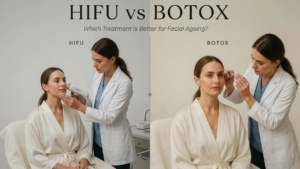
HIFU vs Botox: Which Treatment Is Better for Facial Ageing?
As we age, our skin gradually loses elasticity, collagen and firmness. Facial muscles continue to create expression lines, while changes in skin structure can contribute to sagging, jowls, softer jawline definition and wrinkles.
This is why many people looking for anti-ageing treatment in Delhi come across two popular non-surgical options: HIFU and Botox.
But is HIFU better than Botox?
The answer is: neither treatment is universally better. HIFU and Botox address different causes and signs of facial ageing.
HIFU is primarily associated with skin tightening and lifting, while Botox works by temporarily reducing the activity of targeted muscles responsible for certain dynamic wrinkles. The right option depends on whether your main concern is skin laxity, sagging, loss of definition or expression-related wrinkles.
At Dermedico Clinic in Defence Colony, South Delhi, both HIFU and Botox are available as part of a personalised cosmetic dermatology approach.
If you’re considering treatment, a consultation with a qualified dermatologist can help determine which approach is appropriate for your facial anatomy, skin condition and aesthetic goals.
HIFU vs Botox at a Glance
| Feature | HIFU | Botox |
|---|---|---|
| Full form | High-Intensity Focused Ultrasound | Botulinum toxin |
| Main purpose | Skin tightening and lifting | Reducing dynamic wrinkles |
| Works primarily on | Deeper tissue layers and collagen remodelling | Targeted facial muscles |
| Common concerns | Sagging, jowls, loose neck skin, reduced firmness | Forehead lines, frown lines, crow’s feet |
| Treatment type | Non-invasive energy-based treatment | Injectable treatment |
| Downtime | Generally little or none | Usually minimal |
| Results | Develop gradually | Usually appear progressively after treatment |
| Best suited for | Selected patients with mild-to-moderate laxity | Selected patients with dynamic wrinkles |
| Longevity | Varies by patient and treatment | Temporary; repeat treatments may be needed |
| Can they be combined? | Sometimes, depending on individual assessment | Sometimes, depending on individual assessment |
The important takeaway is that HIFU and Botox are not direct substitutes. They target different mechanisms of facial ageing.
What Is HIFU Treatment?
HIFU stands for High-Intensity Focused Ultrasound.
It is a non-invasive aesthetic treatment that uses focused ultrasound energy to target selected tissue depths. The aim is to stimulate tissue tightening and collagen remodelling.
HIFU has been studied for facial and neck rejuvenation. A systematic review and meta-analysis involving 17 studies and 477 participants found a moderate improvement in facial and neck rejuvenation outcomes, although the researchers also highlighted differences between studies and limitations in long-term follow-up.
More recent research has also investigated HIFU for areas around the eyes. A 2026 systematic review reported improvements in periorbital wrinkles, elasticity and eyebrow or eyelid contour, while also noting that the certainty of evidence was very low because of study heterogeneity and limited high-quality trials.
What Does HIFU Target?
Depending on the device and treatment plan, HIFU may be considered for concerns such as:
- Mild facial skin laxity
- Early jowling
- Reduced jawline definition
- Loose neck skin
- Brow-area laxity
- Loss of firmness
- Some signs of facial ageing
Dermedico Clinic describes its HIFU treatment as a non-surgical facial lifting and skin-tightening option for concerns including jowls, neck laxity and brow lifting.
How Does HIFU Work for Facial Ageing?
Unlike Botox, HIFU does not primarily work by relaxing facial muscles.
Instead, focused ultrasound energy is delivered to selected tissue depths. The treatment is designed to create controlled thermal effects that can stimulate collagen remodelling.
Collagen is an important structural protein that contributes to skin firmness and elasticity. As collagen production and organisation change with age, skin may gradually become less firm.
HIFU is therefore generally considered when skin laxity and loss of firmness are bigger concerns than purely muscle-related wrinkles.
However, HIFU should not be viewed as a replacement for a surgical facelift in every patient. The degree of skin laxity, facial anatomy and expectations all matter.
What Is Botox Treatment?
Botox is a brand name commonly used when referring to a type of botulinum toxin used cosmetically.
Botulinum toxin temporarily reduces nerve signalling to targeted muscles. This reduces muscle contraction and can soften certain facial expression lines.
The American Society of Plastic Surgeons notes that cosmetic botulinum toxin is commonly used for frown lines, forehead creases and crow’s feet.
Botox may therefore be particularly useful when facial ageing is strongly associated with dynamic wrinkles.
Common Botox Treatment Areas
Botulinum toxin may be considered for:
- Forehead lines
- Frown lines between the eyebrows
- Crow’s feet
- Certain brow concerns
- Bunny lines
- Selected neck bands
- Masseter/jawline concerns
Dermedico Clinic currently lists Botox treatments for areas including forehead lines, crow’s feet, brow lift, bunny lines, lip flip, masseter/jaw slimming and neck bands.
HIFU vs Botox: How Are They Different?
The biggest difference is what each treatment is designed to address.
HIFU focuses on skin laxity and tightening.
Botox focuses on muscle-related dynamic wrinkles.
For example, imagine someone has a softer jawline and mild skin sagging but relatively few expression lines. HIFU may be discussed as one possible option.
On the other hand, someone with prominent forehead lines that become more visible when raising the eyebrows may be a candidate for Botox.
Another person may have both concerns.
This is why asking “Is HIFU better than Botox?” without identifying the specific ageing concern can be misleading.
The better question is:
Which treatment is more appropriate for the specific signs of ageing I want to improve?
HIFU vs Botox for Different Ageing Concerns
1. Forehead Wrinkles
Forehead lines are often influenced by repeated movement of the frontalis muscle.
For this type of dynamic wrinkle, Botox may be more directly relevant than HIFU.
Botulinum toxin temporarily reduces muscle activity, which can soften the appearance of expression-related lines.
Potential choice: Botox
2. Frown Lines
Frown lines between the eyebrows are another classic example of dynamic wrinkles.
Botox is commonly used for this area because the treatment targets the muscles contributing to the movement that creates the lines.
Potential choice: Botox
3. Crow’s Feet
Crow’s feet are lines around the outer corners of the eyes that become more noticeable with smiling and other facial expressions.
Botulinum toxin is commonly used for crow’s feet.
However, the causes of ageing around the eyes are complex and can also include changes in skin quality, elasticity and volume.
Potential choice: Botox for expression-related lines; other treatments may be considered for additional concerns.
4. Sagging Jawline
If the main concern is mild skin laxity, jowling or reduced facial firmness, HIFU may be considered.
Dermedico’s HIFU information specifically includes jowls and jawline concerns among the areas that may be treated.
Potential choice: HIFU
5. Loose Neck Skin
Mild neck laxity is another concern for which skin-tightening approaches may be considered.
HIFU can be used in selected facial and neck rejuvenation protocols.
Potential choice: HIFU, depending on the degree of laxity.
6. Loss of Facial Volume
Neither HIFU nor Botox is primarily a volume-restoration treatment.
If ageing has resulted in noticeable loss of volume in areas such as the cheeks, temples or lips, a dermatologist may discuss other options, including dermal fillers, depending on the individual’s anatomy and goals.
Potential choice: Another treatment may be more appropriate.
HIFU vs Botox: Which Gives More Natural Results?
Both treatments can produce natural-looking results when appropriately selected and performed.
However, “natural” does not simply mean using less treatment.
It means creating an outcome that is appropriate for the patient’s facial anatomy and goals.
With Botox, excessive treatment can result in reduced movement or an appearance that the patient may not want. With HIFU, treatment expectations should also be realistic because it is intended for selected degrees of laxity rather than dramatically changing facial structure.
A qualified dermatologist can help determine an appropriate treatment intensity.
HIFU vs Botox: Which Treatment Works Faster?
The timing of visible results differs.
Botox
Botulinum toxin does not produce its full cosmetic effect immediately. Changes develop progressively after treatment.
HIFU
HIFU results can also develop gradually because the treatment relies partly on tissue remodelling and collagen-related changes.
Dermedico’s current HIFU information states that visible results develop over approximately 3–6 months.
Therefore, neither treatment should be judged solely by what you see immediately after the procedure.
How Long Does Botox Last?
Botox results are temporary.
The American Society of Plastic Surgeons describes cosmetic botulinum toxin as a temporary treatment for facial lines and wrinkles.
Dermedico currently states that Botox results may last approximately 3–6 months, although individual results can vary.
Factors that may influence longevity include:
- Treatment area
- Muscle strength
- Individual metabolism
- Dose
- Facial movement
- Treatment technique
- Previous treatment history
Your dermatologist can advise when a repeat treatment may be appropriate.
How Long Does HIFU Last?
The longevity of HIFU results can vary depending on:
- Age
- Degree of skin laxity
- Skin quality
- Lifestyle
- Sun exposure
- Treatment area
- Device and treatment protocol
- Individual collagen response
Dermedico currently states that HIFU results may last around 12–18 months, with collagen remodelling continuing for several months following treatment.
However, results are not permanent because facial ageing continues naturally.
Is HIFU Better Than Botox for Wrinkles?
It depends on what type of wrinkles you have.
Dynamic wrinkles
These are wrinkles strongly associated with repeated muscle movement.
Botox may be more suitable.
Wrinkles associated with skin laxity
When loss of firmness and skin laxity are important contributors, a skin-tightening treatment such as HIFU may be considered.
Mixed ageing
Many people have more than one type of ageing concern.
A personalised treatment plan may therefore involve different procedures at different times.
This is one reason why a professional consultation is more useful than choosing a treatment based only on online comparisons.
Can You Combine HIFU and Botox?
In selected patients, different cosmetic treatments may be used as part of a broader facial rejuvenation plan.
However, combining treatments does not automatically produce better results.
The order, timing, treatment areas and suitability should be determined by a qualified medical professional.
A systematic review examining combinations of biostimulators with botulinum toxin, fillers and energy-based devices found potential benefits across different combination approaches but also highlighted variability in protocols and adverse effects.
Therefore, treatment should be personalised rather than following a fixed “HIFU + Botox” formula.
HIFU vs Botox: Which Is Safer?
Both procedures have established cosmetic uses, but no medical or cosmetic treatment is completely risk-free.
Potential Botox side effects
Depending on the treatment, temporary effects may include:
- Redness
- Swelling
- Bruising
- Tenderness
- Headache
- Temporary muscle weakness
- Asymmetry
Rare but more serious complications are possible, which is why injections should be performed by an appropriately qualified medical professional.
Potential HIFU side effects
Patients may experience:
- Temporary redness
- Swelling
- Tenderness
- Warmth
- Tingling
- Discomfort
A systematic review of HIFU for facial and neck rejuvenation found short-term safety to be generally favourable but noted variation between studies and limited long-term data.
The 2026 systematic review of periorbital HIFU similarly reported generally mild and transient adverse events but emphasised the low certainty of evidence.
HIFU vs Botox: Which Has Less Downtime?
Both treatments can involve relatively little downtime compared with surgery, but your experience can vary.
HIFU
Many patients can return to normal activities relatively quickly, although temporary tenderness, redness or swelling may occur.
Botox
Because Botox involves injections, minor bruising or swelling can occur at injection sites.
Your dermatologist should provide specific aftercare instructions based on the treatment performed.
HIFU vs Botox Cost: Which Is More Expensive?
There is no universal price for either treatment.
The total cost depends on factors such as:
- Treatment area
- Number of areas
- Number of Botox units
- HIFU treatment area
- Device and technology used
- Treatment protocol
- Doctor’s expertise
- Whether additional procedures are recommended
Dermedico currently lists HIFU from approximately ₹8,000 for selected areas, while its Botox pricing varies by treatment area and units.
It is important not to choose cosmetic treatment solely according to the lowest advertised price.
The qualifications of the treating doctor, appropriate patient selection, product/device quality and medical supervision are also important.
HIFU vs Botox: Which Treatment Is Better for You?
Here’s a simplified way to understand the difference:
Choose HIFU may be considered when:
- Your main concern is mild skin laxity
- Your jawline has become less defined
- You have early jowling
- Your neck feels less firm
- You want a non-invasive tightening approach
- Your main concern is loss of firmness rather than muscle-related lines
Botox may be considered when:
- You have forehead expression lines
- You have frown lines
- You have crow’s feet
- Your wrinkles become more prominent with facial expressions
- You want to reduce specific muscle activity
- You are looking for a targeted injectable treatment
Another treatment may be better when:
- Facial volume loss is your main concern
- You have significant skin sagging
- You have substantial pigmentation
- Your main issue is skin texture
- You have concerns that require a different dermatological approach
A dermatologist can assess the underlying cause before recommending treatment.
HIFU vs Botox for Different Age Groups
Age alone should not determine whether you receive HIFU or Botox.
Two people of the same age can have completely different facial ageing patterns.
In Your 20s
Preventive skincare, sun protection and healthy skin habits are usually important. Cosmetic procedures should be considered according to specific concerns rather than age alone.
In Your 30s
Early dynamic wrinkles may become more visible, while some people may begin noticing subtle changes in skin firmness.
Botox or skin-rejuvenation options may be discussed depending on the concern.
In Your 40s
Expression lines, reduced elasticity, early jowling and changes in facial volume may become more noticeable.
A personalised combination of treatments may sometimes be considered.
In Your 50s and Beyond
Skin laxity, wrinkles, volume changes and reduced elasticity may occur together.
At this stage, a dermatologist should evaluate the overall facial structure rather than treating only one visible wrinkle.
HIFU vs Botox for Men
Facial ageing affects men as well as women.
Men may seek treatment for:
- Forehead lines
- Frown lines
- Crow’s feet
- Jawline definition
- Neck laxity
- Skin firmness
The same basic distinction applies:
Botox primarily addresses targeted muscle activity, while HIFU is generally used for selected skin-tightening and lifting concerns.
Treatment planning should also take into account differences in facial anatomy and muscle strength.
Why a Dermatologist Consultation Matters
Aesthetic treatment should begin with an assessment rather than a procedure.
During a consultation, your dermatologist may evaluate:
- Skin quality
- Degree of skin laxity
- Facial movement
- Wrinkle pattern
- Facial volume
- Jawline definition
- Neck skin
- Previous cosmetic procedures
- Medical history
- Your expectations
This helps determine whether HIFU, Botox, another treatment or no procedure at all is appropriate.
Dermedico Clinic states that its cosmetic treatments are provided under the care of Dr. Pallavi Chandna Rohatgi, MD Dermatologist, at its Defence Colony location.
HIFU Treatment in Defence Colony, Delhi
If you are searching for HIFU treatment in Defence Colony, Dermedico Clinic is located at D-95, Defence Colony, New Delhi.
The clinic’s HIFU service is positioned for patients with concerns including facial laxity, jowls, neck laxity and brow-area concerns.
Explore HIFU Treatment in Delhi
Patients searching for HIFU near Lajpat Nagar may also find the Defence Colony location convenient, as the clinic specifically describes itself as being close to Lajpat Nagar.
Botox Treatment in Defence Colony, Delhi
For patients searching for Botox treatment in Defence Colony or Botox near Lajpat Nagar, Dermedico Clinic offers Botox for several cosmetic treatment areas.
The clinic states that Botox treatments are administered by Dr. Pallavi Chandna Rohatgi, MD Dermatologist, and lists treatment options including forehead lines, crow’s feet, brow lift, masseter/jawline treatment and neck bands.
Explore Botox Treatment in Delhi
Frequently Asked Questions About HIFU vs Botox
Is HIFU better than Botox?
Not necessarily. HIFU and Botox treat different aspects of facial ageing. HIFU is generally used for selected skin-tightening and lifting concerns, while Botox is commonly used for dynamic wrinkles caused by muscle activity.
Can Botox tighten sagging skin?
Botox primarily reduces targeted muscle activity. It is not a general skin-tightening treatment. If skin laxity is the primary concern, a dermatologist may discuss other options such as HIFU.
Can HIFU remove forehead wrinkles?
HIFU is not primarily designed to relax the muscles responsible for dynamic forehead lines. Botox may be more directly relevant when muscle movement is the main cause.
Is HIFU a replacement for Botox?
No. The two treatments have different mechanisms and treatment goals.
Is Botox a replacement for HIFU?
Not generally. Botox does not primarily treat skin laxity in the same way as a skin-tightening treatment.
Can HIFU and Botox be done together?
They may be combined in selected treatment plans, but this should be decided by a qualified medical professional based on your individual concerns and treatment areas.
Which treatment lasts longer: HIFU or Botox?
Treatment longevity varies. Dermedico currently states approximately 12–18 months for HIFU results and 3–6 months for Botox results, but individual outcomes can differ.
Does HIFU hurt?
Patients may experience warmth, tingling or discomfort during treatment. The intensity can vary depending on the treatment area, device and individual sensitivity.
Does Botox hurt?
Botox involves small injections, so mild discomfort can occur. Temporary redness, swelling or bruising may also occur.
Which is better for a jawline?
For selected patients with mild skin laxity or reduced jawline definition, HIFU may be considered. Botox may be considered for specific muscle-related jawline concerns such as masseter prominence.
Which is better for forehead lines?
Botox is generally more directly suited to dynamic forehead lines because it reduces the activity of targeted muscles.
Which is better for neck ageing?
It depends on the cause. HIFU may be considered for selected skin laxity, while botulinum toxin may be used for certain neck bands. A consultation is necessary to determine the appropriate approach.
Can HIFU make your face look slimmer?
HIFU is primarily a skin-tightening and lifting treatment. Any change in facial definition depends on the individual’s anatomy, tissue laxity and treatment response.
Is Botox permanent?
No. Cosmetic Botox results are temporary and repeat treatment may be needed to maintain the effect.
Is HIFU permanent?
No. Facial ageing continues after treatment, so HIFU should not be considered a permanent solution.
How soon can I see HIFU results?
Results may develop gradually. Dermedico currently describes visible HIFU results developing over approximately 3–6 months.
How soon can I see Botox results?
Botox effects develop progressively rather than appearing instantly. Your treating doctor can explain the expected timeline for your specific treatment.
Is HIFU suitable for everyone?
No. Suitability depends on skin laxity, anatomy, expectations, medical history and other factors.
Is Botox suitable for everyone?
No. Botox has contraindications and precautions, and suitability should be assessed by a qualified medical professional.
Final Verdict: HIFU or Botox?
So, HIFU vs Botox—which treatment is better for facial ageing?
There is no single winner.
If your main concern is mild skin laxity, early jowling, reduced firmness or a less-defined jawline, HIFU may be an option worth discussing.
Other than that your main concern is forehead lines, frown lines, crow’s feet or other dynamic wrinkles, Botox may be more appropriate.
If you have multiple signs of facial ageing, a dermatologist may recommend a personalised treatment strategy rather than relying on one procedure.
The goal should not simply be to look younger. It should be to achieve natural-looking, proportionate and medically appropriate improvement.
Before choosing HIFU or Botox, consult a qualified dermatologist who can assess your facial anatomy, skin quality, degree of ageing and expectations.
If you are considering HIFU or Botox in South Delhi, Dermedico Clinic offers both treatment options at its Defence Colony location.
Book a Consultation with Dermedico Clinic
Related Treatments at Dermedico Clinic
You can also explore other aesthetic and dermatology treatments depending on your skin concerns:
- HIFU Treatment in Delhi
- Botox Treatment in Delhi
- All Skin & Cosmetic Treatments
- Anti-Aging Treatment Guide
- HIFU Guide for South Delhi
- Botox in Delhi: Cost, Benefits & Safety