Table of Contents
Before Hair Loss Treatment
Hair fall is a common concern among men and women. Whether you are experiencing excessive hair shedding, a receding hairline, thinning hair, or a widening part, understanding the underlying cause is the first step towards effective treatment.
Many people immediately look for solutions such as Hair PRP, hair growth serums, medications, or other hair restoration procedures. However, before starting any hair loss treatment, a dermatologist may recommend certain blood tests to evaluate nutritional deficiencies, hormonal imbalances, and underlying medical conditions.
But which blood tests are actually necessary before hair loss treatment? Do you need to check vitamin levels, thyroid hormones, or iron levels?
In this blog, we explain the commonly recommended blood tests before hair loss treatment, why they matter, and how they help dermatologists develop a personalised treatment plan.
Why Are Blood Tests Recommended Before Hair Loss Treatment?
Hair loss can occur for several reasons. Some people experience temporary hair shedding due to stress, illness, nutritional deficiencies, or hormonal changes. Others may develop gradual hair thinning because of genetic conditions such as androgenetic alopecia.
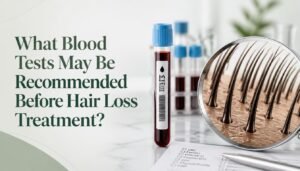
Blood tests can help identify certain underlying factors that may contribute to hair loss, including:
- Iron deficiency or anaemia
- Thyroid dysfunction
- Vitamin deficiencies
- Nutritional imbalances
- Certain hormonal abnormalities
- Underlying medical conditions
However, blood tests are not always necessary for every individual experiencing hair loss. A dermatologist first evaluates your medical history, symptoms, scalp condition, and pattern of hair loss before deciding which investigations may be useful.
8 Blood Tests That May Be Recommended Before Hair Loss Treatment
1. Complete Blood Count (CBC)
A Complete Blood Count (CBC) is one of the commonly considered investigations when evaluating unexplained or excessive hair shedding.
This test measures different components of blood, including red blood cells, white blood cells, haemoglobin, and platelets.
How can CBC help with hair loss?
A CBC can help identify anaemia and certain abnormalities that may indicate an underlying medical condition.
Iron-deficiency anaemia, for example, may be associated with increased hair shedding in some individuals. However, a normal CBC does not necessarily mean that your iron stores are adequate.
Your dermatologist may recommend additional iron-related investigations if required.
2. Serum Ferritin Test
Ferritin is a protein that stores iron in the body. A serum ferritin test measures the body’s iron reserves.
Iron is important for several biological functions, and iron deficiency may contribute to excessive hair shedding, particularly in individuals experiencing diffuse hair loss.
Why is ferritin important before hair treatment?
- Helps assess the body’s stored iron.
- May identify depleted iron reserves even when haemoglobin is normal.
- Helps investigate possible iron deficiency associated with hair shedding.
- Can guide further evaluation and nutritional management.
Ferritin levels should be interpreted carefully because inflammation and certain medical conditions can affect the results.
There is no single universally accepted ferritin target for hair growth. Your dermatologist will interpret your results in the context of your symptoms and overall health.
3. Thyroid Function Test (TSH, T3 and T4)
The thyroid gland regulates several important functions in the body, including metabolism.
Both an underactive thyroid (hypothyroidism) and an overactive thyroid (hyperthyroidism) may be associated with hair changes or excessive shedding.
A dermatologist may recommend thyroid function tests, particularly when hair loss is unexplained or accompanied by other symptoms.
Common thyroid investigations include:
- TSH (Thyroid-Stimulating Hormone)
- Free T4 (Free Thyroxine)
- T3, when clinically indicated
Symptoms such as fatigue, unexplained weight changes, constipation, increased sensitivity to cold or heat, and menstrual irregularities may make thyroid evaluation particularly relevant.
Identifying and managing an underlying thyroid disorder may help improve associated hair shedding.
4. Vitamin D Test
Vitamin D plays an important role in several bodily functions, including bone health and immune regulation. Research has also explored its potential association with certain hair-loss conditions. When a deficiency is identified, appropriate medical guidance can help determine whether supplementation is necessary.
A dermatologist may recommend measuring 25-hydroxyvitamin D [25(OH)D] levels in selected patients, particularly those with diffuse hair loss or suspected nutritional deficiencies.
This test can help identify vitamin D deficiency that may require medical attention.
However, low vitamin D levels do not automatically mean that they are the primary cause of hair loss. The findings must be considered alongside the clinical examination.
5. Vitamin B12 Test
Vitamin B12 is essential for red blood cell formation, DNA synthesis, and normal neurological function.
A deficiency can develop due to inadequate dietary intake, certain digestive conditions, or problems with nutrient absorption. In some cases, low B12 levels may contribute to hair-related concerns and other health symptoms.
A dermatologist may consider a vitamin B12 test if you have:
- Persistent or unexplained hair shedding
- A vegetarian or vegan diet with potential nutritional gaps
- Symptoms suggestive of vitamin B12 deficiency
- A history of malabsorption or certain medical conditions
- Other abnormalities identified during initial investigations
Vitamin B12 testing is not mandatory for every hair-loss patient. Its usefulness depends on your individual history and symptoms.
6. Serum Zinc Test
Zinc is an essential mineral involved in cell growth, tissue repair, and various biological processes.
Significant zinc deficiency may be associated with hair changes and excessive shedding. However, zinc levels are not routinely abnormal in everyone experiencing hair loss.
A dermatologist may recommend serum zinc testing if there is a clinical suspicion of deficiency, such as:
- Nutritional inadequacy
- Restricted dietary intake
- Certain digestive or absorption disorders
- Specific clinical findings suggesting a deficiency
Taking zinc supplements without confirming a need is not recommended, as excessive zinc intake can also cause health problems.
7. Hormonal Blood Tests
Hormonal investigations may be useful for selected individuals, particularly women experiencing hair thinning alongside signs of hormonal imbalance.
A dermatologist may consider hormonal testing if hair loss is accompanied by symptoms such as:
- Irregular or missed menstrual periods
- Persistent acne
- Increased facial or body hair
- Sudden or unexplained changes in hair growth
- Other signs of androgen excess
Depending on the clinical assessment, tests may include:
| Test | Why it may be recommended |
|---|---|
| Total testosterone | To assess suspected androgen abnormalities |
| Free testosterone or SHBG | To evaluate androgen activity in selected cases |
| DHEAS | To investigate possible adrenal androgen excess |
| Prolactin | When symptoms suggest elevated prolactin |
Important: Hormonal blood tests are not routinely required for every person with pattern hair loss. They are generally considered when the patient’s symptoms and examination suggest a possible hormonal condition.
8. Additional Nutritional or Medical Investigations
In certain cases, a dermatologist may recommend further investigations based on your symptoms, dietary habits, medical history, or initial test results.
These may include:
- Folate: If nutritional deficiency or anaemia is suspected.
- Liver function tests (LFTs): If there are concerns about liver-related or systemic conditions.
- Kidney function tests (KFTs): If an underlying medical condition is suspected.
- Serum calcium: When a calcium imbalance is clinically suspected.
- Additional iron studies: Such as serum iron, transferrin saturation, and total iron-binding capacity (TIBC).
These investigations are selected according to individual needs rather than ordered as a standard panel for every patient.
Which Blood Tests Are Usually Considered First?
For someone experiencing unexplained diffuse hair shedding, a dermatologist may initially consider a focused group of tests depending on the history and examination.
| Blood test | What it helps evaluate |
|---|---|
| CBC | Anaemia and blood abnormalities |
| Serum ferritin | Iron stores |
| TSH | Thyroid function |
| Vitamin D | Vitamin D deficiency |
| Vitamin B12 | Vitamin B12 deficiency, when suspected |
| Zinc | Zinc deficiency, when suspected |
| Hormonal profile | Possible androgen or hormonal abnormalities |
The exact combination varies from patient to patient. Sometimes, a detailed scalp examination and medical history are sufficient to identify the likely cause without extensive blood investigations.
Do You Need Blood Tests Before Hair PRP Treatment?
Hair PRP (Platelet-Rich Plasma) is a treatment that uses a concentrated preparation of platelets obtained from your own blood and administered into selected areas of the scalp.
PRP has been studied for certain types of hair loss, particularly androgenetic alopecia. However, it is not suitable for every hair-loss condition.
Before recommending Hair PRP, a dermatologist may assess:
- The type and pattern of hair loss
- The condition of the scalp and hair follicles
- Whether there is excessive active shedding
- Your medical history and medications
- Whether nutritional or medical factors require attention
- Whether PRP is appropriate for your specific diagnosis
Blood investigations may be recommended if the dermatologist suspects anaemia, nutritional deficiencies, or another medical condition that could contribute to hair loss.
PRP should not automatically be considered the first step for every patient. Identifying the cause of hair loss is essential before deciding on a suitable treatment.
You can learn more about Hair PRP treatment at Dermedico Clinic and its potential role in managing selected hair-loss conditions.
Can Hair Loss Be Treated Without Blood Tests?
Yes. Blood tests are not required in every case.
For example, some individuals with typical male or female pattern hair loss may be diagnosed through their medical history and scalp examination.
On the other hand, unexplained diffuse shedding, symptoms of nutritional deficiency, thyroid-related symptoms, or other medical concerns may make blood investigations helpful.
A dermatologist determines whether testing is necessary based on the suspected diagnosis.
How to Prepare for Blood Tests Before Hair Loss Treatment
If your dermatologist recommends blood investigations, consider the following:
- Follow the laboratory’s instructions: Some tests may require fasting, while others do not.
- Share your medication history: Inform your doctor about prescription medicines, vitamins, and supplements.
- Mention recent illnesses: Fever, infections, surgery, or significant physical stress may be relevant.
- Discuss dietary habits: Your nutritional history can help determine whether additional testing is useful.
- Avoid self-prescribing supplements: Taking excessive vitamins or minerals may be unnecessary and potentially harmful.
- Ask about biotin supplements: High-dose biotin may interfere with certain laboratory tests, including some thyroid and hormone tests. Consult your doctor about whether and when to pause it before testing.
Proper preparation helps your dermatologist interpret the results accurately and avoid unnecessary investigations.
When Should You Consult a Dermatologist for Hair Loss?
Consider a professional evaluation if you notice:
- Persistent or excessive hair shedding
- Gradually increasing scalp visibility
- A widening central hair part
- A receding hairline
- Sudden bald patches
- Hair loss accompanied by scalp itching, redness, or pain
- Hair thinning along with irregular periods or other hormonal symptoms
Early evaluation may help identify the underlying cause and determine whether treatment is required.
If you are looking for hair loss treatment in South Delhi, a dermatologist-led assessment can help you understand the available options and select a treatment approach appropriate for your condition.
Hair Loss Evaluation at Dermedico Clinic, Defence Colony
At Dermedico Clinic, Defence Colony, South Delhi, hair and scalp concerns are evaluated through a personalised dermatological approach.
Dr. Pallavi Chandna Rohatgi, MD Dermatologist, assesses the patient’s hair-loss pattern, scalp condition, medical history, and treatment goals before recommending appropriate options.
Depending on the diagnosis, treatment may involve medical management, addressing nutritional deficiencies, Hair PRP, or other suitable hair-restoration approaches.
Patients considering Hair PRP for hair loss in South Delhi can discuss whether the procedure is appropriate for their condition during a consultation.
For more information about the clinic and its services, visit the official Dermedico Clinic website.
Frequently Asked Questions (FAQs)
1. What blood tests are recommended for hair loss?
Depending on the suspected cause, a dermatologist may recommend CBC, serum ferritin, thyroid function tests, vitamin D, vitamin B12, or zinc testing. Hormonal investigations may be advised when symptoms indicate a possible hormonal imbalance.
2. Is a CBC test enough to identify the cause of hair fall?
Not always. A CBC can help detect anaemia and certain blood abnormalities, but it does not directly measure iron stores. A serum ferritin test may be recommended to evaluate iron deficiency more thoroughly.
3. Can thyroid problems cause hair loss?
Yes. Both hypothyroidism and hyperthyroidism may be associated with hair changes and excessive shedding. Thyroid function tests can help identify these conditions when clinically suspected.
4. Should I check vitamin D levels before Hair PRP?
Vitamin D testing may be considered if your dermatologist suspects a deficiency or identifies other relevant clinical factors. It is not a mandatory test for every person undergoing Hair PRP.
5. Is a hormonal test necessary for female hair loss?
Not in every case. Hormonal investigations are generally considered when hair thinning is accompanied by symptoms such as irregular periods, excess facial hair, persistent acne, or other signs of hormonal imbalance.
6. Can low ferritin cause hair fall even if haemoglobin is normal?
Yes, iron stores may become depleted before haemoglobin levels fall enough to indicate anaemia. Serum ferritin helps assess iron reserves and may be useful when investigating unexplained hair shedding.
7. Are blood tests required before every hair-loss treatment?
No. The need for blood tests depends on the type of hair loss, medical history, symptoms, and clinical examination. Some cases can be diagnosed without laboratory investigations.
8. Can blood tests help identify the best hair-loss treatment?
Blood tests may identify underlying conditions or deficiencies that need attention. However, the best treatment also depends on the scalp examination, pattern of hair loss, medical history, and diagnosis.
Conclusion
Hair loss is not always caused by a single factor. Nutritional deficiencies, iron deficiency, thyroid dysfunction, hormonal changes, genetic conditions, and other medical concerns may contribute to different types of hair loss.
Blood tests such as CBC, serum ferritin, thyroid function tests, vitamin D, vitamin B12, and selected hormonal investigations may help identify contributing factors in appropriate patients.
However, the most important step before hair loss treatment is an accurate diagnosis by a qualified dermatologist. Not everyone requires the same tests, and not everyone benefits from the same treatment.
If you are experiencing persistent hair thinning or excessive hair shedding, consult a dermatologist to understand the cause and explore appropriate treatment options.
Medical Disclaimer
This article is intended for educational and informational purposes only. It does not replace professional medical advice, diagnosis, or treatment. Blood investigations and hair-loss treatments should be recommended by a qualified medical professional based on your individual health needs.
References
- Expert Consensus on the Management of Telogen Effluvium in India – PubMed Central
- Diffuse Alopecia – DermNet
- Telogen Effluvium – StatPearls, NCBI Bookshelf
- A Comprehensive Investigation of Biochemical Status in Patients With Telogen Effluvium – PubMed Central
- Alopecia in General Medicine – PubMed Central