Table of Contents
Hair Loss Treatments
Hair loss is a common concern affecting both men and women. Whether you are experiencing excessive hair fall, a receding hairline, thinning at the crown, or a widening hair parting, finding the right treatment is important for maintaining healthy hair and scalp.
Today, several hair loss treatments are available in South Delhi, ranging from dermatologist-prescribed medications and nutritional correction to advanced procedures such as Platelet-Rich Plasma (PRP) therapy and hair transplantation.
However, not every treatment works for every individual. The most effective approach depends on the underlying cause, the severity of hair loss, your medical history, and the condition of your hair follicles.
If you are searching for the best hair loss treatment in South Delhi, this guide explains the available options for men and women, their potential benefits, and how to choose the right treatment.
What Causes Hair Loss in Men and Women?
Before selecting a hair fall treatment, it is important to understand why hair loss is happening.
Hair loss can occur due to several factors, including:
- Genetics: Hereditary hair loss, also known as androgenetic alopecia, is one of the most common causes of progressive hair thinning.
- Hormonal changes: Thyroid disorders, pregnancy, menopause, and certain hormonal conditions can contribute to hair loss.
- Nutritional deficiencies: Low iron levels, inadequate protein intake, and certain nutritional deficiencies may affect healthy hair growth.
- Stress: Physical or emotional stress can trigger a condition called telogen effluvium, which causes increased hair shedding.
- Medical conditions: Scalp infections, autoimmune conditions, and other medical disorders can affect hair growth.
- Lifestyle and hair-care habits: Excessive heat styling, chemical treatments, tight hairstyles, and inadequate scalp care may contribute to hair damage and hair loss.
Identifying the underlying cause is the first step towards selecting an appropriate hair restoration treatment.
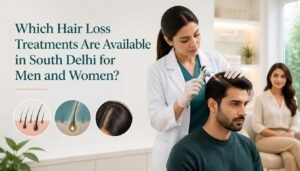
Which Hair Loss Treatments Are Available in South Delhi?
Men and women have different hair-loss patterns, and treatment recommendations can vary accordingly. Here are some commonly used options.
1. PRP Hair Treatment (Platelet-Rich Plasma)
PRP hair treatment is a non-surgical procedure used to manage certain types of hair thinning and pattern hair loss.
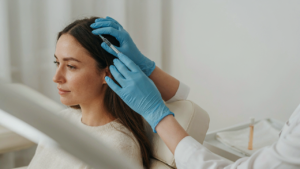
The procedure involves collecting a small blood sample from the patient and processing it in a centrifuge to separate platelet-rich plasma. This concentrated plasma is then injected into selected areas of the scalp.
Platelets contain growth factors that may support tissue repair and follicular activity.
Potential benefits of PRP hair treatment:
- May help improve hair density in selected patients.
- Can be considered for certain types of male and female pattern hair loss.
- Uses a component prepared from the patient’s own blood.
- Does not involve surgical hair transplantation.
- Can be incorporated into a personalised hair restoration plan.
PRP generally requires multiple sessions, and results vary depending on the individual’s condition and response to treatment.
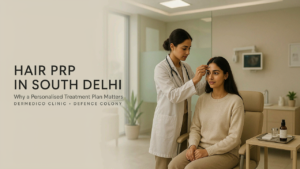
At Dermedico Clinic, Defence Colony, Hair PRP is available for concerns such as androgenetic alopecia, diffuse hair thinning, and early pattern baldness in men and women.
Read more about PRP Therapy in Delhi to understand the procedure and its applications.
2. Minoxidil Treatment for Hair Loss
Minoxidil is a commonly used topical medication for certain types of hair loss in both men and women.
It works by supporting the hair growth cycle and may help stimulate hair growth in areas experiencing thinning.
A dermatologist may recommend an appropriate formulation and strength depending on the patient’s condition.
Potential benefits include:
- Supporting hair regrowth in suitable patients.
- Helping manage hereditary hair thinning.
- Improving hair density over time.
- Providing a non-surgical treatment option.
Visible improvement can take several months, and continued use is generally necessary to maintain its benefits. Temporary increased shedding and scalp irritation can occur.
Minoxidil should be used under appropriate medical guidance, particularly during pregnancy, breastfeeding, or when other scalp conditions are present.
3. Hair Mesotherapy
Hair mesotherapy involves delivering selected substances into the scalp through small injections.
Depending on the formulation and clinical approach, these may include vitamins, amino acids, and other ingredients intended to support scalp health.
Some clinics offer mesotherapy as an additional hair-loss management option.
However, evidence supporting its effectiveness is limited and varies according to the ingredients and protocols used. It should not be considered a replacement for established treatments without a proper diagnosis.
A dermatologist can help determine whether this procedure is appropriate for your particular hair-loss concern.
4. Finasteride and Other Prescription Treatments
Certain prescription medications may help manage hereditary hair loss, particularly male pattern baldness.
Finasteride is one such medication. It works by reducing the conversion of testosterone into dihydrotestosterone (DHT), a hormone associated with follicular miniaturisation in genetically susceptible individuals.
Depending on the diagnosis, dermatologists may also consider other prescription treatments, including spironolactone for selected women with female-pattern hair loss.
Important considerations:
- These medications are not suitable for everyone.
- Potential side effects must be discussed before treatment.
- Finasteride requires particular caution regarding pregnancy and reproductive safety.
- Women who are pregnant or may become pregnant should not handle crushed or broken finasteride tablets.
- Treatment should always be prescribed and monitored by a qualified doctor.
Never start prescription hair-loss medication without consulting a dermatologist.
5. Low-Level Laser Therapy (LLLT)
Low-Level Laser Therapy is a non-invasive approach that uses specific wavelengths of light to target the scalp.
Some studies suggest that it may help improve hair density in certain individuals with hereditary hair loss.
Potential advantages include:
- A non-surgical approach.
- No injections or incisions.
- Minimal downtime.
- The possibility of combining it with other treatments when clinically appropriate.
However, results are variable, and repeated sessions may be required. It is important to understand the evidence and limitations before investing in laser-based hair restoration devices or procedures.
6. Hair Transplantation
Hair transplantation is a surgical procedure generally considered for individuals with established pattern baldness and suitable donor hair.
The procedure involves moving hair follicles from a donor area, usually the back or sides of the scalp, to areas affected by hair loss.
Two commonly discussed techniques are:
- FUE (Follicular Unit Extraction): Individual follicular units are extracted and implanted into the recipient area.
- FUT (Follicular Unit Transplantation): A strip of scalp is removed and divided into individual follicular units for transplantation.
Hair transplantation may provide long-lasting results in appropriately selected patients. However, it is not suitable for every type of hair loss, and a specialist must assess donor hair availability, the progression of hair loss, and expectations before surgery.
Hair Loss Treatment for Men vs Women: What Is the Difference?
Although both men and women experience hair thinning, the patterns and underlying causes can differ.
Hair Loss Treatments for Men
Men commonly experience:
- Receding hairlines.
- Thinning around the crown.
- Gradual development of bald patches.
- Hereditary male pattern baldness.
Depending on the diagnosis, treatment may involve topical minoxidil, prescription finasteride, PRP therapy, or hair transplantation.
Starting treatment early may help slow progressive hair loss.
Hair Loss Treatments for Women
Women may experience:
- Widening of the central hair parting.
- Diffuse thinning across the scalp.
- Increased hair shedding.
- Hair loss associated with hormonal changes or nutritional deficiencies.
Treatment may include topical minoxidil, correction of nutritional deficiencies, management of underlying medical conditions, and selected dermatologist-guided procedures such as PRP.
Women experiencing sudden or unexplained hair loss should undergo a proper medical evaluation before starting treatment.
How to Choose the Best Hair Loss Treatment in South Delhi?
Choosing a treatment simply because it is popular or advertised online may not provide the results you expect.
Consider these important factors before selecting a hair restoration clinic:
1. Choose a qualified dermatologist: Look for a doctor with appropriate dermatology qualifications and experience in hair and scalp conditions.
2. Understand the cause of hair loss: A proper consultation and scalp examination can help identify whether your hair loss is hereditary, hormonal, nutritional, or related to another condition.
3. Discuss available treatment options: Ask about the benefits, limitations, potential side effects, and expected treatment duration.
4. Understand the treatment plan: Some procedures require multiple sessions and follow-up appointments.
5. Set realistic expectations: No treatment guarantees complete hair regrowth. Results depend on the underlying condition and individual response.
Why Consider Dermedico Clinic for Hair PRP in South Delhi?
For individuals searching for Hair PRP treatment in South Delhi, Dermedico Clinic is located at D-95, Defence Colony, New Delhi.
The clinic offers dermatologist-guided Hair PRP for selected concerns, including:
- Androgenetic alopecia.
- Diffuse hair thinning.
- Early pattern baldness in men and women.
Hair PRP at Dermedico Clinic is performed by Dr. Pallavi Chandna Rohatgi, MD Dermatologist.
The treatment approach focuses on assessing individual hair concerns and determining whether PRP is an appropriate option.
Its Defence Colony location is also convenient for patients travelling from Lajpat Nagar, South Extension, Greater Kailash, and other parts of South Delhi.
If you are considering hair restoration, a consultation can help you understand the available options and whether Hair PRP is suitable for your condition.
Explore the Hair PRP treatment details at Dermedico Clinic.
Frequently Asked Questions About Hair Loss Treatments in South Delhi
1. Which is the best hair loss treatment for men and women?
The best treatment depends on the cause of hair loss. Options may include minoxidil, prescription medications, PRP therapy, nutritional correction, and hair transplantation. A dermatologist can recommend the appropriate approach after evaluating your scalp and medical history.
2. Is PRP treatment effective for hair loss?
PRP may help improve hair density and reduce shedding in selected patients, particularly those with certain types of pattern hair loss. However, results vary, and it is not a guaranteed cure for baldness.
3. How many PRP sessions are required for hair regrowth?
Many PRP protocols begin with approximately three to four sessions spaced several weeks apart. The actual number depends on the individual’s hair-loss condition, response to treatment, and dermatologist’s recommendation.
4. Can women undergo PRP treatment for hair loss?
Yes. Women with certain types of hair thinning, including female-pattern hair loss, may be considered for PRP after a dermatologist evaluates the underlying cause.
5. Is hair loss treatment painful?
It depends on the procedure. Topical treatments are generally painless, while PRP involves injections that may cause temporary discomfort. Hair transplantation involves surgery and appropriate anaesthesia.
6. How long does it take to see results from hair loss treatment?
Results depend on the treatment and the underlying cause. Some medications may require six to twelve months for noticeable improvement. PRP results may also take several months and vary between individuals.
7. Where can I find Hair PRP treatment near Lajpat Nagar?
Dermedico Clinic offers Hair PRP treatment at D-95, Defence Colony, New Delhi. Its location is convenient for people travelling from Lajpat Nagar and other South Delhi neighbourhoods.
8. Can hair loss be treated permanently?
Some causes of hair loss are reversible, while hereditary hair loss generally requires ongoing management. Hair transplantation can provide long-lasting results in suitable candidates, but it does not prevent future hair loss in untreated areas.
Final Thoughts
Hair loss can affect confidence and quality of life, but several treatment options are available for men and women today.
From topical medications and prescription treatments to PRP therapy, laser-based approaches, and hair transplantation, the right option depends on identifying the underlying cause and assessing the condition of your hair follicles.
If you are looking for hair loss treatment in South Delhi, consulting a qualified dermatologist is an important first step.
Dermedico Clinic in Defence Colony offers Hair PRP for selected hair-thinning concerns, helping patients explore a personalised approach to hair restoration.
Book a consultation to discuss your hair concerns and understand which treatment may be appropriate for you.
Medical Disclaimer: This article is intended for general educational purposes and does not replace professional medical advice, diagnosis, or treatment. Hair-loss treatments should be selected following an assessment by a qualified dermatologist. Individual results may vary.