Table of Contents
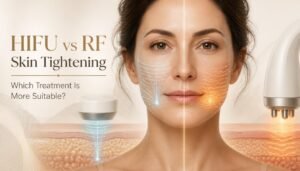
HIFU vs RF Skin Tightening
Loose skin, reduced facial firmness, fine lines and a less-defined jawline are common concerns as the skin ages. With advancements in aesthetic dermatology, non-surgical skin tightening treatments such as HIFU and Radiofrequency (RF) have become popular options for people seeking firmer, smoother-looking skin without surgery.
But when comparing HIFU vs RF skin tightening, which treatment is more suitable for your skin?
Both treatments work by delivering energy beneath the skin to stimulate collagen remodelling. However, they use different technologies, target different tissue depths and may be recommended for different skin concerns.
Understanding the difference between HIFU and RF skin tightening can help you make an informed decision before undergoing treatment.
What Is HIFU Skin Tightening?
HIFU stands for High-Intensity Focused Ultrasound. It is a non-surgical aesthetic treatment that uses focused ultrasound energy to target specific tissue depths beneath the skin.
The treatment creates controlled thermal effects in the targeted tissue, stimulating the body’s natural healing response and encouraging collagen remodelling.
Collagen is an essential structural protein that helps maintain skin firmness, elasticity and support. As collagen production and organisation change with age, the skin may gradually become less firm, resulting in facial laxity and wrinkles.
HIFU is designed to address selected concerns associated with deeper tissue laxity rather than simply treating the skin’s surface.
Common concerns addressed by HIFU
HIFU may be considered for:
- Mild to moderate facial skin laxity
- Early jowling and sagging around the lower face
- Reduced jawline definition
- Mild neck skin laxity
- Loss of firmness around selected facial areas
- Early signs of facial ageing
At Dermedico Clinic, HIFU is offered as a non-surgical facial lifting and skin-tightening treatment in Defence Colony, South Delhi.
Learn more about HIFU Treatment in Delhi.
What Is RF Skin Tightening?
Radiofrequency (RF) skin tightening is a non-surgical aesthetic treatment that uses controlled radiofrequency energy to heat targeted skin tissues.
The heat stimulates collagen contraction and encourages the body’s natural collagen-remodelling process. Over time, this may help improve skin firmness, elasticity and texture.
Different RF technologies are available, including monopolar, bipolar, multipolar and fractional radiofrequency. Their applications, treatment depths and protocols vary.
Some RF treatments primarily target the dermis, while fractional RF and RF microneedling may combine thermal energy with controlled micro-injury to address additional concerns.
Common concerns addressed by RF skin tightening
Depending on the RF technology used, treatment may be considered for:
- Mild skin laxity
- Fine lines and wrinkles
- Uneven skin texture
- Enlarged-looking pores
- Loss of skin firmness
- Certain acne scars
- Overall skin rejuvenation
At Dermedico Clinic, advanced skin rejuvenation options are available for patients seeking to improve skin texture, firmness and overall appearance.
Explore Derma Genesis Treatment to learn more about the clinic’s skin-renewal approach.
HIFU vs RF Skin Tightening: Key Differences
Although both treatments stimulate collagen, their mechanisms and applications differ.
| Feature | HIFU | RF Skin Tightening |
|---|---|---|
| Technology | Focused ultrasound energy | Radiofrequency energy |
| Primary target | Selected deeper tissue layers | Primarily dermal tissue, depending on device |
| Main objective | Lifting and tightening | Firmness, texture and tightening |
| Common concerns | Jowls, jawline, mild sagging, neck laxity | Fine lines, texture, pores, mild laxity |
| Collagen stimulation | Yes | Yes |
| Treatment sessions | Often a single session, depending on protocol | May require multiple sessions |
| Results | Gradual, over several months | Gradual; varies by device and sessions |
| Downtime | Usually minimal | Usually minimal; varies by RF type |
| Best approach | Individual assessment | Individual assessment |
Important: These are general differences. The results and treatment experience depend on the specific device, energy settings, treatment area and individual skin condition.
How Does HIFU Work Compared to RF?
1. Difference in energy delivery
HIFU delivers focused ultrasound energy to selected tissue depths. The energy creates controlled thermal points beneath the skin without intentionally treating the entire surface.
RF skin tightening uses radiofrequency energy to generate heat within targeted tissues. Depending on the device, the treatment may cover a broader dermal area or deliver energy through fractional or microneedling techniques.
2. Difference in treatment depth
One of the main distinctions between HIFU and RF is the depth at which energy is delivered.
HIFU can target deeper tissue layers, making it useful for selected lifting and tightening concerns.
RF treatments are commonly used to stimulate collagen within the dermis and improve firmness and skin quality. Certain advanced RF systems can also target deeper tissues.
3. Difference in collagen stimulation
Both technologies can stimulate collagen-related remodelling.
HIFU creates controlled thermal effects at specific tissue depths, while RF generates heat in targeted tissues to support collagen contraction and remodelling.
The response is gradual, which means results may continue to develop after treatment.
Which Treatment Is Better for Sagging Skin?
If your primary concern is mild to moderate facial sagging, HIFU may be considered because it can target deeper tissue layers and support a lifting and tightening effect.
It may be particularly relevant for concerns such as:
- Early jowls
- Mild lower-face sagging
- Reduced jawline definition
- Mild neck laxity
However, HIFU cannot remove excess skin or reproduce the results of a surgical facelift.
If the skin laxity is significant, neither HIFU nor RF may provide the level of correction you expect. A dermatologist can help determine whether a non-surgical treatment or another approach is more appropriate.
Is RF Better for Fine Lines and Skin Texture?
RF skin tightening may be a suitable option when your primary concerns involve skin quality rather than deeper structural laxity.
Depending on the type of RF treatment, it may help improve the appearance of:
- Fine lines
- Mild wrinkles
- Uneven skin texture
- Enlarged-looking pores
- Loss of dermal firmness
- Certain acne scars
Fractional RF and RF microneedling are different from conventional non-invasive RF skin tightening. They involve different techniques, indications and recovery considerations.
For patients with concerns about texture, pores or acne scars, the dermatologist may consider other skin-rejuvenation options as well.
Explore Derma Genesis at Dermedico Clinic for more information about advanced skin renewal treatments.
HIFU vs RF: Which Gives Faster Results?
Neither HIFU nor RF should be considered an instant skin-tightening solution.
HIFU results
Some patients may notice an initial change, but the more gradual tightening effect develops as collagen remodelling takes place over the following months.
Visible results commonly develop over approximately 2–6 months, although the timeline varies by device, treatment protocol and individual response.
RF results
RF may produce some immediate tightening from collagen contraction, but longer-term improvement in firmness and skin quality develops gradually.
Depending on the type of RF treatment, multiple sessions may be recommended to achieve the desired result.
The number of sessions and expected timeline should be discussed during a professional consultation.
How Long Do HIFU and RF Results Last?
The longevity of results varies from person to person.
Factors that may influence treatment outcomes include:
- Age and natural ageing process
- Degree of skin laxity
- Skin quality and thickness
- Treatment area
- Type of device used
- Energy settings and treatment protocol
- Lifestyle and skincare habits
- Individual collagen response
HIFU results may remain noticeable for several months to over a year in some patients, while RF results depend considerably on the technology and whether maintenance sessions are recommended.
Neither treatment permanently stops ageing. Maintenance may be considered based on individual needs and professional assessment.
Are HIFU and RF Skin Tightening Safe?
Both HIFU and RF are established energy-based aesthetic treatment categories. However, non-surgical does not mean completely risk-free.
Possible temporary effects may include:
- Redness
- Swelling
- Tenderness
- Mild discomfort
- Temporary sensitivity
Less common complications can occur, particularly if treatment is performed incorrectly or inappropriate energy settings are used.
Treatment suitability depends on your medical history, skin condition, treatment area and the specific device.
Choosing a qualified dermatologist and an appropriate treatment protocol is essential for safety.
Can HIFU and RF Be Combined?
In selected cases, a dermatologist may consider combining HIFU and RF as part of an individualised treatment plan.
The rationale is that the technologies can target different tissue depths and address different concerns. HIFU may focus on deeper tissue tightening, while RF may help improve dermal firmness and skin texture.
However, combining treatments does not automatically produce better results for everyone.
Treatment sequencing, energy settings and intervals must be determined according to the patient’s skin condition, previous procedures and treatment goals.
A 2025 clinical study published in the Journal of Cosmetic Dermatology compared focused ultrasound and RF for facial rejuvenation. Both treatments demonstrated improvement, with differences in efficacy across facial areas. The study also highlighted that individual treatment selection matters.
Read the clinical study on PubMed.
HIFU vs RF Skin Tightening: Which Is More Suitable for You?
The right treatment depends on the primary concern rather than simply choosing the more popular procedure.
HIFU may be considered if:
- Your main concern is mild to moderate skin laxity.
- You notice early jowling or a less-defined jawline.
- You want a non-surgical lifting and tightening approach.
- You have mild neck laxity.
- Your dermatologist determines that deeper tissue targeting is appropriate.
RF skin tightening may be considered if:
- Your primary concern is skin firmness.
- You want to improve the appearance of fine lines.
- Your skin texture or pores are a concern.
- You are exploring non-surgical skin rejuvenation.
- Your dermatologist recommends a suitable RF technology for your skin.
A combination or alternative treatment may be considered if:
- You have multiple concerns involving skin laxity and texture.
- You have acne scars, pigmentation or volume loss.
- Your skin requires a more comprehensive treatment approach.
- A single procedure may not adequately address your concerns.
A personalised dermatological consultation can help determine the most suitable treatment based on your skin’s condition and expectations.
HIFU vs RF Skin Tightening in South Delhi
If you are searching for HIFU or RF skin tightening in South Delhi, choosing a clinic that prioritises medical assessment and individualised treatment planning is important.
At Dermedico Clinic, Defence Colony, aesthetic dermatology treatments are approached according to individual skin concerns and treatment suitability.
Before recommending a procedure, a dermatologist can assess your skin laxity, texture, facial anatomy, medical history and expectations to help you understand your options.
You can explore all skin and cosmetic treatments at Dermedico Clinic or visit the clinic to discuss your skin-tightening concerns.
Frequently Asked Questions (FAQs)
1. Is HIFU better than RF skin tightening?
Neither treatment is universally better. HIFU may be suitable for selected deeper tissue lifting and skin laxity concerns, while RF may be useful for improving dermal firmness and skin texture. The right choice depends on individual skin condition.
2. Does RF skin tightening work on sagging skin?
RF may help improve the appearance of mild skin laxity by stimulating collagen remodelling. The results depend on the device, treatment protocol and degree of sagging.
3. Is HIFU more effective for jawline tightening?
HIFU may be considered for mild skin laxity and reduced jawline definition. However, jawline concerns can also result from fat distribution, facial anatomy and volume changes, so assessment is important.
4. How many RF skin-tightening sessions are required?
The number of sessions varies according to the RF technology and individual treatment goals. Some treatments are performed in a single session, while others require a series of sessions.
5. Can HIFU and RF be performed together?
They may be combined in selected cases. However, the treatment sequence and timing should be determined by a qualified dermatologist.
6. Is there downtime after HIFU or RF?
Both treatments generally involve minimal downtime, but temporary redness, swelling, tenderness or discomfort may occur. Recovery depends on the device and treatment technique.
7. Is HIFU suitable for younger skin?
HIFU should not automatically be used as a preventive anti-ageing treatment. A dermatologist should assess whether a genuine treatment indication exists.
8. Which treatment is better for wrinkles?
The answer depends on the type of wrinkles. RF may help improve certain fine lines and skin texture concerns. Wrinkles caused by facial muscle movement may require a different treatment, such as Botox.
9. Can HIFU replace a surgical facelift?
No. HIFU is a non-surgical treatment that may improve selected mild-to-moderate skin laxity. It cannot remove excess skin or reproduce the results of surgical tissue repositioning.
10. Where can I get HIFU or RF skin tightening in South Delhi?
You can consult Dermedico Clinic in Defence Colony, South Delhi, for an assessment of your skin-tightening concerns and suitable aesthetic treatment options.
Final Verdict: HIFU or RF Skin Tightening?
When comparing HIFU vs RF skin tightening, the most important factor is understanding what your skin actually needs.
HIFU may be more appropriate for selected deeper tissue lifting and mild-to-moderate skin laxity, while RF skin tightening may be considered for dermal firmness, fine lines and overall skin rejuvenation.
Both treatments have their own advantages and limitations. Neither is a universal solution for every skin concern, and results vary between individuals.
The best way to choose is through a professional dermatological assessment that considers your skin condition, treatment goals and expectations.
Considering HIFU or RF skin tightening in South Delhi? Book a consultation at Dermedico Clinic, Defence Colony, to explore an individually tailored treatment plan.
Medical Disclaimer
This article is intended for educational and informational purposes only. It does not replace professional medical advice, diagnosis or treatment. HIFU and RF procedures should be performed only after assessment by a qualified medical professional. Results, risks and suitability vary between individuals.