Table of Contents
Pigmentation
Have you noticed brown, dark or uneven spots on your face after acne has healed? You may be wondering whether these are acne marks, pigmentation, or something else.
The terms are often used interchangeably, but they are not exactly the same.
Pigmentation is a broad term used to describe changes in skin colour, while acne marks can refer to the colour changes left behind after acne. One common type of acne-related pigmentation is called post-inflammatory hyperpigmentation (PIH).
This distinction matters because different types of pigmentation can have different causes and may require different approaches.
If you are looking for pigmentation treatment in South Delhi, Defence Colony or near Lajpat Nagar, understanding the difference between pigmentation and acne marks is a useful first step.
What Is Pigmentation?
Pigmentation refers broadly to a change in the normal colour of the skin.
When the skin produces or distributes more melanin than usual, certain areas may appear darker than the surrounding skin. Pigmentation can occur because of several factors, including:
- Sun exposure
- Hormonal changes
- Melasma
- Acne and inflammation
- Skin irritation
- Previous injuries
- Certain medications
- Other skin conditions
Therefore, pigmentation is not a single disease or condition.
For example, brown patches appearing symmetrically across the cheeks may have a different cause from an isolated brown spot left behind after a pimple.
What Are Acne Marks?
Acne marks are colour changes that remain on the skin after an acne lesion has healed.
One of the most common types is post-inflammatory hyperpigmentation (PIH).
After inflammation caused by a pimple, the affected area may produce or retain additional pigment. Once the acne has disappeared, a brown or darker mark may remain in the same location.
The American Academy of Dermatology notes that dark spots can appear after acne clears, particularly in people with medium-to-dark skin tones, and these spots can remain for months.
Acne Marks Are Not Always Acne Scars
This distinction is important.
A flat brown or dark spot left after acne is generally a colour change, not necessarily a scar.
Acne scars involve a structural or textural change in the skin. They may appear as:
- Ice-pick scars
- Boxcar scars
- Rolling scars
- Depressed scars
- Raised scars
So, if you have a flat brown spot but the skin surface remains smooth, you may be dealing with post-acne pigmentation rather than a true acne scar.
Pigmentation vs Acne Marks: What Is the Difference?
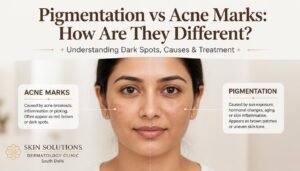
The easiest way to understand the difference is to look at the cause, pattern and location.
| Feature | Pigmentation | Acne Marks |
|---|---|---|
| Meaning | Broad term for changes in skin colour | Marks that appear following acne |
| Common causes | Sun, hormones, melasma, inflammation and other factors | Usually inflammation caused by acne |
| Appearance | Spots, patches or uneven areas | Usually flat red, brown or dark marks |
| Distribution | Can occur in different areas | Usually occurs where acne previously appeared |
| Common example | Melasma | Post-inflammatory hyperpigmentation after acne |
| Treatment | Depends on the underlying cause | Often involves managing acne and pigmentation |
| Can it recur? | Yes, depending on the cause | Yes, especially if new acne continues |
The important point is that acne marks can be a type of pigmentation, but not all pigmentation is caused by acne.
How Can You Tell If a Dark Spot Is From Acne?
Look at where the pigmentation appears.
If you notice individual brown or dark spots exactly where previous pimples occurred, they may be post-acne pigmentation.
For example, you may have:
- A brown spot on the cheek where a pimple healed
- Several dark spots along the jawline after repeated breakouts
- Small dark marks on the forehead following acne
- Brown spots remaining after inflammatory pimples
These patterns can be consistent with post-inflammatory hyperpigmentation.
However, appearance alone cannot always establish the diagnosis.
Other conditions can also produce brown or greyish pigmentation, which is why persistent or unusual pigmentation should be evaluated by a dermatologist.
Can Acne Cause Permanent Pigmentation?
Acne-related pigmentation can gradually become less noticeable, but the time required varies considerably.
The duration can depend on factors such as:
- Skin tone
- Depth of pigmentation
- Severity of inflammation
- Frequency of new acne
- Sun exposure
- Skin irritation
- Treatment
- Individual healing response
This is one reason why repeatedly picking or squeezing pimples can be problematic. More inflammation or injury can increase the likelihood of post-inflammatory colour changes.
Why Are Acne Marks More Noticeable on Indian Skin?
People with medium-to-deep skin tones can be more prone to noticeable post-inflammatory hyperpigmentation following inflammation.
The American Academy of Dermatology specifically notes that dark spots after acne are more commonly seen in people with darker skin tones.
For this reason, treating active acne as well as the marks it leaves behind can be important.
If acne continues to appear, new inflammatory lesions may continue creating new marks even while older pigmentation is fading.
What Causes Pigmentation Other Than Acne?
Not every dark spot on the face is an acne mark.
Common causes of facial pigmentation include:
1. Sun Exposure
UV exposure can stimulate pigment production and make existing pigmentation more noticeable.
Sun protection is therefore an important part of managing many pigmentation concerns.
2. Melasma
Melasma is a specific pigmentary condition that commonly produces brown or grey-brown patches on the face.
It often appears symmetrically on areas such as:
- Cheeks
- Forehead
- Nose
- Upper lip
- Chin
Melasma is different from a single acne mark and may require a different long-term management strategy.
3. Skin Irritation
Aggressive exfoliation, unsuitable skincare products or repeated irritation may contribute to pigmentation in some individuals.
4. Previous Skin Inflammation
Pigmentation can develop after different types of inflammatory skin conditions, not only acne.
5. Hormonal Factors
Hormonal changes can contribute to certain pigmentary conditions, including melasma.
Because pigmentation has multiple possible causes, identifying the underlying condition is an important first step before choosing treatment.
Pigmentation vs Acne Marks: Why Diagnosis Matters
Two people may both describe their concern as “dark spots,” but their underlying conditions can be completely different.
For example:
A:
Has flat brown marks exactly where previous acne lesions occurred.
B:
Has symmetrical brown patches across both cheeks.
C:
Has small sun-related brown spots.
All three may call the problem “pigmentation,” but the underlying cause may differ.
Dermedico’s existing pigmentation guidance similarly emphasizes identifying the type, depth, trigger and pattern of pigmentation before selecting treatment.
This is why copying another person’s skincare routine or treatment may not produce the same result.
How Are Acne Marks and Pigmentation Treated?
Treatment depends on the diagnosis.
There is no single pigmentation treatment that is appropriate for every person.
A dermatologist may consider factors such as:
- Type of pigmentation
- Skin tone
- Pigment depth
- Current acne activity
- Previous treatments
- Skin sensitivity
- Sun exposure
- Existing skincare routine
- Risk of post-inflammatory hyperpigmentation
Depending on the condition, treatment may involve medical skincare, prescription treatments, chemical peels or selected laser/light-based procedures.
Dermedico Clinic also explains that pigmentation treatment may be individualised according to the pigmentation type, skin tone, depth and triggers.
Treatment for Post-Acne Marks
If the main concern is post-acne pigmentation, treatment may focus on two areas:
1. Controlling Active Acne
If new acne continues to develop, new marks can continue appearing.
The American Academy of Dermatology recommends addressing acne early because controlling acne can help reduce the development of lingering dark spots.
2. Managing Existing Pigmentation
Once active acne is under control, a dermatologist may consider appropriate treatments to improve the appearance of remaining pigmentation.
Depending on the individual’s skin and diagnosis, options may include:
- Medical skincare
- Prescription topical treatments
- Chemical peels
- Selected laser or light-based procedures
- Combination approaches
The exact treatment should be selected following a dermatological assessment rather than simply choosing a procedure because it worked for someone else.
Can Chemical Peels Help Acne Marks?
Chemical peels may be considered for selected patients with acne, pigmentation and uneven skin tone.
However, the type and strength of peel should be selected according to the individual’s skin condition and skin type.
Dermedico’s chemical peel information discusses the use of peels for acne and pigmentation concerns.
A dermatologist can determine whether a chemical peel is appropriate and how it should fit into an overall treatment plan.
Can Laser Treatment Help Pigmentation?
Certain laser and light-based procedures may be considered for selected pigmentation concerns.
However, laser treatment is not automatically appropriate for every dark spot.
Factors such as:
- Type of pigmentation
- Skin tone
- Pigment depth
- Previous treatment
- Risk of irritation
- Risk of post-inflammatory pigmentation
should be considered before treatment.
This is particularly important for people who are prone to pigmentation after inflammation.
Therefore, laser treatment should be planned by a qualified dermatologist rather than selected solely based on an online advertisement.
What Can You Do at Home for Acne Marks and Pigmentation?
A simple skincare routine can support professional treatment and help reduce factors that may worsen pigmentation.
Use Sun Protection
Daily broad-spectrum sunscreen is important because UV exposure can make many forms of pigmentation darker.
DermNet specifically recommends broad-spectrum SPF 50+ sunscreen for exposed areas affected by post-inflammatory hyperpigmentation.
Avoid Picking Pimples
Picking or squeezing acne can increase inflammation and potentially contribute to post-inflammatory marks.
Avoid Excessive Exfoliation
Using multiple strong exfoliating products at the same time can irritate the skin.
Irritation itself can contribute to pigmentation in some people.
Treat Active Acne
If acne is still developing, focusing only on old marks may not address the underlying problem.
A dermatologist can help develop a routine that addresses both active acne and post-acne pigmentation.
When Should You See a Dermatologist for Pigmentation?
Consider professional evaluation if:
- Pigmentation keeps getting darker
- Dark spots are spreading
- Pigmentation repeatedly returns
- You cannot identify the cause
- Acne continues to cause new marks
- Pigmentation is affecting your confidence
- Over-the-counter products are not helping
- You are considering chemical peels or laser treatment
- You are unsure whether the problem is pigmentation, acne marks or acne scars
A dermatologist can examine the pattern and determine whether the discoloration is likely to be post-acne pigmentation, melasma, another pigmentary condition or something else.
Pigmentation Treatment in South Delhi
If you are searching for pigmentation treatment in South Delhi, pigmentation treatment in Defence Colony, or pigmentation treatment near Lajpat Nagar, the first step should be identifying the cause of the pigmentation.
Dermedico Clinic is located at D-95, Defence Colony, New Delhi – 110024, and provides dermatology and cosmetic skin treatments. The clinic lists pigmentation and acne-related concerns among its dermatology services.
You can explore Dermedico’s pigmentation treatment information and complete treatment options to learn more about the services available.
For acne-related concerns, you can also explore the clinic’s acne and acne-scar treatment information.
Frequently Asked Questions
Is pigmentation the same as acne marks?
No. Pigmentation is a broad term for changes in skin colour. Acne marks are colour changes that develop after acne, and post-inflammatory hyperpigmentation is one common type.
Are acne marks a type of pigmentation?
They can be. A flat brown or dark mark left after an inflamed acne lesion may represent post-inflammatory hyperpigmentation.
How do I know if I have acne marks or melasma?
Individual dark marks appearing where previous pimples occurred may suggest post-acne pigmentation, while symmetrical brown or grey-brown facial patches may be more consistent with melasma. However, a dermatologist should diagnose persistent pigmentation.
Do acne marks go away naturally?
They can become lighter over time, but the duration varies. Some marks may take months or longer to fade, particularly in darker skin tones.
Can sunscreen help acne marks?
Sun protection can help reduce UV-related darkening of post-inflammatory pigmentation. It is an important part of managing many pigmentation concerns.
Can acne cause pigmentation?
Yes. Inflammation from acne can lead to post-inflammatory hyperpigmentation, particularly in people with darker skin tones.
Are acne marks and acne scars the same?
No. Acne marks generally refer to colour changes, while acne scars involve changes to the structure or texture of the skin.
What is the treatment for acne pigmentation?
Treatment depends on the diagnosis and may include medical skincare, acne control, chemical peels or selected procedures. A dermatologist should determine which approach is appropriate.
Can pigmentation come back after treatment?
Yes. Recurrence depends on the underlying cause. Conditions such as melasma can be influenced by ongoing triggers, including sun exposure.
Should I visit a dermatologist for persistent acne marks?
If marks are persistent, worsening, recurring or accompanied by ongoing acne, a dermatologist can help determine the cause and discuss appropriate treatment options.
Final Takeaway
Pigmentation and acne marks are related, but they are not the same thing.
Pigmentation is a broad term that covers many types of changes in skin colour. Acne marks, on the other hand, usually refer to the colour changes left behind after acne, with post-inflammatory hyperpigmentation being a common example.
The most important distinction is the cause.
A brown mark left exactly where a pimple healed may be post-acne pigmentation, while symmetrical patches across the cheeks may have another cause, such as melasma.
Because different pigmentation concerns can require different treatment strategies, it is better to identify the underlying condition before starting strong products, chemical peels or laser procedures.
If you are dealing with persistent pigmentation or post-acne marks and are looking for a dermatologist in South Delhi, Defence Colony or near Lajpat Nagar, a professional skin assessment can help determine the most appropriate approach.
Medical Disclaimer: This article is intended for general educational purposes and does not replace an in-person medical examination, diagnosis or treatment plan. Pigmentation and acne marks can have different causes, so treatment should be selected according to individual skin characteristics and professional dermatological assessment.