Table of Contents
HIFU Treatment
If you are noticing sagging skin, early jowls, a less-defined jawline or loose skin around your neck, you may be wondering: Is HIFU treatment a good alternative to a surgical facelift?
HIFU, or High-Intensity Focused Ultrasound, has become a popular non-surgical option for people who want firmer, tighter and more lifted-looking skin without undergoing facial surgery.
Unlike a traditional facelift, HIFU does not require surgical incisions, stitches or the same type of recovery period. Instead, focused ultrasound energy is delivered to selected tissue depths to create controlled thermal effects that can support collagen remodelling and gradual skin tightening.
However, it is important to understand that HIFU and a surgical facelift are not the same treatment.
A facelift can surgically reposition facial tissues and remove excess skin. HIFU cannot remove excess skin or reproduce the structural correction achieved through surgery.
So, can HIFU replace a facelift? For some people with mild to moderate skin laxity, it can be a useful non-surgical alternative. For people with significant sagging or substantial excess skin, a surgical facelift may provide a more noticeable correction.
The right choice depends on your skin condition, facial anatomy, degree of laxity, expectations and treatment goals.
What Is HIFU Treatment?
HIFU stands for High-Intensity Focused Ultrasound. It is a non-invasive aesthetic treatment that uses focused ultrasound energy at selected depths beneath the skin.
The controlled energy creates a thermal effect in targeted tissue. This can stimulate a healing response and encourage collagen remodelling over time.
Collagen is an important structural protein that contributes to skin firmness and elasticity. As we age, changes in collagen and elastin can contribute to wrinkles, loss of firmness and facial skin laxity.
HIFU may therefore be considered for concerns such as:
- Mild to moderate facial skin laxity
- Early jowling
- Reduced jawline definition
- Loose neck skin
- Mild skin laxity beneath the chin
- Loss of facial firmness
- Selected brow-area laxity
- Early signs of facial ageing
Clinical research supports the potential of microfocused ultrasound for facial tightening. A systematic review published in Aesthetic Surgery Journal evaluated 13 studies involving 477 participants and found improvements in facial rejuvenation and tightening following microfocused ultrasound treatment.
For patients considering treatment locally, you can learn more about HIFU Treatment in Delhi at Dermedico Clinic.
How Does HIFU Tighten the Skin?
One of the key differences between HIFU and many surface-level skincare treatments is that HIFU delivers focused ultrasound energy to selected tissue depths.
The process generally involves:
1. Assessment and Treatment Planning
Before treatment, a qualified dermatologist should assess your facial anatomy, skin quality and degree of laxity.
This is important because not every type of facial ageing is caused by loose skin.
2. Focused Ultrasound Energy
The HIFU device delivers focused ultrasound energy to predetermined tissue depths.
3. Controlled Thermal Effect
The energy produces controlled thermal effects within the targeted tissue.
4. Collagen Remodelling
The treatment can stimulate a wound-healing response and collagen remodelling.
5. Gradual Improvement
Because collagen remodelling takes time, the final tightening effect does not usually appear immediately.
Results can develop progressively over the following weeks and months.
A systematic review of microfocused ultrasound found that facial skin tightening could continue to show improvement over time, although the degree of improvement varies between patients.
Is HIFU Really a Non-Surgical Facelift?
HIFU is frequently called a “non-surgical facelift.”
However, this phrase needs to be understood correctly.
HIFU can create a lifting and tightening effect without surgery, but it does not reproduce everything that a surgical facelift does.
A surgical facelift may involve:
- Surgical incisions
- Repositioning deeper facial tissues
- Removing excess skin
- More substantial correction of advanced sagging
HIFU:
- Does not require surgical incisions
- Does not remove excess skin
- Does not surgically reposition facial tissues
- Works through focused ultrasound energy and collagen remodelling
- Generally produces a more gradual and subtle result
Therefore, it is more accurate to describe HIFU as a non-surgical skin-tightening and lifting treatment, rather than an exact replacement for facelift surgery.
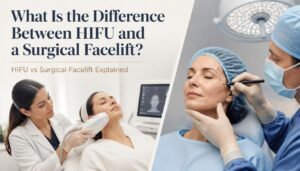
HIFU vs Surgical Facelift: What Is the Difference?
| Feature | HIFU Treatment | Surgical Facelift |
|---|---|---|
| Surgery | No | Yes |
| Incisions | No | Yes |
| Skin removal | No | Possible |
| Tissue repositioning | No surgical repositioning | Yes |
| Recovery | Usually minimal | Longer recovery |
| Results | Gradual | Generally more significant |
| Best suited for | Mild to moderate laxity | Significant sagging/excess skin |
| Anaesthesia | Usually not required, depending on protocol | Surgical anaesthesia |
| Maintenance | May be required | Ageing continues after surgery |
The most important difference is the degree of correction possible.
HIFU may be a practical option for someone who has started noticing mild sagging but does not want surgery.
A surgical facelift may be more appropriate when there is substantial excess skin or advanced facial laxity.
Is HIFU a Good Alternative to a Surgical Facelift?
Yes, HIFU can be a good alternative for the right patient—but it cannot replace a surgical facelift in every case.
HIFU may be particularly suitable if you:
- Have mild to moderate skin laxity
- Have early jowls
- Notice a less-defined jawline
- Have mild loose skin around your neck
- Want a non-surgical treatment
- Prefer minimal downtime
- Want gradual and natural-looking improvement
- Are not ready for facial surgery
- Have realistic expectations about the result
On the other hand, HIFU may not provide the result you want if you have:
- Significant excess skin
- Advanced facial sagging
- Severe jowling
- Major structural changes associated with ageing
- Expectations of a dramatic surgical-level lift
A dermatologist should assess your face before deciding which treatment is appropriate.
What Are the Benefits of Choosing HIFU Instead of a Facelift?
1. No Surgical Incisions
One of the biggest advantages of HIFU is that it does not require surgical cuts or stitches.
2. Minimal Downtime
Most people choose HIFU because they want to improve facial firmness without committing to the longer recovery associated with surgery.
Temporary redness, swelling, tenderness or sensitivity can occur, depending on the treatment and individual response.
3. Gradual Results
HIFU results generally develop progressively as collagen remodelling occurs.
This can make the improvement appear more subtle and natural rather than creating an abrupt change in facial appearance.
4. Improves Mild Skin Laxity
HIFU can be considered when mild or moderate skin laxity is the primary concern.
5. Can Improve Jawline Definition
When loose skin contributes to a less-defined jawline, HIFU may help create a firmer-looking lower-face contour.
6. Can Be Used for Selected Neck Concerns
HIFU may also be considered for selected patients with mild to moderate neck skin laxity.
What Does HIFU Treatment Feel Like?
HIFU is non-surgical, but that does not necessarily mean that every patient feels nothing during treatment.
Depending on the device, treatment settings and individual sensitivity, you may experience:
- Warmth
- Tingling
- Pressure
- Brief discomfort
- Mild tenderness
The experience can vary considerably between individuals.
At Dermedico Clinic, treatment planning and comfort measures are discussed according to the patient’s requirements.
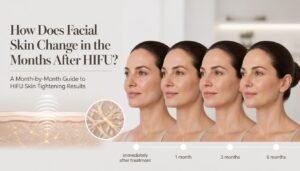
How Long Does HIFU Take to Show Results?
One of the most important things to understand about HIFU is that the final result is not usually immediate.
The treatment stimulates processes that occur gradually within the skin.
Some people may notice an early improvement in firmness, but more noticeable changes can develop over the following weeks and months.
Dermedico Clinic currently states that visible HIFU improvement may develop over approximately 3–6 months, although individual results vary.
Factors that can influence the result include:
- Age
- Skin quality
- Degree of laxity
- Treatment area
- Facial anatomy
- Device and treatment settings
- Treatment technique
- Individual collagen response
How Long Do HIFU Results Last?
HIFU does not stop the natural ageing process.
The longevity of results varies from person to person and depends on factors such as age, skin condition, lifestyle and the degree of laxity being treated.
Dermedico Clinic currently states that HIFU results may last approximately 12–18 months, although individual outcomes can differ.
Your dermatologist can advise whether maintenance treatment is appropriate for you.
Can HIFU Remove Loose Skin?
This is an important distinction.
HIFU can improve the appearance of mild skin laxity, but it does not surgically remove excess skin.
If a patient has significant excess skin, a surgical procedure may be more appropriate because surgery can physically remove and reposition tissue.
HIFU is therefore generally better suited to patients who have mild to moderate laxity rather than substantial excess skin.
Can HIFU Tighten the Jawline?
Yes, HIFU may be considered when mild skin laxity contributes to poor jawline definition.
As collagen remodelling occurs, the treated skin may appear firmer and more lifted.
However, a less-defined jawline can have multiple causes, including:
- Skin laxity
- Submental fat
- Facial volume changes
- Muscle activity
- Bone structure
- Natural facial anatomy
HIFU primarily addresses the skin-laxity component.
This is why an assessment is important before treatment.
HIFU for Neck Sagging
The neck is another area where signs of ageing can become noticeable.
Loss of collagen and elasticity may contribute to loose or less-firm neck skin.
HIFU may be considered for selected patients with mild to moderate neck laxity.
However, significant excess neck skin may require a different treatment approach.
If your primary concern is neck ageing, your dermatologist can determine whether HIFU is appropriate or whether another treatment may provide a better result.
Who Is a Good Candidate for HIFU?
A good HIFU candidate is generally someone who wants gradual improvement in skin firmness and has realistic expectations.
You may be considered for HIFU if:
- You have mild to moderate skin laxity.
- You have early jowling.
- Your jawline has become less defined.
- You have mild neck laxity.
- You want a non-surgical option.
- You prefer minimal downtime.
- You understand that results are gradual.
- You do not expect HIFU to produce the same correction as surgery.
However, only a qualified medical professional can determine whether HIFU is appropriate for you.
Who May Need a Surgical Facelift Instead?
A surgical facelift may be discussed when facial ageing involves significant tissue laxity and excess skin.
A consultation with an appropriately qualified surgeon or dermatologist can help determine the most suitable treatment pathway.
The important point is that more invasive does not automatically mean better, and less invasive does not automatically mean better.
The appropriate procedure depends on the problem being treated.
HIFU vs Botox: Are They the Same?
No.
HIFU and Botox work in fundamentally different ways.
HIFU is primarily used for selected skin-laxity and tightening concerns.
Botox temporarily reduces muscle activity and is commonly used for dynamic wrinkles such as forehead lines, frown lines and crow’s feet.
Therefore:
- Mild sagging → HIFU may be considered
- Early jowling → HIFU may be considered
- Loose neck skin → HIFU may be considered
- Forehead expression lines → Botox may be considered
- Frown lines → Botox may be considered
- Crow’s feet → Botox may be considered
Read more about Botox Treatment and other cosmetic treatments at Dermedico Clinic.
HIFU vs Dermal Fillers
Dermal fillers and HIFU also address different aspects of facial ageing.
Fillers may be used to restore or enhance volume in selected areas, whereas HIFU primarily focuses on skin tightening and lifting.
For some patients, facial ageing is more related to volume loss than skin laxity.
In those situations, fillers or another treatment may be discussed.
The best treatment depends on the underlying cause of the concern rather than simply choosing the most popular aesthetic procedure.
Can HIFU and Other Treatments Be Combined?
In some patients, different aesthetic treatments may be combined as part of a personalised treatment plan.
For example, HIFU may address skin laxity while another procedure focuses on skin texture, pigmentation, wrinkles or volume loss.
Dermedico Clinic offers several aesthetic and dermatology treatments, including HIFU, Botox, dermal fillers, PRP and Derma Genesis.
You can explore the clinic’s complete range of skin and cosmetic treatments to understand the available options.
However, treatments should not be combined simply because multiple procedures are available. A qualified dermatologist should determine whether a combination is appropriate for your skin and treatment goals.
Is HIFU Safe?
HIFU has been studied as a non-invasive technology for facial and neck rejuvenation.
A systematic review and meta-analysis published in Aesthetic Surgery Journal evaluated HIFU studies involving facial and neck rejuvenation and reported moderate improvement with a generally favourable short-term safety profile. The researchers also highlighted differences between treatment protocols and limited long-term follow-up in many studies.
More recent research continues to support the potential of focused ultrasound for skin tightening, while also emphasising the importance of appropriate patient selection and standardised treatment protocols.
Possible temporary effects can include:
- Redness
- Swelling
- Tenderness
- Sensitivity
- Tingling
- Temporary discomfort
The risks and suitability of treatment should always be discussed with a qualified medical professional before proceeding.
Why Choosing the Right HIFU Clinic Matters
The device is only one part of a successful treatment.
Patient selection, treatment depth, energy settings, facial anatomy and technique can all influence the outcome.
A qualified dermatologist can assess whether your concern is primarily related to:
- Skin laxity
- Facial volume loss
- Excess fat
- Muscle activity
- Skin texture
- A combination of ageing changes
This is particularly important because treating the wrong underlying concern may lead to disappointing results.
If you are considering HIFU in South Delhi, Dermedico Clinic in Defence Colony provides HIFU treatment under dermatological supervision.
You can also read HIFU Treatment in South Delhi: Benefits, Procedure and Results for more information about the procedure, results and candidacy.
HIFU Treatment in Defence Colony and South Delhi
For people searching for HIFU treatment near Defence Colony, Lajpat Nagar or other parts of South Delhi, location and accessibility may also be important.
Dermedico Clinic is located in Defence Colony, New Delhi, and offers HIFU as part of its aesthetic dermatology services.
If you are comparing treatment options, you can also read:
- HIFU Treatment Near Lajpat Nagar
- HIFU in South Delhi: How to Know Whether You Actually Need It?
- What Is HIFU Treatment and How Does It Tighten Sagging Skin?
- How Much Does HIFU Treatment Cost in South Delhi?
These supporting articles can help readers understand HIFU from different angles before booking a consultation.
So, Is HIFU Better Than a Surgical Facelift?
There is no universal answer.
If you have mild to moderate skin laxity, want gradual improvement and prefer to avoid surgery, HIFU may be an attractive option.
If you have significant sagging or substantial excess skin, HIFU may not provide the degree of correction you expect from a surgical facelift.
Think of the difference this way:
HIFU = gradual, non-surgical tightening and lifting
Surgical facelift = structural surgical correction of significant ageing and excess skin
Neither is automatically “better.” The appropriate choice depends on your individual anatomy, degree of ageing and desired outcome.
Final Verdict: Is HIFU Treatment a Good Alternative to a Surgical Facelift?
HIFU can be a good alternative to a surgical facelift for selected patients, particularly those with mild to moderate facial skin laxity who want a non-surgical approach.
It may help improve the appearance of:
- Early jowls
- Mild facial sagging
- Reduced jawline definition
- Loose neck skin
- Loss of facial firmness
The major advantages are that HIFU is non-surgical, does not require incisions and generally involves much less downtime than facelift surgery.
However, HIFU does not remove excess skin or surgically reposition facial tissues. People with advanced sagging or substantial excess skin may require a surgical approach for the level of correction they want.
The best first step is therefore not to decide between HIFU and surgery based only on online comparisons.
Instead, have your skin and facial anatomy assessed by a qualified dermatologist who can explain whether HIFU, another non-surgical treatment, surgery—or no procedure—is appropriate for you.
For readers considering treatment in South Delhi, you can learn more about HIFU Treatment in Delhi at Dermedico Clinic.
Frequently Asked Questions About HIFU vs Surgical Facelift
1. Can HIFU completely replace a surgical facelift?
No. HIFU can be a useful non-surgical option for selected patients with mild to moderate skin laxity, but it cannot remove excess skin or surgically reposition facial tissues.
2. Is HIFU better than a facelift?
Neither treatment is universally better. HIFU offers a non-surgical approach with gradual improvement, while a surgical facelift can provide more substantial correction for significant sagging.
3. Is HIFU painful?
Comfort varies. Some patients experience warmth, tingling, pressure or brief discomfort during treatment.
4. How quickly does HIFU work?
HIFU results generally develop gradually as collagen remodelling occurs. Visible improvement may continue for several months.
5. How long do HIFU results last?
Results vary between individuals. Dermedico Clinic currently states that results may last approximately 12–18 months, although maintenance requirements can differ.
6. Can HIFU remove loose skin?
HIFU can improve the appearance of mild skin laxity but cannot surgically remove significant excess skin.
7. Can HIFU tighten the jawline?
HIFU may improve the appearance of jawline definition when mild skin laxity is contributing to the concern.
8. Can HIFU treat a double chin?
HIFU may help when loose skin contributes to the appearance beneath the chin. However, not every double chin is caused by skin laxity, so assessment is important.
9. Is HIFU suitable for severe sagging?
HIFU is generally better suited to mild to moderate skin laxity. Significant excess skin may require a different treatment approach.
10. Should I choose HIFU or a facelift?
The decision depends on your degree of sagging, excess skin, facial anatomy, expectations and desired result. A professional consultation can help determine the most appropriate option.
Medical Disclaimer
This article is intended for general educational purposes and should not replace an in-person medical consultation. HIFU is a medical/aesthetic procedure, and suitability, expected results, contraindications, potential side effects and treatment plans vary between individuals. Always consult a qualified medical professional before undergoing treatment.