Table of Contents
Botox Treatment Differ for Forehead Lines and Crow’s Feet?
Forehead lines and crow’s feet are two of the most common facial expression lines people notice as they age.
The muscles involved, location of the wrinkles, injection pattern, amount of product required and desired aesthetic result can all differ between forehead Botox treatment and Botox for crow’s feet.
Botox, or botulinum toxin treatment, works by temporarily reducing activity in selected muscles. When those muscles contract less strongly, certain dynamic wrinkles become less noticeable. According to the American Academy of Dermatology (AAD), results from botulinum toxin treatment commonly become noticeable within several days and may last around three to four months, sometimes longer.
If you are considering Botox treatment in Delhi, understanding these differences can help you have a more informed conversation with your dermatologist.
Quick Answer: How Are Forehead Lines and Crow’s Feet Botox Different?
The main difference is where the muscles are located and how they affect facial movement.
| Feature | Botox for Forehead Lines | Botox for Crow’s Feet |
|---|---|---|
| Location | Horizontal lines across the forehead | Lines around the outer corners of the eyes |
| Main muscle involved | Frontalis muscle | Lateral orbicularis oculi |
| Common trigger | Raising the eyebrows | Smiling and squinting |
| Main goal | Soften horizontal forehead lines | Soften lines around the eyes |
| Injection planning | Requires careful assessment of forehead and brow movement | Requires precise treatment around the outer eye area |
| Desired result | Smoother forehead while preserving natural brow movement | Softer eye-area lines while preserving a natural smile |
| Assessment | Forehead movement, brow position and existing lines | Eye-area movement, smile pattern and skin condition |
The treatment should therefore be individualized rather than using the same injection strategy for everyone.
What Are Forehead Lines?
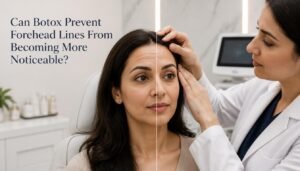
Forehead lines are horizontal wrinkles that appear across the forehead. They can become more noticeable when you raise your eyebrows, show surprise or make other facial expressions.
The forehead muscle, known as the frontalis, plays an important role in raising the eyebrows and creating horizontal forehead lines.
Over time, repeated muscle movement can contribute to lines becoming increasingly visible.
Sun exposure, natural ageing, changes in skin elasticity and other environmental factors can also influence how noticeable facial lines become.
When forehead wrinkles are primarily dynamic, Botox may temporarily reduce the muscle activity contributing to them.
Dermedico Clinic offers Botox treatment for forehead wrinkles as part of its cosmetic dermatology services. The clinic is located in Defence Colony, South Delhi, and its treatment information specifically includes forehead lines among its Botox treatment areas.
How Does Botox Work on Forehead Lines?
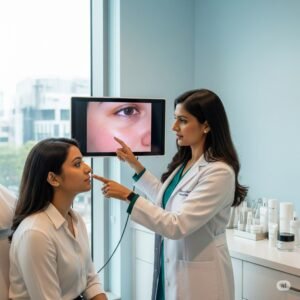
During a consultation, the dermatologist evaluates your facial movements, forehead lines, eyebrow position and overall facial anatomy.
Small injections are then placed into selected muscles.
The objective isn’t necessarily to completely stop forehead movement. Instead, treatment can be planned to reduce excessive muscle activity while maintaining natural-looking facial expression.
This is particularly important because excessive weakening of the forehead muscles can affect brow position or facial expression.
For this reason, forehead Botox requires individualized treatment planning.
What Can Affect Forehead Botox Treatment?
Several factors can influence the treatment plan, including:
- Strength of the forehead muscles
- Degree of forehead movement
- Depth of existing wrinkles
- Brow position
- Facial symmetry
- Previous Botox treatments
- Age-related changes
- Skin elasticity
- Desired cosmetic outcome
A qualified dermatologist can determine the appropriate treatment approach after examining your face.
What Are Crow’s Feet?
Crow’s feet are fine lines that develop around the outer corners of the eyes.
They are particularly noticeable when you:
- Smile
- Squint
- Laugh
- Look into bright light
- Make other expressions involving the muscles around the eyes
The orbicularis oculi muscle surrounds the eye and contributes to these expressions.
Because the eye area is delicate and highly expressive, Botox treatment in this region requires careful injection placement.
How Does Botox Work for Crow’s Feet?
Botox for crow’s feet targets selected muscle activity around the outer eye.
The objective is to soften excessive contraction responsible for dynamic lines while preserving the ability to smile and express emotions naturally.
Treatment around the eyes therefore requires precision.
The dermatologist must consider:
- The strength of the muscles around each eye
- Facial symmetry
- The patient’s smile pattern
- Existing wrinkles
- Skin quality
- The desired degree of softening
The treatment plan may differ between the left and right sides depending on individual muscle activity and facial movement.
Why Isn’t the Same Botox Technique Used for Both Areas?
Although both forehead lines and crow’s feet are dynamic wrinkles, the muscles and anatomy are different.
The frontalis muscle primarily controls forehead movement, while the muscles around the eyes create crow’s feet.
This means the injection locations, treatment pattern and aesthetic considerations are different.
Another important consideration is facial movement.
The forehead contributes to eyebrow movement, while the muscles around the eyes contribute to smiling and squinting.
A dermatologist should tailor Botox treatment to the patient’s natural facial expressions rather than use a standard formula.
Botox for Forehead Lines vs Crow’s Feet: Injection Approach
Forehead Botox
Forehead treatment requires careful attention to eyebrow position.
If the forehead muscles are weakened too much, the balance between the forehead and brow muscles can change.
Your dermatologist may therefore examine your forehead when your face is relaxed and when you raise your eyebrows.
The treatment is planned according to:
- Muscle activity
- Existing forehead wrinkles
- Brow position
- Facial symmetry
- Desired result
Crow’s Feet Botox
Crow’s feet treatment involves the outer eye area.
Because the eyes and surrounding muscles are particularly delicate, injections must be placed precisely.
The objective is generally to soften dynamic lines without creating an unnatural change in the way the eyes move or the person smiles.
This is one reason why choosing a qualified medical professional with experience in facial anatomy is important.
Does Forehead Botox Hurt More Than Crow’s Feet Botox?
Both treatments involve small injections, and discomfort can vary from person to person.
Most people describe Botox injections as brief pinches or stings.
The number of injections and individual sensitivity can influence the experience.
The forehead and eye area may also feel different because facial anatomy varies between treatment areas.
If you are nervous about injections, discuss this with your dermatologist before treatment.
How Long Does Botox Take to Work?
Botox does not usually produce its complete effect immediately.
The AAD states that patients commonly begin seeing results within 3 to 7 days, while the improvement generally lasts approximately 3 to 4 months, sometimes longer.
The exact timing and duration can vary depending on:
- Individual muscle activity
- Treatment area
- Product used
- Amount administered
- Previous treatment history
- Individual response
Therefore, it is better to think of Botox as a temporary treatment rather than a permanent solution for wrinkles.
How Long Does Forehead Botox Last?
Forehead Botox is temporary.
As the effect gradually wears off, muscle activity returns and forehead lines may become visible again.
The duration varies between individuals.
Some people may choose repeat treatment when muscle movement and wrinkles become noticeable again.
Your dermatologist can advise you about appropriate follow-up based on your individual response.
How Long Does Botox for Crow’s Feet Last?
Botox for crow’s feet is also temporary.
As muscle activity gradually returns, lines around the eyes can become more visible again.
The duration isn’t necessarily identical for every person or every treatment area.
Regular treatment should be based on individual need rather than automatically following a fixed schedule.
Can Botox Completely Remove Forehead Lines and Crow’s Feet?
Not necessarily.
This is an important distinction.
Botox primarily addresses muscle activity contributing to dynamic wrinkles.
If a line remains visible even when you completely relax your face, it may have developed into a static wrinkle.
Botox may reduce the muscle movement contributing to that wrinkle, but it may not completely erase deeper lines.
Other factors such as:
- Skin elasticity
- Sun damage
- Collagen loss
- Skin texture
- Facial volume
- Age-related changes
can also contribute to visible wrinkles.
Depending on the underlying concern, a dermatologist may discuss skincare, skin-resurfacing procedures, fillers or other treatments.
Botox vs Dermal Fillers for Facial Lines
It and dermal fillers work differently.
Botox temporarily reduces selected muscle activity, while dermal fillers generally add or restore facial volume.
For example, dermatologists may use Botox to address dynamic forehead lines and crow’s feet, while they may recommend fillers when volume loss contributes to a particular facial concern.
Neither treatment is automatically suitable for every wrinkle.
The appropriate option depends on the cause of the concern and your facial anatomy.
You can read more about the differences between these approaches in our Botox treatment guide.
Can Botox and HIFU Be Used Together?
Botox and HIFU address different aspects of facial ageing.
Botox primarily targets muscle activity that causes dynamic wrinkles, while HIFU can help address skin laxity and support skin tightening.
Dermedico Clinic discusses these differences in its guide to Botox and HIFU for facial ageing.
Whether treatments can be combined, and in what sequence, depends on the individual’s skin, facial anatomy, treatment areas and goals.
Who Should Perform Botox Treatment?
Botox is a medical injectable treatment and should be administered by an appropriately qualified healthcare professional.
The American Academy of Dermatology recommends asking who will perform the injections, how much experience they have with the procedure and what results you can realistically expect.
Before treatment, a proper consultation should consider:
- Medical history
- Current medications
- Previous cosmetic procedures
- Facial anatomy
- Muscle movement
- Existing wrinkles
- Treatment expectations
- Potential risks and side effects
Avoid choosing an injector solely because of a discounted price or social media promotion.
Botox Treatment in Defence Colony and South Delhi
If you are searching for Botox treatment in South Delhi, Dermedico Clinic is located at D-95, Defence Colony, New Delhi.
The clinic provides cosmetic dermatology services including Botox treatment for concerns such as forehead lines and crow’s feet. Its website identifies Dr. Pallavi Chandna Rohatgi as an M.D. dermatologist with experience in dermatology, dermatosurgery and cosmetic procedures including Botox and fillers.
Patients searching for Botox near Lajpat Nagar, Defence Colony, South Extension, Greater Kailash and nearby South Delhi areas may consider a consultation to discuss their individual concerns.
You can learn more about Botox treatment in Delhi before booking a consultation.
What Should You Ask Before Getting Botox?
If you’re considering Botox for forehead lines or crow’s feet, ask your dermatologist:
1. Is Botox appropriate for my wrinkles?
Not every line requires Botox.
2. Are my wrinkles dynamic or static?
This can influence the treatment approach.
3. Which muscles will be treated?
Understanding the treatment area can help you know what to expect.
4. What result should I realistically expect?
A good consultation should include realistic expectations.
5. Who will administer the injections?
Make sure you know the qualifications of the person performing the treatment.
6. What product will be used?
Ask about the product and its source.
7. What are the possible side effects?
Your dermatologist should explain potential risks before treatment.
8. Will I still be able to make natural facial expressions?
Discuss this if maintaining facial movement is important to you.
What Are the Possible Side Effects of Botox?
Botulinum toxin treatments can cause side effects.
Depending on the treatment area and individual circumstances, temporary effects may include:
- Mild redness
- Swelling
- Bruising
- Tenderness
- Headache
- Temporary changes in muscle activity
More significant complications are possible, which is why proper medical assessment and injection technique are important.
Discuss your medical history and any concerns with your healthcare professional before treatment.
Forehead Lines or Crow’s Feet: Which Botox Treatment Is Right for You?
There isn’t one standard Botox treatment that works identically for every person.
If your primary concern is horizontal forehead lines, your dermatologist will assess your forehead and brow movement.
If your concern is crow’s feet, the focus will be on the muscles surrounding the outer eye.
Some people have both concerns and may be assessed for treatment of multiple facial areas.
The important factor is individualized treatment planning.
Rather than deciding on a particular number of injections based on an online article, have your facial anatomy and muscle activity assessed by a qualified medical professional.
Frequently Asked Questions
Is Botox for forehead lines different from Botox for crow’s feet?
Yes. Although both treatments use botulinum toxin to temporarily reduce muscle activity, the muscles, injection areas and treatment goals are different.
Is Botox safe for forehead wrinkles?
Botulinum toxin is an established medical treatment, but it is not risk-free. Appropriate patient assessment, qualified administration and proper technique are important.
Can Botox treat both forehead lines and crow’s feet at the same appointment?
Depending on your individual assessment, multiple areas may be treated during one appointment. Your dermatologist determines whether this is appropriate.
How quickly does Botox work for crow’s feet?
Results are gradual rather than immediate. The AAD states that noticeable improvement commonly begins within 3 to 7 days.
How long does Botox for forehead lines last?
The effect is temporary. The AAD reports that improvement commonly lasts around three to four months, although individual results can vary.
Can Botox permanently remove forehead wrinkles?
No. Botox temporarily reduces muscle activity. When its effect wears off, muscle movement gradually returns.
Can Botox remove crow’s feet permanently?
No. Botox temporarily reduces the muscle activity responsible for dynamic lines. It does not permanently stop the natural ageing process.
Is Botox better than fillers for forehead lines?
Botox and fillers work differently. Botox reduces targeted muscle activity, while fillers are generally used to add or restore volume. A dermatologist should determine which treatment is appropriate for your concern.
Can I get Botox if my forehead lines are visible when my face is relaxed?
You may still be a candidate, but the result may depend on how deep the static component of the wrinkle is. Your dermatologist can determine whether Botox alone is appropriate or whether another treatment may be considered.
Can Botox make my face look frozen?
An overly aggressive treatment can alter facial movement. Treatment planning should therefore aim to balance wrinkle reduction with natural expression.
Is Botox around the eyes safe?
Botulinum toxin can be used for crow’s feet, but the eye area requires precise technique. Treatment should be performed by an appropriately qualified professional.
How much does Botox cost in Delhi?
The cost varies according to treatment area, number of units, product, muscle activity, facial anatomy and treatment plan. Dermedico Clinic publishes indicative starting prices, but the final cost should be confirmed after consultation.
Where can I get Botox near Lajpat Nagar?
Dermedico Clinic is located in Defence Colony, South Delhi, and its website states that it serves patients from Lajpat Nagar and surrounding areas.
Final Takeaway
So, how does Botox treatment differ for forehead lines and crow’s feet?
The biggest difference is the anatomy and muscle movement involved.
Forehead Botox focuses on muscles responsible for eyebrow and forehead movement, while crow’s feet Botox focuses on selected muscles around the outer eyes.
Both treatments can soften dynamic wrinkles, but the injection pattern, treatment planning and desired outcome can be different.
Because facial anatomy varies from person to person, Botox should not be treated as a one-size-fits-all procedure.
If you are considering Botox treatment in Delhi, Defence Colony or near Lajpat Nagar, a consultation with a qualified dermatologist can help determine whether Botox is appropriate for your specific wrinkles and what type of result can realistically be expected.
Medical Disclaimer:
This article is intended for general educational purposes and does not replace professional medical advice, diagnosis or treatment. Botox is a prescription medical treatment. Suitability, dosage, risks, results and treatment intervals vary between individuals and should be determined by a qualified healthcare professional.
Trusted References
- American Academy of Dermatology – Botulinum Toxin Therapy
- U.S. Food and Drug Administration – BOTOX Cosmetic
- Dermedico Clinic – Botox Treatment in Delhi
- Dermedico Clinic – Botox and HIFU for Facial Ageing
- Dermedico Clinic – Botox Treatment Near Lajpat Nagar