Table of Contents
If you are looking for melasma vs pigmentation in South Delhi, understanding the difference can help you know when professional dermatological evaluation may be useful.
In this guide, we explain the difference between melasma and pigmentation, their common causes, how they look, and the treatment options a dermatologist may consider.
What Is Pigmentation?
Pigmentation refers to a change in the normal colour of the skin. It can appear as darker or lighter areas and may have several different causes.
Common forms of pigmentation include:
- Sun-induced pigmentation
- Post-acne pigmentation
- Post-inflammatory hyperpigmentation
- Freckles
- Age spots
- Hormonal pigmentation
- Pigmentation caused by skin irritation
- Certain medication-related pigmentation
For example, a dark mark left behind after acne heals can be pigmentation, while brown patches appearing symmetrically on both cheeks may be more suggestive of melasma.
This is why simply buying a “pigmentation cream” without identifying the cause may not produce the desired results.
What Is Melasma?
Melasma is a common acquired pigmentary disorder that usually causes brown, grey-brown or sometimes bluish-grey patches on the face.
It commonly appears on:
- Cheeks
- Forehead
- Nose
- Upper lip
- Chin
- Jawline
DermNet describes melasma as a bilateral, blotchy, brownish facial pigmentation and notes that conditions such as post-inflammatory hyperpigmentation, freckles and solar lentigines can sometimes resemble melasma.
Melasma can be particularly noticeable after sun exposure and may become darker during periods of increased UV exposure.
Melasma vs Pigmentation: What Is the Difference?
The easiest way to understand the difference is that melasma is one particular type of pigmentary condition, whereas pigmentation is a much broader term.
| Feature | Melasma | General Pigmentation |
|---|---|---|
| Meaning | Specific pigmentary skin disorder | Broad term for abnormal skin colour |
| Appearance | Usually symmetrical patches | May be spots, patches or marks |
| Common locations | Cheeks, forehead, upper lip, nose and chin | Can occur anywhere |
| Common triggers | Sun exposure, hormones and other factors | Sun, acne, inflammation, irritation, hormones and more |
| Pattern | Often symmetrical | May be random or localized |
| Diagnosis | Dermatological examination may be required | Depends on the cause |
| Treatment | Usually requires a targeted long-term approach | Treatment depends on the underlying cause |
The important point is that not every dark patch on the face is melasma.
How Can You Identify Melasma?
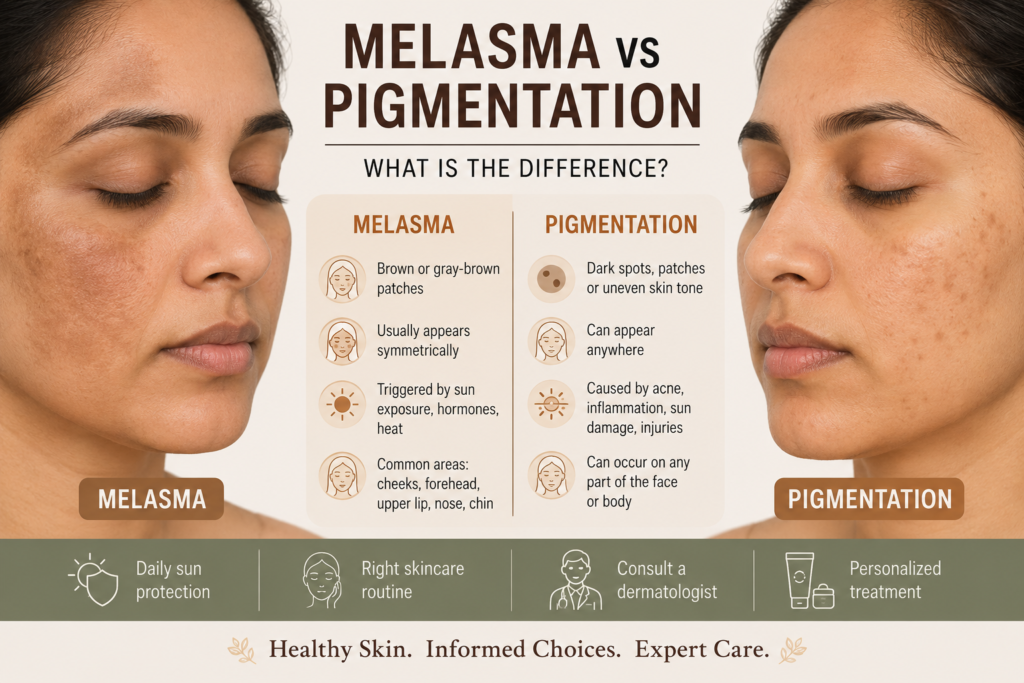
While only a qualified dermatologist can provide a proper diagnosis, some characteristics may make melasma more likely.
1. The patches are symmetrical
Melasma often appears on both sides of the face. For example, you may notice similar brown patches on both cheeks.
2. The patches are flat
Melasma usually appears as flat areas of discoloration rather than raised lesions.
3. It commonly affects the central face
Cheeks, forehead, nose and upper lip are frequent locations.
4. Sun exposure makes it more noticeable
UV exposure can stimulate pigment production and worsen existing melasma. The AAD recommends consistent sun protection as an important part of managing melasma.
5. It may be associated with hormonal factors
Melasma can develop or become more noticeable during hormonal changes, including pregnancy or use of certain hormonal medications.
What Causes Pigmentation?
Unlike melasma, pigmentation can have many different causes.
Sun Exposure
UV radiation can increase melanin production and make existing dark spots more prominent.
Acne and Inflammation
After acne or another inflammatory skin condition heals, it can leave behind dark marks known as post-inflammatory hyperpigmentation.
Skin Irritation
Aggressive scrubbing, unsuitable skincare products or excessive exfoliation may irritate the skin and contribute to pigmentation in some people.
Hormonal Changes
Hormonal fluctuations can contribute to melasma and other pigmentation concerns.
Skin Injuries
Cuts, burns or other forms of inflammation can sometimes leave darker areas during the healing process.
Because pigmentation has multiple possible causes, treatment should be selected after identifying what type of pigmentation you actually have.
Melasma vs Post-Acne Pigmentation
This is another common confusion.
If you have individual brown marks exactly where previous pimples occurred, they may be post-inflammatory hyperpigmentation (PIH).
If you have broad, irregular and relatively symmetrical patches across the cheeks, forehead or upper lip, melasma may be more likely.
However, both conditions can occur at the same time. A dermatologist can assess the pattern and decide which condition is contributing most to the discoloration.
How Is Melasma Diagnosed?
A dermatologist can often diagnose melasma by examining the skin. In some cases, specialised tools such as a Wood’s lamp or dermatoscope can help assess the pigmentation and determine how deeply the pigment extends.
This distinction is important because pigmentation can exist at different depths of the skin, and the treatment approach may vary.
If you have persistent facial pigmentation, avoid assuming that every brown patch is melasma.
Melasma Treatment in South Delhi
There is no single treatment that works for every person with melasma. The appropriate approach depends on your skin type, pigmentation pattern, triggers and severity.
A dermatologist may recommend a combination of:
1. Sun Protection
Daily sun protection is one of the most important steps.
Dermatologists commonly recommend broad-spectrum sunscreen, along with practical sun-protection measures such as seeking shade and wearing protective clothing or a wide-brimmed hat. The AAD notes that sun exposure can darken existing melasma and contribute to recurrence.
2. Prescription Topical Treatments
Depending on the diagnosis, a dermatologist may recommend topical medications or pigment-reducing ingredients.
Examples used in dermatological treatment can include hydroquinone, tretinoin, azelaic acid, kojic acid or vitamin C. These should be selected according to the patient’s skin and diagnosis rather than used randomly.
3. Chemical Peels
Chemical peels may be considered for selected pigmentation concerns.
Dermedico Clinic offers medically supervised chemical peel treatments for concerns including pigmentation and melasma. The clinic states that peel selection is based on the individual’s skin type and concern. Explore Chemical Peel Treatment in Delhi.
4. Laser and Light-Based Treatments
Some patients may be candidates for laser or light-based procedures. However, these treatments need careful selection because inappropriate treatment can sometimes aggravate pigmentation, particularly in darker skin types.
The AAD notes that laser and light treatments may sometimes be added to an existing melasma treatment plan, rather than necessarily being used as a standalone solution.
5. Individualised Dermatological Care
Melasma can be stubborn and may return even after improvement. According to the AAD, treatment results can take months and ongoing sun protection is important.
This makes professional assessment especially important if pigmentation has been persistent or repeatedly returning.
Why You Should Not Treat Every Dark Spot as Melasma
One of the biggest mistakes people make is treating pigmentation without first identifying its cause.
A dark spot may be:
- Melasma
- Post-inflammatory hyperpigmentation
- Sun spot
- Freckle
- Medication-related pigmentation
- Another pigmentary condition
These conditions can look similar but may require different management.
DermNet specifically lists post-inflammatory hyperpigmentation, solar lentigines, freckles and drug-induced hyperpigmentation among conditions that can resemble melasma.
When Should You See a Dermatologist?
Consider a professional skin evaluation if:
- Facial pigmentation has persisted for several months.
- Dark patches keep returning.
- Pigmentation is spreading.
- Over-the-counter products have not helped.
- Your skin becomes irritated after using pigmentation products.
- You are unsure whether you have melasma or another condition.
- You are considering a peel, laser or other cosmetic procedure.
A dermatologist can assess your skin and create a treatment plan based on the actual cause rather than treating the pigmentation blindly.
Why Choose Dermedico Clinic for Pigmentation Concerns in South Delhi?
Dermedico Clinic is located at D-95, Defence Colony, New Delhi, and provides dermatology and cosmetic treatments in South Delhi.
According to the clinic’s website, Dr. Pallavi Chandna Rohatgi is an MD Dermatologist, Cosmetologist and Laser Surgeon with experience in dermatology, dermatosurgery and laser procedures. The clinic specifically lists experience with conditions including melasma and pigmentation.
You can also explore Dermedico’s complete range of skin and cosmetic treatments to understand the procedures available at the clinic.
Frequently Asked Questions
Is melasma the same as pigmentation?
No. Pigmentation is a broad term for changes in skin colour, while melasma is a specific pigmentary condition that commonly causes symmetrical brown or grey-brown facial patches.
How do I know if I have melasma or pigmentation?
The appearance and distribution of the patches can provide clues, but a dermatologist should diagnose the condition. Melasma commonly appears as symmetrical patches on areas such as the cheeks, forehead and upper lip.
Can pigmentation turn into melasma?
Pigmentation itself does not simply “turn into” melasma. They are different concepts, and several pigmentary conditions can look similar. Correct diagnosis is important before treatment.
Is melasma permanent?
Melasma can improve with appropriate treatment, but it can recur. Long-term sun protection is an important part of management.
Is sunscreen important for melasma?
Yes. Sun exposure can darken melasma and make it more difficult to control. Dermatologists recommend consistent sun protection.
Can chemical peels treat pigmentation?
Chemical peels may be useful for selected pigmentation concerns, but the appropriate peel and strength depend on the diagnosis and skin type. Medical supervision is recommended.
Should I use a pigmentation cream without consulting a dermatologist?
It is better to identify the cause first. Some active ingredients can cause irritation or may be unsuitable for particular skin conditions or skin types.
Final Takeaway: Melasma vs Pigmentation
The terms melasma and pigmentation are related but not interchangeable. Melasma is a specific pigmentary disorder, while pigmentation can describe a much wider range of conditions.
If you are dealing with persistent brown patches or uneven skin tone in South Delhi, the first step should be identifying the cause. Once the diagnosis is clear, a dermatologist can recommend an appropriate combination of skincare, sun protection, medication and, when suitable, professional procedures.
For a personalised evaluation, you can explore Dermedico Clinic’s dermatology services or contact the clinic at its Defence Colony location.
Medical Review Note
Medical review: Dr. Pallavi Chandna Rohatgi, MD Dermatology, Venereology & Leprosy
Clinic: Dermedico Clinic, D-95, Defence Colony, New Delhi
This article is intended for general educational purposes and should not replace an in-person dermatological consultation.