Table of Contents
Hair PRP Treatment
Hair loss can start gradually. You may notice more hair on your pillow, increased shedding while shampooing, a widening hair part, a receding hairline, or thinning around the crown. When these changes continue, many people start searching for treatments that can improve hair density without undergoing surgery.
One treatment that frequently appears in those searches is Hair PRP treatment.
But does Hair PRP treatment really work for hair loss?
The short answer is: PRP can help some people with certain types of hair loss, particularly androgenetic alopecia, but it is not a guaranteed cure or a permanent solution for everyone.
The American Academy of Dermatology also recognises platelet-rich plasma as one treatment option that dermatologists may use for certain types of hair loss.
If you are considering PRP for hair loss in Delhi or South Delhi, understanding how the treatment works, who may benefit, expected results, limitations, and possible side effects can help you make a more informed decision.
What Is Hair PRP Treatment?
PRP stands for Platelet-Rich Plasma.
Hair PRP is a minimally invasive treatment that uses a concentrated component of your own blood.
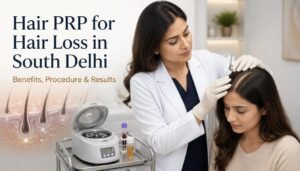
During the procedure, the doctor collects a small blood sample and places it in a centrifuge. The centrifuge separates the blood components, allowing the doctor to prepare platelet-rich plasma (PRP). The doctor then carefully injects the PRP into the areas of the scalp affected by thinning or hair loss.
Platelets contain various growth-related substances that researchers believe may influence the environment around hair follicles.
The goal of Hair PRP is not to magically create new follicles. Instead, it is intended to support existing, weakened follicles and potentially improve hair density in suitable patients.
At Dermedico Clinic, dermatologists use Hair PRP to address selected hair-loss concerns, including androgenetic alopecia, diffuse hair thinning, and early pattern hair loss.
For more information about the treatment, you can explore Hair PRP treatment at Dermedico Clinic.
Does Hair PRP Really Work for Hair Loss?
Yes, Hair PRP can work for selected patients, but it is important to understand what “work” means.
PRP is not a permanent cure for every form of hair loss. Its strongest clinical interest is in androgenetic alopecia, commonly known as male-pattern or female-pattern hair loss.
A systematic review published in 2024 examined PRP studies involving patients with androgenetic alopecia. Several studies reported improvements in hair density or hair count, although the researchers also highlighted differences between studies and limitations in evidence quality.
This means the evidence is encouraging, but it does not mean every person receiving PRP will experience the same result.
Your response may depend on:
- The underlying cause of hair loss
- How advanced the hair thinning is
- Whether hair follicles are still active
- Age and individual factors
- PRP preparation and treatment protocol
- Number and spacing of sessions
- Other treatments being used
- Consistency with follow-up care
Therefore, Hair PRP should be viewed as a potential treatment for appropriate patients, rather than a guaranteed hair-regrowth solution.
How Does PRP Help With Hair Growth?
The exact biological mechanisms behind PRP and hair growth are still being studied.
Platelets contain growth factors and other biological substances that may influence tissue repair and cellular activity. Researchers have investigated whether these substances can positively affect the environment surrounding weakened hair follicles.
Potential benefits may include:
- Supporting weakened hair follicles
- Improving the scalp environment
- Supporting the active growth phase of hair
- Potentially increasing hair density
- Helping reduce progressive thinning in some patients
- Improving the appearance of existing hair
However, there is an important limitation.
PRP cannot recreate hair follicles that have been permanently destroyed.
This is one reason why early evaluation of progressive hair loss can be important.
If you are experiencing increasing shedding or thinning, it is better to determine the cause before choosing a procedure.
Which Type of Hair Loss Can PRP Treat?
PRP has been studied most extensively for androgenetic alopecia.
This is commonly called male-pattern hair loss in men and female-pattern hair loss in women.
Typical signs may include:
- Receding hairline
- Thinning at the crown
- Gradual reduction in hair density
- Widening of the hair part
- Smaller or finer-looking hairs
- Progressive thinning over time
However, not every type of hair loss should automatically be treated with PRP.
Hair shedding can also be associated with factors such as stress, illness, nutritional deficiencies, hormonal changes, thyroid problems, medications, scalp conditions, and autoimmune disorders.
The American Academy of Dermatology recommends identifying the type and cause of hair loss because treatment depends on the diagnosis.
You can also read our related guide on Hair Shedding vs Hair Loss to understand why increased shedding does not always mean permanent hair loss.
Who May Be a Good Candidate for Hair PRP?
PRP may be considered for people with:
- Early or moderate pattern hair loss
- Androgenetic alopecia
- Diffuse hair thinning
- Reduced hair density
- Early-stage hair loss
- Existing but weakened hair follicles
A dermatologist should assess the scalp and hair-loss pattern before treatment.
This is particularly important because two people with similar-looking hair loss may actually have different underlying conditions.
A personalised treatment plan can help determine whether PRP is appropriate or whether another treatment, combination approach, or further investigation is needed.
Who May Not Benefit as Much From PRP?
PRP may have limited benefits when hair loss is very advanced or when follicles have been permanently destroyed.
A person may also need a different treatment if hair loss is primarily caused by an untreated medical or scalp condition.
PRP may not be the first or only treatment recommended when:
- Baldness is advanced
- Hair follicles are no longer viable
- The underlying cause has not been identified
- There is an active scalp disorder requiring treatment
- Expectations are unrealistic
- The patient needs a different medical treatment
This is why a consultation is more useful than choosing PRP simply because it is popular.
What Happens During Hair PRP Treatment?
Although protocols can vary, a typical Hair PRP procedure involves several steps.
1. Scalp Assessment
Your dermatologist first evaluates your hair loss, scalp condition, pattern of thinning, medical history, and treatment goals.
2. Blood Collection
A small amount of blood is collected from your arm.
3. PRP Preparation
The blood is processed in a centrifuge to separate the platelet-rich plasma from other blood components.
4. Scalp Preparation
The scalp is cleaned and prepared for treatment. Depending on the individual and treatment protocol, measures may be used to improve comfort.
5. PRP Injection
The prepared PRP is carefully injected into selected areas of the scalp where thinning is present.
6. Aftercare
Your dermatologist provides instructions regarding scalp care, washing, exercise, and other activities following treatment.
The American Academy of Dermatology describes a similar process and notes that PRP treatment generally does not require significant downtime.
How Many PRP Sessions Are Needed for Hair Loss?
There is no single PRP schedule that is ideal for every patient.
Treatment schedules can vary based on the diagnosis, degree of hair loss, response to treatment, and the protocol followed by the treating dermatologist.
The American Academy of Dermatology notes that some patients receive monthly PRP injections during the initial treatment period followed by maintenance treatments every few months.
Your dermatologist may therefore recommend an initial course followed by reassessment and, where appropriate, maintenance sessions.
The important point is that PRP should not be approached as a one-time procedure that guarantees permanent hair growth.
When Can You See Results From Hair PRP?
One of the most common misconceptions about PRP is expecting immediate hair growth.
Hair grows in cycles, so changes take time.
Some patients may notice reduced shedding before obvious changes in density. Visible improvement may develop gradually over several months.
A general timeline may look like this:
First few weeks:
The scalp recovers from the injections. Visible regrowth may not yet be apparent.
Around 2–3 months:
Some responsive patients may begin noticing changes in shedding or hair appearance.
Around 3–6 months:
Changes in hair density or thickness may become more noticeable in suitable patients.
After 6 months:
The response can be evaluated and the dermatologist can determine whether maintenance or another treatment approach is appropriate.
Clinical research has reported improvements in hair density at three and six months in patients with androgenetic alopecia treated with PRP.
However, individual results vary.
What Are the Benefits of Hair PRP?
Uses Your Own Blood
PRP is prepared from the patient’s own blood, making it an autologous treatment.
Minimally Invasive
Unlike hair transplantation, PRP does not involve surgically moving hair follicles from one area of the scalp to another.
May Improve Hair Density
Research suggests that PRP may increase hair density in selected patients with androgenetic alopecia.
Suitable for Men and Women
PRP has been studied in both male and female pattern hair loss, although evidence and response can vary.
Can Be Part of a Combination Approach
Depending on the diagnosis, a dermatologist may recommend PRP alongside other evidence-based hair-loss treatments.
The key is to choose treatments based on the cause of hair loss rather than assuming that one procedure is suitable for everyone.
Are There Any Side Effects of Hair PRP?
Hair PRP is generally considered minimally invasive, but temporary side effects can occur.
These may include:
- Mild scalp tenderness
- Temporary redness
- Swelling
- Sensitivity
- Minor bruising
- Discomfort around injection sites
- Mild headache in some cases
Most injection-related effects are temporary.
However, if you experience unusual, persistent, or worsening symptoms after treatment, contact your treating medical professional for appropriate evaluation.
PRP vs Minoxidil: Which Is Better?
PRP and minoxidil are different approaches to managing hair loss.
Minoxidil is a medical treatment used for certain forms of hair loss.
PRP is a procedure involving injections of platelet-rich plasma into the scalp.
The question should not always be “Which one is better?”
A more useful question is:
Which treatment is appropriate for my specific type and stage of hair loss?
Some patients may be candidates for one treatment, while others may benefit from a combination approach under medical supervision.
Research has also investigated PRP in combination with other hair-loss treatments, but the appropriate combination should be decided after a professional assessment.
PRP vs Hair Transplant: Are They the Same?
No.
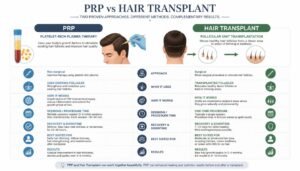
PRP and hair transplantation have very different purposes.
Hair PRP:
Uses platelet-rich plasma to support existing hair follicles and potentially improve hair density.
Hair transplant:
Surgically moves healthy hair follicles from a donor area to areas affected by hair loss.
PRP does not replace missing follicles.
For patients with advanced hair loss and suitable donor hair, hair transplantation may be discussed as an option.
For patients with existing but weakened follicles, PRP may be considered as part of a non-surgical treatment plan.
You can learn more about the differences in our guide: PRP vs Hair Transplant: Which Treatment Is Better for Hair Loss?
Is Hair PRP a Permanent Cure for Hair Loss?
No.
This is one of the most important things to understand before undergoing treatment.
PRP may improve hair density and support existing follicles in suitable patients, but it does not permanently eliminate the underlying tendency toward genetic pattern hair loss.
The American Academy of Dermatology specifically notes that PRP is not a permanent solution and that maintenance treatments may be required.
For long-term management, your dermatologist may monitor your hair density and shedding and determine whether additional PRP sessions or another treatment is appropriate.
You can also read our detailed article: Is Hair PRP Safe for Long-Term Hair Loss Management?
How Can You Improve Your PRP Hair Treatment Results?
PRP is only one part of an overall hair-loss management plan.
To support better long-term outcomes:
- Get the correct diagnosis before treatment.
- Follow your dermatologist’s recommended treatment schedule.
- Attend follow-up appointments.
- Follow post-treatment scalp-care instructions.
- Discuss nutrition and lifestyle factors that may contribute to hair loss.
- Take consistent progress photographs.
- Avoid expecting overnight results.
- Follow other prescribed hair-loss treatments if recommended.
It is also important to remember that hair growth takes time.
Why Early Hair-Loss Evaluation Matters
Hair loss can become progressively noticeable before a person seeks professional help.
Early thinning may appear as:
- Increased hair shedding
- A widening part
- A receding hairline
- Thinning at the crown
- Reduced overall hair volume
- Finer hair strands
Getting evaluated early may help identify the cause and determine which treatments are suitable.
PRP is not necessarily the right treatment for every person with hair fall. A dermatologist can assess whether your hair follicles are likely to respond and whether another treatment should be considered.
Why Choose a Dermatologist-Guided Hair PRP Treatment?
The popularity of PRP has resulted in many different treatment claims online.
However, PRP protocols can differ in terms of preparation, concentration, injection technique, treatment intervals, and patient selection.
A dermatologist-guided approach focuses on the cause of hair loss first, followed by an appropriate treatment plan.
At Dermedico Clinic in Defence Colony, South Delhi, Hair PRP is offered as part of a personalised approach to hair and scalp concerns.
If you are looking for Hair PRP in South Delhi, a consultation can help determine whether PRP is appropriate for your specific hair-loss pattern.
Frequently Asked Questions About Hair PRP
Does Hair PRP really work for hair loss?
Yes, research suggests PRP can improve hair density in some patients, particularly those with androgenetic alopecia. However, results vary and PRP is not a guaranteed cure.
How long does PRP take to show hair results?
Visible improvement generally takes several months rather than days. Research has reported changes in hair density at approximately three and six months in some patients.
Is PRP good for male-pattern baldness?
PRP has been studied for androgenetic alopecia, commonly called male-pattern hair loss. It may be considered for selected patients, particularly when follicles are still active.
Can women get Hair PRP?
Yes. PRP has also been studied for female-pattern hair thinning. However, the cause of hair loss should be identified before treatment.
Does PRP regrow hair on a completely bald scalp?
PRP cannot recreate hair follicles that have been permanently destroyed. It is generally more relevant when existing follicles are weakened or miniaturised.
Is Hair PRP painful?
Some patients experience temporary discomfort, tenderness, or sensitivity because PRP involves multiple scalp injections. Your treating clinician can discuss ways to improve comfort.
How many PRP sessions are required?
The number and frequency of sessions depend on your diagnosis, severity of hair loss, treatment protocol, and response. There is no universal schedule for every patient.
Are PRP results permanent?
No. PRP should not be considered a permanent cure for pattern hair loss. Maintenance treatment may be recommended for some patients.
Can PRP stop hair fall completely?
PRP may help reduce hair loss in some patients, but it cannot guarantee that all shedding will stop. Hair loss has many possible causes.
Is PRP better than a hair transplant?
Neither is universally “better.” PRP supports existing follicles, whereas a hair transplant moves follicles from a donor area. The appropriate choice depends on the type and stage of hair loss.
Can PRP be combined with other hair-loss treatments?
It may be combined with other treatments in selected patients. Your dermatologist should decide whether combination treatment is appropriate.
Is Hair PRP safe?
PRP is generally considered to have a favourable safety profile, but temporary injection-related effects can occur. Individual suitability should be assessed by a medical professional.
Final Verdict: Does Hair PRP Treatment Really Work for Hair Loss?
So, does Hair PRP treatment really work for hair loss?
The evidence suggests that PRP can improve hair density in some appropriately selected patients, particularly those with androgenetic alopecia. However, it should not be marketed as a miracle cure or permanent solution.
The best candidates are generally people who still have active but weakened hair follicles and whose hair loss has been properly diagnosed.
The most important step is therefore not simply booking PRP. It is understanding why you are losing hair and whether PRP is appropriate for your condition.
If you are experiencing progressive thinning, excessive shedding, a receding hairline, or reduced hair density, consider consulting a qualified dermatologist for an individual assessment.
For patients considering Hair PRP treatment in Delhi or South Delhi, Dermedico Clinic provides dermatologist-guided evaluation and treatment for selected hair-loss concerns.