Table of Contents
HIFU Work on the Lower Face
Have you started noticing sagging cheeks, early jowls, or a less-defined jawline when you look in the mirror? These changes can occur gradually as skin elasticity and collagen production change with age.
If you are looking for a non-surgical way to improve facial firmness, you may have come across HIFU (High-Intensity Focused Ultrasound).
But does HIFU actually work on the lower face and cheeks?
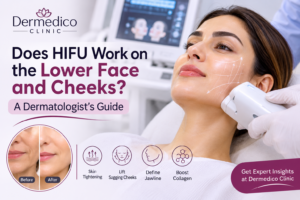
Yes, HIFU may help improve mild to moderate skin laxity in the lower face and cheeks in appropriately selected individuals. It uses focused ultrasound energy to target specific tissue depths beneath the skin, stimulating a response associated with collagen remodelling and gradual tightening.
However, HIFU is not a replacement for a surgical facelift, and results differ from person to person.
At Dermedico Clinic, Defence Colony, South Delhi, HIFU is offered as a non-surgical facial lifting and skin-tightening option under dermatological supervision.
Let’s understand how it works, what results you can expect, and whether it may be suitable for your skin concerns.
What Is HIFU Treatment?
HIFU stands for High-Intensity Focused Ultrasound. It is a non-invasive aesthetic treatment that delivers focused ultrasound energy to selected tissue depths beneath the skin.
Unlike treatments that primarily work on the skin’s surface, HIFU targets deeper layers to create controlled thermal effects.
These effects can stimulate the body’s natural healing response and encourage collagen remodelling.
Collagen is a structural protein that helps maintain skin firmness, elasticity, and support. As collagen production and organisation change with age, the skin may gradually lose firmness, contributing to sagging and changes in facial contours.
HIFU is commonly considered for concerns such as:
- Mild to moderate facial skin laxity
- Early sagging cheeks
- Loss of jawline definition
- Early jowling
- Mild lower-face sagging
- Loose skin beneath the chin
- Selected signs of facial ageing
Learn more about HIFU treatment at Dermedico Clinic.
How Does HIFU Work on the Lower Face and Cheeks?
The main principle behind HIFU is the controlled delivery of ultrasound energy to specific tissue depths.
During treatment, the energy creates tiny zones of thermal stimulation beneath the skin while leaving surrounding tissue relatively unaffected.
This process can encourage collagen remodelling and gradual tissue tightening.
1. Stimulates Collagen Remodelling
Collagen provides structural support to the skin. As collagen changes with age, the cheeks and lower face may gradually appear less firm.
HIFU stimulates a controlled response within the targeted tissue, encouraging collagen-related remodelling over time.
This may help improve the appearance of skin firmness and mild facial laxity.
2. Improves the Appearance of Sagging Cheeks
When the cheeks begin to lose firmness, the face may appear heavier or less lifted.
HIFU may help improve the appearance of mild cheek laxity by targeting selected tissue depths and stimulating gradual tightening.
However, the outcome depends on skin condition, facial anatomy, treatment settings, and individual response.
3. Helps Improve Jawline Definition
Early jowling and reduced jawline definition are common lower-face concerns.
When mild skin laxity contributes to these changes, HIFU may help improve the appearance of a firmer, more defined jawline.
It is important to understand that a less-defined jawline can also result from facial fat distribution, bone structure, muscle activity, and other anatomical factors.
HIFU primarily addresses the skin-laxity component rather than correcting every cause of facial contour changes.
4. Supports Gradual Facial Tightening
HIFU does not mechanically pull the skin upward like a surgical facelift.
Instead, the treatment works through controlled energy delivery and gradual tissue remodelling.
This is why results develop progressively rather than appearing as an immediate, dramatic lift.
What Areas of the Lower Face Can HIFU Treat?
Depending on the device, treatment protocol, and individual suitability, HIFU may be considered for:
- Lower cheeks
- Jawline
- Early jowls
- Skin beneath the chin
- Selected areas of the neck
- Mild facial skin laxity
Not every HIFU device has identical indications. Your dermatologist should explain which areas are appropriate for the specific device being used.
Does HIFU Really Lift Sagging Cheeks?
HIFU can provide improvement in selected patients with mild to moderate skin laxity, but it is important to maintain realistic expectations.
A more recent systematic review published in 2025 evaluated 45 clinical trials and cohort studies and reported improvements in skin laxity, particularly in the lower face, neck, and periorbital regions.
These findings support the potential of focused ultrasound for facial skin tightening. However, the extent of improvement varies, and further standardised research is still needed.
The key takeaway: HIFU may help with mild sagging, but it should not be expected to deliver the same results as surgery.
How Long Does HIFU Take to Show Results on the Face?
HIFU results are gradual because collagen remodelling takes time.
| Stage | What you may notice |
|---|---|
| Immediately after treatment | Some people notice a subtle initial change, but it is not the final result |
| First few weeks | The skin’s natural response and remodelling process begins |
| 2–3 months | Gradual improvement in firmness may become more noticeable |
| 3–6 months | Further improvement may develop, depending on individual response |
These are general timelines, not guaranteed outcomes. Results vary according to the device, treatment protocol, skin condition, and individual response.
For more information, read HIFU Treatment in South Delhi: Benefits, Procedure and Results.
Who Is a Good Candidate for HIFU on the Lower Face and Cheeks?
HIFU may be worth discussing with a qualified dermatologist if you:
- Have mild to moderate cheek skin laxity
- Notice early jowling
- Have a less-defined jawline
- Want non-surgical facial skin tightening
- Prefer gradual, subtle improvement
- Have realistic expectations about treatment outcomes
- Want to explore options before considering surgery
However, suitability cannot be determined by age alone. Facial anatomy, skin condition, degree of laxity, and treatment goals all matter.
Who May Not Be Suitable for HIFU?
HIFU is not appropriate for everyone.
A dermatologist may recommend an alternative treatment if you have:
- Significant facial sagging
- Extensive excess skin
- Very thin or compromised skin in the treatment area
- Certain active skin conditions
- A treatment area affected by an underlying medical concern
- Expectations of dramatic surgical-level lifting
Patients with substantial excess skin may benefit more from a surgical consultation than from non-surgical skin tightening.
HIFU vs Surgical Facelift: Which Is Better for the Lower Face?
HIFU and a surgical facelift are different procedures that address facial ageing in different ways.
| Feature | HIFU | Surgical Facelift |
|---|---|---|
| Treatment type | Non-surgical | Surgical |
| Incisions | No | Yes |
| Main approach | Focused ultrasound and tissue remodelling | Tissue repositioning and removal of excess skin |
| Results | Gradual and generally subtle | More significant structural correction |
| Downtime | Usually limited | Surgical recovery required |
| Best suited for | Selected mild to moderate laxity | Significant sagging and excess skin |
Neither treatment is universally better. The right choice depends on the degree of skin laxity, facial anatomy, medical suitability, and expectations.
If you are exploring alternatives, read Is HIFU Treatment a Good Alternative to a Surgical Facelift?.
Is HIFU Safe for the Lower Face and Cheeks?
HIFU has been studied as a non-invasive facial skin-tightening procedure and generally has a favourable short-term safety profile when performed appropriately.
However, like any aesthetic treatment, it is not completely risk-free.
Possible temporary side effects include:
- Redness
- Swelling
- Tenderness
- Sensitivity
- Tingling
- Temporary discomfort
Rare complications have also been reported in the medical literature. Proper patient selection, appropriate device use, and knowledge of facial anatomy are essential.
The US Food and Drug Administration has documented specific aesthetic indications for certain focused ultrasound devices, including lifting lax tissue beneath the chin and in the neck.
You can read more about the FDA’s documentation for the Ulthera System.
It is important to remember that regulatory indications depend on the specific device. Not all HIFU devices are identical.
What Should You Do Before Getting HIFU?
Before undergoing HIFU treatment, a professional consultation is recommended.
During your consultation, your dermatologist should evaluate:
- Your degree of skin laxity
- Cheek and lower-face anatomy
- Jawline definition
- Skin condition and thickness
- Medical history and previous cosmetic procedures
- Treatment expectations
- Whether HIFU or an alternative procedure is more appropriate
This assessment helps ensure that the treatment plan is based on your actual skin concerns rather than general aesthetic trends.
HIFU Treatment in Defence Colony, South Delhi
If you are looking for HIFU treatment in Defence Colony, Lajpat Nagar, or South Delhi, Dermedico Clinic offers aesthetic dermatology consultations to assess skin laxity and treatment suitability.
Located in Defence Colony, the clinic provides treatment options for individuals exploring non-surgical facial lifting and skin tightening.
The focus of a consultation is to understand your skin concerns, explain realistic outcomes, and recommend an appropriate treatment approach.
Book a consultation: Contact Dermedico Clinic
Frequently Asked Questions (FAQs)
1. Does HIFU work on the lower face and cheeks?
Yes, HIFU may improve mild to moderate skin laxity in the lower face and cheeks by stimulating collagen remodelling and gradual tissue tightening. Results vary between individuals.
2. Can HIFU lift sagging cheeks?
HIFU may help improve the appearance of mildly sagging cheeks. It does not provide the same degree of lifting as a surgical facelift.
3. Can HIFU reduce jowls?
HIFU may improve the appearance of early jowls when skin laxity is a contributing factor. Significant jowling may require a different treatment approach.
4. Does HIFU improve jawline definition?
HIFU may help improve jawline definition when mild skin laxity contributes to a less-defined lower face. Other factors, including fat distribution and facial structure, can also affect the jawline.
5. How many HIFU sessions are required?
The number of sessions depends on the treatment area, device, degree of skin laxity, and individual response. Your dermatologist should recommend a personalised treatment plan.
6. Is HIFU painful on the cheeks?
Comfort varies. Some people experience warmth, tingling, pressure, or brief discomfort during treatment. Your dermatologist can explain comfort measures before the procedure.
7. How long do HIFU results last?
Results vary according to individual skin condition, ageing, treatment protocol, and response. Maintenance treatment may be considered in selected patients after professional assessment.
8. Can HIFU replace a facelift?
No. HIFU is a non-surgical skin-tightening treatment. A surgical facelift can reposition tissues and remove excess skin, making it more appropriate for significant facial sagging.
9. Is HIFU suitable for younger people?
Age alone does not determine suitability. HIFU may be considered when there is a relevant concern involving mild skin laxity, but preventive treatment without a clear indication may not be necessary.
10. Is HIFU safe for all skin types?
Suitability depends on the specific device, skin condition, treatment area, and individual medical history. A dermatologist should evaluate these factors before recommending treatment.
Conclusion
So, does HIFU work on the lower face and cheeks?
HIFU can help improve the appearance of mild to moderate skin laxity, early jowling, cheek sagging, and reduced jawline definition in appropriately selected individuals.
It offers a non-surgical approach to facial tightening, with gradual results rather than dramatic surgical changes.
The most important step is choosing the right treatment for your skin concerns. A professional dermatological consultation can help you understand whether HIFU is suitable or whether another option may provide better results.
If you are considering HIFU treatment in South Delhi, consult the team at Dermedico Clinic for an individual assessment.
Medical Disclaimer: This article is for educational purposes only and should not be considered a substitute for medical advice, diagnosis, or treatment. HIFU suitability and outcomes vary between individuals. Consult a qualified dermatologist before undergoing any aesthetic procedure.