Table of Contents
PRP Help With Miniaturised
Hair thinning does not always mean that your hair follicles have stopped working. In many cases, the follicles are still present but gradually become smaller, producing thinner, shorter and weaker hair strands. This process is known as hair follicle miniaturisation and is commonly associated with androgenetic alopecia, also called male or female pattern hair loss.
If you have noticed a widening hair part, a receding hairline, reduced hair volume or increasingly fine hair strands, you may wonder whether PRP can help restore your hair thickness.
The good news is that PRP (Platelet-Rich Plasma) therapy may help support hair growth and improve hair density in people with miniaturised but still active hair follicles. However, the results depend on the extent of follicle damage, the underlying cause of hair loss and individual treatment response.
Let’s understand how PRP works, whether it can help weakened hair follicles and when you should consider consulting a dermatologist.
What Are Miniaturised Hair Follicles?
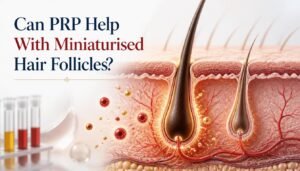
Hair follicle miniaturisation is a gradual process in which healthy, thick hair-producing follicles become progressively smaller. As the follicles shrink, they produce finer, shorter and less pigmented hair strands.
This condition is particularly common in people experiencing androgenetic alopecia, which is influenced by genetics and sensitivity to hormones such as dihydrotestosterone (DHT).
Normally, hair follicles go through three main growth stages:
- Anagen: The active growth phase during which hair grows longer and thicker.
- Catagen: A short transitional phase when hair growth slows.
- Telogen: The resting phase before the hair naturally sheds.
With follicular miniaturisation, the growth phase may become shorter, and the hair produced during each cycle may become progressively thinner.
Common Signs of Hair Follicle Miniaturisation
You may be experiencing follicular miniaturisation if you notice:
- Hair strands becoming thinner and weaker over time.
- A widening hair part, particularly in women.
- A gradually receding hairline or thinning temples.
- Reduced hair density around the crown.
- More visible scalp under bright lighting.
- Short, fine hairs replacing thicker strands.
Recognising these changes early is important because treatment options may be more helpful when functioning hair follicles are still present.
Can PRP Help With Miniaturised Hair Follicles?
Yes, PRP therapy may help improve hair density and support the activity of miniaturised hair follicles in selected patients.
PRP is prepared using a small sample of your own blood. The sample is processed in a centrifuge to concentrate platelets in a portion of plasma. This platelet-rich preparation contains growth factors and signalling molecules involved in tissue repair and cellular activity.
When injected into selected areas of the scalp, PRP may help create a more supportive environment for existing hair follicles.
For individuals experiencing early or moderate follicular miniaturisation, this may contribute to improvements in hair density and the appearance of thinning hair.
However, it is important to understand that PRP does not reverse every stage of follicular damage. It cannot reliably regenerate follicles that have been permanently lost.
What Does Research Say About PRP for Hair Follicle Miniaturisation?
Clinical research has shown promising results for PRP in androgenetic alopecia.
A 2024 systematic review published in the Journal of Cosmetic Dermatology examined nine studies involving 291 participants. Six studies reported a statistically significant improvement in hair density in the PRP groups compared with control groups.
Another 2024 systematic review and meta-analysis, published in the Anais Brasileiros de Dermatologia, included 13 randomised clinical trials in its meta-analysis. It reported an average improvement of approximately 27.55 hairs per square centimetre compared with control treatment.
However, the researchers rated the evidence as low certainty because of differences in study methods, treatment protocols and participant characteristics.
These findings suggest that PRP may be beneficial for selected individuals, but they do not guarantee the same results for every patient.
How Does PRP Work on Weak and Miniaturised Hair Follicles?
PRP contains concentrated platelets that release growth factors involved in tissue repair and cellular signalling.
Researchers are studying how these growth factors may influence the hair follicle environment and its growth cycle.
Potential effects include:
1. Supporting Existing Hair Follicles
PRP may support the activity of follicles that are still producing fine or weakened hair. This is particularly relevant during the earlier stages of follicular miniaturisation.
2. Improving Hair Density
Some clinical studies have reported increased hair density following PRP treatment. This may help make thinning areas appear fuller.
3. Supporting the Hair Growth Cycle
PRP may influence signalling pathways associated with the hair growth cycle, potentially supporting the active growth phase.
4. Improving the Appearance of Thinning Hair
Where viable follicles remain, treatment may contribute to improvements in hair thickness and overall scalp coverage. However, increased hair thickness is not guaranteed.
Is PRP Effective for Early or Advanced Hair Follicle Miniaturisation?
The stage of hair thinning plays an important role in determining whether PRP is worth considering.
| Stage | Condition of follicles | Potential role of PRP |
|---|---|---|
| Early miniaturisation | Most follicles remain active, but produce finer hair | May support hair density and follicle activity |
| Moderate miniaturisation | Many follicles produce thin, weak hair | May help selected patients, depending on follicle viability |
| Advanced hair loss | Significant loss of active hair-producing follicles | Results may be limited |
| Long-standing bald areas | Follicles may be permanently lost | PRP is unlikely to restore hair in these areas |
This is why an early dermatological assessment can be valuable. The sooner the underlying cause of thinning is identified, the sooner appropriate treatment options can be discussed.
How Many PRP Sessions Are Needed for Miniaturised Hair Follicles?
The number of PRP sessions varies according to the extent of hair thinning, the individual’s response and the treatment protocol.
A dermatologist may recommend an initial course of multiple sessions, often spaced several weeks apart, followed by an assessment of progress.
The treatment plan may involve:
- An initial scalp and hair examination.
- Evaluation of hair density and follicular condition.
- Preparation and administration of PRP.
- Follow-up assessments using scalp photographs or other measurements.
- Maintenance sessions if clinically appropriate.
PRP does not produce instant hair growth. Hair follicles follow natural growth cycles, so improvements generally need to be evaluated over several months.
Can PRP Be Combined With Other Hair Loss Treatments?
In some cases, PRP may be combined with other evidence-based hair loss treatments.
For example, minoxidil is an established treatment option for androgenetic alopecia. A dermatologist may recommend it alongside PRP when suitable.
Other treatment options depend on the underlying diagnosis, medical history, age and pattern of hair loss.
It is important not to start, stop or combine hair loss medications without professional medical advice.
Who Is a Suitable Candidate for PRP Hair Treatment?
PRP may be considered for people experiencing:
- Early-stage androgenetic alopecia.
- Gradual hair thinning.
- Reduced hair density around the crown.
- A widening hair part.
- Miniaturised hair strands with remaining active follicles.
However, PRP is not suitable for every type of hair loss.
Sudden hair shedding, patchy baldness, scalp inflammation and hair loss associated with nutritional deficiencies or thyroid problems may require different investigations and treatments.
A dermatologist can assess the scalp, identify the likely cause and determine whether PRP is an appropriate option.
Is PRP Safe for Miniaturised Hair Follicles?
PRP uses a preparation made from the patient’s own blood and is generally considered well tolerated when performed by a qualified medical professional under appropriate clinical conditions.
Some temporary side effects may include:
- Mild scalp tenderness.
- Redness or swelling around injection sites.
- Minor bruising or pinpoint bleeding.
- Temporary headache or scalp discomfort.
People with platelet disorders, certain blood conditions, active scalp infections or other medical concerns may require additional evaluation before treatment.
Always inform your dermatologist about your medical history and medications before undergoing PRP.
PRP Hair Treatment at Dermedico Clinic, Defence Colony, South Delhi
If you are noticing progressively thinner hair, reduced scalp coverage or a widening hair part, it is worth understanding whether follicular miniaturisation is contributing to your hair loss.
At Dermedico Clinic, Defence Colony, New Delhi, patients can consult Dr. Pallavi Chandna Rohatgi, an MD-qualified dermatologist, to discuss their skin and hair concerns.
A personalised assessment can help determine the underlying cause of hair thinning and whether PRP hair treatment or another evidence-based option may be appropriate.
Rather than choosing treatment based only on the amount of hair fall, understanding the condition of your existing follicles is an important step towards making an informed decision.
Explore Dermedico Clinic’s hair PRP treatment information or visit the official Dermedico Clinic website to learn more.
Frequently Asked Questions
1. Can PRP reverse hair follicle miniaturisation?
PRP may help improve hair density and support existing miniaturised follicles in some patients. However, it cannot reliably reverse advanced follicular damage or restore permanently lost follicles.
2. Can miniaturised hair follicles become thick again?
Some miniaturised follicles may respond to appropriate treatment and produce thicker hair. The outcome depends on the extent of miniaturisation, the underlying cause and individual response.
3. Is PRP good for thinning hair?
PRP may be beneficial for selected people with androgenetic alopecia and thinning hair. A dermatologist should first identify the cause of hair loss and assess whether viable follicles remain.
4. How do I know if my hair follicles are miniaturised?
Common signs include increasingly fine hair strands, reduced hair density, a widening parting and a receding hairline. A dermatologist may use scalp examination and trichoscopy to assess follicular changes.
5. Can PRP regrow hair in completely bald areas?
PRP is unlikely to restore hair in areas where hair follicles have been permanently lost. Its potential benefits are more relevant when functioning follicles are still present.
6. How long does PRP take to show results for hair thinning?
PRP does not produce immediate results. Changes may become noticeable over the following months, although the timing and degree of improvement vary between individuals.
7. Is PRP better than minoxidil for miniaturised hair follicles?
Neither treatment is automatically better for everyone. Minoxidil is an established treatment for pattern hair loss, while PRP may be considered as an additional treatment option. A dermatologist can recommend an appropriate approach.
8. Can women with miniaturised hair follicles undergo PRP?
Yes, PRP may be considered for women with diagnosed androgenetic alopecia and other suitable hair-thinning conditions. The cause of hair loss should be established before treatment.
9. Does PRP permanently stop hair follicle miniaturisation?
No. PRP is not a permanent cure for genetic hair loss. Ongoing management and follow-up may be necessary to maintain improvements.
10. Is early treatment important for miniaturised hair follicles?
Early assessment is helpful because more functioning follicles may remain during the initial stages of miniaturisation. Identifying the cause early can help a dermatologist recommend suitable treatment options.
Final Thoughts
Miniaturised hair follicles do not always mean that hair growth has permanently stopped. In some cases, the follicles remain active but produce increasingly fine and weak hair strands.
PRP therapy may help support these existing follicles and improve hair density in selected individuals, particularly those experiencing early or moderate androgenetic alopecia.
However, the treatment is not a guaranteed solution, and its effectiveness depends on several individual factors. A proper scalp assessment and professional diagnosis are essential before deciding whether PRP is suitable.
If you are experiencing gradual hair thinning, consult a qualified dermatologist to understand your options and develop an appropriate hair restoration plan.
Medical Disclaimer: This article is intended for educational purposes only. It does not replace professional medical advice, diagnosis or treatment. Individual results may vary.