Table of Contents
Hair PRP for Hair Loss
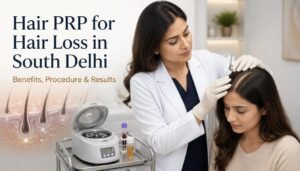
Hair thinning and excessive hair fall can be frustrating, particularly when you begin noticing a wider hair part, a receding hairline, reduced density around the crown, or more hair than usual on your pillow and comb. If conventional hair-care measures are not addressing the problem, you may have come across Hair PRP for Hair Loss in South Delhi.
Platelet-Rich Plasma, commonly called PRP, is a minimally invasive treatment that uses a concentrated portion of your own blood and injects it into selected areas of the scalp. PRP has been studied particularly for androgenetic alopecia, also known as male-pattern or female-pattern hair loss. Clinical research suggests that PRP can improve hair density in appropriately selected patients, although results differ between individuals and treatment protocols.
If you are considering Hair PRP treatment in South Delhi, it is important to understand what PRP can realistically do, how the procedure works, how many sessions may be needed, when results can appear, and whether it is appropriate for your type of hair loss.
What Is Hair PRP for Hair Loss?
Hair PRP is a treatment in which a small sample of the patient’s own blood is collected and processed to separate the platelet-rich plasma.
The prepared PRP contains platelets and biological components involved in tissue repair and cellular signaling. The PRP is then injected into selected areas of the scalp where hair is thinning.
The goal is to create a supportive environment around existing hair follicles and potentially improve hair density and the appearance of thinning hair.
Importantly, PRP should not be considered a guaranteed cure for every form of hair loss. Hair loss can have many causes, so identifying the underlying condition is an important first step.
At Dermedico Clinic’s PRP Therapy page, Hair PRP is described as a treatment option for concerns including androgenetic alopecia, diffuse hair thinning and early pattern baldness in men and women.
How Does PRP Help With Hair Loss?
The exact mechanisms through which PRP may influence hair growth are still being studied. However, platelets contain growth factors and other signaling molecules that may influence the environment surrounding hair follicles.
Potential effects studied in hair-loss treatment include:
- Supporting the activity of weakened hair follicles
- Improving hair density in suitable patients
- Supporting the growth phase of the hair cycle
- Helping reduce progressive thinning in some patients
- Improving the appearance of hair thickness and fullness
- Providing an autologous treatment option using the patient’s own blood
However, research also shows considerable variation in PRP preparation, injection techniques, treatment schedules and study quality. Therefore, individual results should never be guaranteed.
Who May Be a Good Candidate for Hair PRP?
PRP may be considered for people experiencing certain types of hair thinning, particularly when hair follicles are still present and potentially responsive to treatment.
A dermatologist may consider Hair PRP for patients with:
- Early or moderate androgenetic alopecia
- Male-pattern hair loss
- Female-pattern hair thinning
- Diffuse hair thinning
- Reduced scalp hair density
- Early-stage pattern baldness
- Progressive thinning where viable follicles remain
However, increased hair shedding does not automatically mean that PRP is the right treatment.
Hair loss can also occur because of nutritional deficiencies, hormonal changes, thyroid disorders, stress, illness, medications, scalp disorders and other medical conditions.
This is why a dermatologist should evaluate the cause of hair loss before deciding on treatment.
If you are experiencing sudden or unexplained hair shedding, getting the underlying cause assessed is particularly important.
Hair Shedding vs Hair Loss: Why the Difference Matters
Not every episode of increased hair fall represents permanent hair loss.
Temporary shedding can occur after certain physical or emotional stressors, illness, nutritional changes and other triggers. Pattern hair loss, on the other hand, typically involves progressive thinning and miniaturisation of hair follicles.
This distinction is important because the treatment approach depends on the diagnosis.
Before searching for the best Hair PRP treatment in South Delhi, consider whether you have actually been evaluated for the cause of your hair loss.
You can also read our detailed guide on Hair Shedding vs Hair Loss to understand when increased shedding may require professional evaluation.
Benefits of Hair PRP for Hair Loss
1. Uses Your Own Blood
PRP is an autologous treatment, meaning the material used for the procedure comes from the patient’s own blood.
2. Minimally Invasive
Unlike surgical hair restoration procedures, PRP involves injections into selected areas of the scalp rather than a hair-transplant operation.
3. May Improve Hair Density
Clinical studies suggest that PRP can improve hair density in some patients with androgenetic alopecia. A 2025 systematic review and meta-analysis involving 43 randomized controlled trials also reported evidence of benefit for hair density, although differences between PRP protocols remain an important consideration.
4. Can Be Considered for Men and Women
PRP has been studied in both male and female pattern hair loss. However, suitability depends on the diagnosis, stage of hair loss and individual circumstances.
5. May Be Combined With Other Treatments
Depending on the underlying condition, a dermatologist may recommend PRP alongside other evidence-based hair-loss treatments.
Combination treatment should be medically guided rather than chosen simply because multiple treatments are being promoted together.
What Happens During Hair PRP Treatment?
A typical Hair PRP procedure in South Delhi involves several steps.
Step 1: Consultation and Hair Assessment
The process should begin with an assessment of your hair loss and scalp.
Your dermatologist may consider:
- Pattern of hair loss
- Duration of hair thinning
- Family history
- Scalp condition
- Previous treatments
- Overall health and relevant medical factors
The purpose is to determine whether PRP is appropriate for your condition.
Step 2: Blood Collection
A small amount of blood is collected, generally from the arm.
Step 3: PRP Preparation
The blood sample is processed using centrifugation to separate the platelet-rich portion from other blood components.
The exact preparation technique can vary between clinics and treatment protocols.
Step 4: Scalp Preparation
The scalp is cleaned and prepared for treatment. Depending on the treatment protocol and individual comfort, a numbing approach may be used.
Step 5: PRP Injection
The prepared PRP is injected into selected areas of the scalp where thinning or reduced density is present.
The treatment areas and injection approach can be adapted according to the patient’s hair-loss pattern.
Step 6: Post-Treatment Care
Your dermatologist will provide aftercare instructions. Temporary tenderness, redness or sensitivity can occur following scalp injections.
The American Academy of Dermatology describes PRP as involving blood collection, separation of plasma and injection into the scalp, with repeat sessions commonly used as part of treatment.
How Many PRP Sessions Are Needed for Hair Loss?
There is no single PRP schedule that is appropriate for every patient.
Many clinical protocols use an initial series of treatments spaced several weeks apart, followed by maintenance treatment when appropriate.
At Dermedico Clinic, the published PRP information states that 3–4 monthly sessions may be recommended initially, with maintenance depending on the individual’s response.
Your dermatologist should determine the number and frequency of sessions based on your diagnosis and response rather than following a fixed package automatically.
When Can You See Hair PRP Results?
One of the most important things to understand about PRP is that it does not produce overnight hair growth.
Hair follicles operate through natural growth cycles, so visible improvement takes time.
A general timeline may look like this:
First few weeks:
The scalp may settle after treatment, but visible hair growth may not yet be noticeable.
Around 2–3 months:
Some patients may begin noticing changes such as reduced shedding or early improvement in hair density.
Around 3–6 months:
Responsive patients may notice more visible changes in thickness and density.
After 6 months:
A dermatologist can assess the overall response and determine whether further or maintenance treatment is appropriate.
The American Academy of Dermatology also notes that PRP-related improvement can take several months to become noticeable.
The exact outcome depends on factors such as the underlying cause of hair loss, stage of thinning, age, individual biology, treatment protocol and adherence to the recommended plan.
Can Hair PRP Regrow Completely Bald Areas?
PRP is primarily intended to support existing or weakened follicles.
It should not be promoted as a guaranteed way to recreate hair follicles that have been permanently destroyed.
Patients with advanced baldness may therefore require a different treatment approach. Depending on the diagnosis, a dermatologist may discuss medical treatment, hair transplantation or other appropriate options.
This is one reason early evaluation can be valuable.
Is Hair PRP Painful?
PRP involves multiple scalp injections, so some patients may experience temporary discomfort during treatment.
The level of discomfort can vary depending on individual sensitivity and the treatment technique. A numbing approach may be used when appropriate to improve comfort.
After treatment, some people may experience temporary:
- Tenderness
- Redness
- Mild swelling
- Scalp sensitivity
These effects generally settle, but your dermatologist should explain the expected recovery and when to contact the clinic if you experience an unusual reaction.
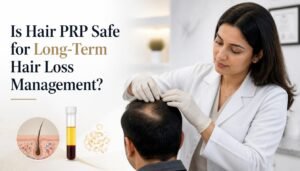
Is Hair PRP Safe?
Available clinical research generally describes PRP as having a favourable safety profile, with most reported effects being temporary and related to the injection procedure.
However, “safe” does not mean that PRP is suitable for everyone.
The correct approach is to first determine the cause of hair loss and then decide whether PRP is medically appropriate.
You can learn more in our guide: Is Hair PRP Safe for Long-Term Hair Loss Management?
Hair PRP in South Delhi: Why Location Matters
If you are looking for Hair PRP in South Delhi, accessibility can be useful because PRP generally involves multiple sessions and follow-up.
Dermedico Clinic is located in Defence Colony, making it accessible for patients from areas such as Lajpat Nagar, South Extension, Greater Kailash, Hauz Khas, Saket and other parts of South Delhi.
The clinic’s published address is D-95, Defence Colony, New Delhi.
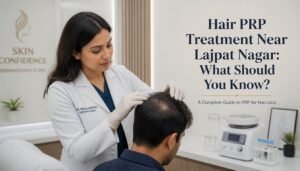
For people specifically searching for Hair PRP near Lajpat Nagar, you can also read our detailed guide on Hair PRP Near Lajpat Nagar.
What Does Hair PRP Cost in South Delhi?
Hair PRP pricing can vary according to several factors, including:
- Number of sessions
- Treatment area
- PRP preparation method
- Clinic and dermatologist
- Individual hair-loss condition
- Whether PRP is recommended alone or with another treatment
According to Dermedico Clinic’s currently published information, Hair PRP starts from ₹6,000 per session. The final cost should be confirmed after individual assessment because treatment requirements can vary.
If cost is one of your concerns, read our guide to Hair PRP Cost in South Delhi.
Why Choose a Dermatologist for Hair PRP?
Hair loss is not simply a cosmetic concern. Different types of hair loss can require completely different treatment approaches.
A dermatologist can help determine:
- What type of hair loss you have
- Whether your follicles are still active
- Whether PRP is appropriate
- Whether another treatment may be more suitable
- What results are realistically achievable
- Whether additional investigation is required
At Dermedico Clinic, PRP treatment is performed by Dr. Pallavi Chandna Rohatgi, MD Dermatologist, according to the clinic’s published information.
The focus should be on diagnosis, personalised treatment planning and appropriate follow-up rather than choosing a treatment solely because it is popular.
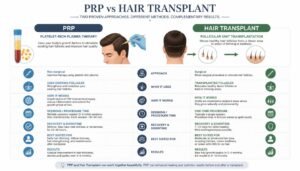
Hair PRP vs Hair Transplant: Are They the Same?
No.
Hair PRP and hair transplantation are fundamentally different treatments.
PRP involves injecting prepared platelet-rich plasma into the scalp with the goal of supporting existing follicles.
Hair transplantation is a surgical hair-restoration procedure in which hair follicles are moved from one area of the scalp to another.
For patients with advanced or extensive hair loss, a dermatologist or hair-restoration specialist may discuss whether transplantation or another approach is more appropriate.
The choice depends on the diagnosis, degree of hair loss, donor hair availability, expectations and individual circumstances.
Frequently Asked Questions About Hair PRP in South Delhi
Is Hair PRP effective for hair loss?
PRP may improve hair density in selected patients, particularly those with androgenetic alopecia. Research supports potential benefits, but results vary and PRP is not a guaranteed cure.
How long does Hair PRP take to show results?
Visible changes generally take several months rather than appearing immediately. Some patients may notice early changes around two to three months, while more noticeable improvements can take three to six months or longer.
How many PRP sessions are required for hair loss?
The number varies according to the patient’s condition and response. Initial treatment commonly involves multiple sessions spaced several weeks apart.
Is PRP suitable for women with hair loss?
PRP may be considered for selected women with female-pattern hair thinning and other suitable conditions. However, the cause of hair loss should be evaluated before treatment.
Can PRP stop hair fall permanently?
PRP should not be described as a permanent cure for hair loss. Pattern hair loss can be a chronic condition, and maintenance or other treatments may be required.
Can PRP regrow hair on a completely bald scalp?
PRP is intended mainly to support existing or weakened follicles. It cannot reliably recreate follicles that have been permanently lost.
Is Hair PRP better than minoxidil?
PRP and minoxidil are different treatments. Research comparing them is still evolving, and the most appropriate option depends on the diagnosis and individual circumstances. A dermatologist can help determine the suitable treatment plan.
Can PRP be combined with minoxidil?
It may be considered for some patients. Combination treatment should be recommended by a dermatologist after assessing the underlying cause of hair loss.
Is Hair PRP painful?
Some discomfort can occur because PRP involves scalp injections. A numbing approach may be used depending on the treatment protocol and patient’s needs.
Where can I get Hair PRP in South Delhi?
Dermedico Clinic offers Hair PRP at its Defence Colony location in South Delhi. The clinic’s published address is D-95, Defence Colony, New Delhi.
Final Thoughts
If you are experiencing thinning hair, a receding hairline, reduced crown density or persistent hair fall, Hair PRP for Hair Loss in South Delhi may be worth discussing with a qualified dermatologist.
PRP has shown potential for improving hair density in selected patients, particularly those with androgenetic alopecia. However, it is not a universal treatment and should not be promoted as a guaranteed solution.
The most important step is identifying the cause of your hair loss before starting treatment.
At Dermedico Clinic in Defence Colony, South Delhi, Hair PRP is offered as part of a dermatologist-guided approach to hair and scalp concerns. If you are considering treatment, a consultation can help determine whether PRP is appropriate for your condition and what type of results may realistically be expected.