Table of Contents
PRP vs Hair Transplant
Hair loss can begin with a few extra strands on your pillow or shower floor, but over time it may become noticeable thinning, a receding hairline, a widening part or visible bald areas.
When searching for a solution, two treatments frequently come up: PRP and hair transplant.
But is PRP better than a hair transplant? Is a hair transplant more effective than PRP? And can PRP regrow hair without surgery?
The answer depends largely on why you are losing hair, how advanced the hair loss is, the condition of your existing follicles and your treatment goals.
PRP and hair transplantation are not interchangeable treatments. PRP is an injectable treatment that uses platelet-rich plasma prepared from your own blood, while hair transplantation is a surgical procedure that moves hair follicles from a donor area to areas affected by hair loss.
This guide explains PRP vs hair transplant, including how each treatment works, who may benefit, expected results, recovery, limitations and the factors a dermatologist or hair-restoration specialist considers before recommending either option.
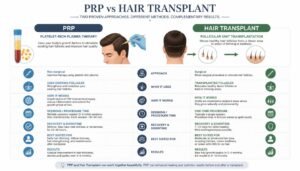
PRP vs Hair Transplant: Quick Comparison
| Feature | Hair PRP | Hair Transplant |
|---|---|---|
| Type of treatment | Injectable/non-surgical | Surgical |
| Uses your own blood? | Yes | No |
| Moves hair follicles? | No | Yes |
| Main purpose | Support existing/thinning hair | Restore areas with established hair loss |
| Donor hair required? | No | Yes |
| Recovery | Usually minimal | Requires post-procedure recovery |
| Number of sessions | Usually multiple | Usually planned as a surgical procedure |
| Permanent restoration | Not considered permanent | Transplanted follicles can provide permanent growth in suitable patients |
| Best suited to | Selected thinning/pattern hair loss | Suitable candidates with sufficient donor hair |
| Can treatments be combined? | Sometimes | Sometimes |
The important point is that PRP and hair transplantation solve different problems.
PRP aims to support existing hair follicles, whereas a transplant physically relocates follicles into areas where restoration is needed.
What Is PRP for Hair Loss?
PRP stands for platelet-rich plasma.
During a Hair PRP treatment, a small amount of your blood is collected and processed to separate a platelet-rich component. This prepared plasma is then injected into selected areas of the scalp.
PRP has been studied particularly for androgenetic alopecia, commonly known as male or female pattern hair loss.
Research suggests PRP may improve hair-density measures in appropriately selected patients. A systematic review published in 2024 included eight randomized controlled trials and one prospective cohort study involving 291 participants. Several studies reported increased hair density or hair count, although the researchers also noted limitations including moderate risk of bias and considerable variation between studies.
Another meta-analysis of randomized trials found that PRP increased hair density at three and six months compared with placebo, although the evidence and treatment protocols are not completely uniform.
This means PRP can be a useful option for selected types of hair thinning, but it should not be presented as a guaranteed cure for every form of hair loss.
Who May Be Considered for Hair PRP?
A dermatologist may consider PRP when a patient has:
- Early or moderate pattern hair thinning
- Androgenetic alopecia
- Diffuse hair thinning
- Reduced hair density
- Progressive thinning where follicles are still producing hair
- A preference for a non-surgical treatment
At Dermedico Clinic, Hair PRP is offered as part of a dermatologist-guided approach to selected hair-loss concerns. The clinic’s published information includes androgenetic alopecia, diffuse hair thinning and early pattern baldness among the concerns for which Hair PRP may be considered.
You can learn more through the clinic’s existing Hair PRP treatment content and related hair-loss resources.
What Is a Hair Transplant?
A hair transplant is a surgical hair-restoration procedure.
Instead of trying to stimulate existing follicles, the procedure involves moving healthy hair follicles from a donor area of the scalp to areas affected by hair loss.
Modern hair transplantation commonly uses follicular-unit techniques. The American Academy of Dermatology notes that modern transplantation can produce permanent, natural-looking results because individual follicular units can be transplanted into thinning areas rather than using the large “plug” techniques associated with older procedures.
A transplant therefore differs fundamentally from PRP.
Hair Transplant May Be Considered When:
- There is established hair loss
- The hairline has receded
- There are bald or significantly thinning areas
- Sufficient donor hair is available
- The pattern of hair loss is appropriate for transplantation
- The patient’s expectations are realistic
- The underlying hair-loss condition has been assessed
A hair transplant does not necessarily stop the progression of native hair loss elsewhere on the scalp. A long-term hair-loss management plan may therefore still be important.
PRP vs Hair Transplant: What Is the Main Difference?
The simplest way to understand the difference is:
PRP supports existing hair follicles.
A hair transplant relocates hair follicles.
PRP does not create a new donor supply of follicles. If an area has significant established baldness and there are no functioning follicles capable of responding sufficiently, PRP may not provide the same type of coverage that transplantation is designed to achieve.
On the other hand, someone with early thinning may not necessarily need surgery.
This is why asking only “Which treatment is better?” may not be the most useful question.
A better question is:
“Which treatment is appropriate for my type and stage of hair loss?”
PRP vs Hair Transplant for Different Stages of Hair Loss

Early Hair Thinning
If you have recently noticed:
- Increased hair shedding
- Slightly reduced density
- Early crown thinning
- A widening part
- Mild recession
a dermatologist may first investigate the cause of the hair loss.
Depending on the diagnosis, PRP may be considered as one component of treatment.
Early intervention can also help determine whether the problem is temporary shedding, pattern hair loss or another scalp/hair condition.
Moderate Hair Thinning
Moderate thinning can be more complicated.
Some follicles may still be producing thinner, miniaturized hairs. In such cases, treatments aimed at supporting existing follicles may have a role.
A dermatologist may recommend PRP for selected patients, but the diagnosis should guide the treatment plan—not simply the amount of hair being shed.
Dermedico Clinic’s existing guidance similarly emphasises identifying the underlying cause before selecting PRP.
Advanced Hair Loss or Bald Areas
When hair loss creates clearly bald areas, a hair transplant can help suitable candidates restore hair in those areas.
The reason is straightforward: a transplant can introduce hair follicles into an area that needs restoration.
However, candidacy depends on factors such as:
- Donor-hair availability
- Donor-hair quality
- Pattern and extent of hair loss
- Scalp condition
- Age and progression of hair loss
- Overall health
- Expectations
A consultation is therefore essential before deciding whether transplantation is appropriate.
Is PRP Better Than a Hair Transplant?
There isn’t one answer that applies to everyone.
PRP may be more relevant when the goal is to support existing, thinning hair without undergoing surgery.
Doctors may recommend hair transplantation when patients want to restore areas with established hair loss by relocating healthy follicles. Should not view these treatments simply as competitors.
For some patients, doctors may combine PRP and hair transplantation as part of a broader hair-restoration strategy.
The American Academy of Dermatology notes that doctors may use PRP alone or before a hair transplant in certain circumstances. The organization also describes hair transplantation as an option that can provide permanent results.
PRP vs Hair Transplant: Results
PRP Results
Clinical research has commonly evaluated outcomes at approximately three and six months. Some studies have reported improvements in hair density, but results vary because PRP preparation, injection techniques and treatment schedules differ between studies. Results develop gradually.
Patients should therefore avoid promises such as:
- “100% hair regrowth”
- “Permanent PRP results”
- “One session will stop hair loss”
- “Guaranteed new hair”
Hair biology is more complicated than these claims suggest.
Hair Transplant Results
The transplanted follicles need time to establish and progress through their normal growth cycle. The final appearance develops gradually rather than immediately after surgery. Transplantation requires patience.
The AAD states that modern hair transplantation can provide permanent, natural-looking results, but also notes that outcomes depend significantly on the surgeon selected.
The availability and quality of donor hair are also important because transplantation works by redistributing existing follicles rather than creating an unlimited supply of new follicles.
PRP vs Hair Transplant: Recovery
One of the major differences is recovery.
PRP
PRP is minimally invasive and usually involves:
- Blood collection
- Preparation of PRP
- Scalp injections
- A relatively short procedure
- Little or no significant downtime for many patients
The AAD describes PRP as a procedure that generally takes about 10 minutes and usually does not require downtime, although individual treatment protocols and aftercare can vary.
Hair Transplant
Hair transplantation is surgery, so recovery is more involved.
Depending on the technique and individual case, patients may experience:
- Temporary swelling
- Redness
- Tenderness
- Scabbing
- Temporary shedding
- A recovery period before normal activities
Your surgeon should provide detailed pre- and post-operative instructions.
PRP vs Hair Transplant: How Many Sessions Are Needed?
There is no universal treatment schedule for either approach.
PRP Sessions
PRP commonly involves a series of sessions rather than a single treatment.
The number and frequency can depend on:
- Type of hair loss
- Severity
- Treatment response
- Scalp health
- Previous treatment
- Individual goals
Research protocols also vary considerably, which is one reason it is difficult to prescribe one universal PRP schedule for everyone.
Hair Transplant Sessions
A hair transplant may sometimes achieve the planned restoration in one surgical session, but this depends on:
- Size of the treatment area
- Number of grafts required
- Donor supply
- Hair characteristics
- Surgical plan
- Future progression of hair loss
Some patients may eventually require additional procedures, particularly when hair loss continues over time.
Can PRP Prevent the Need for a Hair Transplant?
Doctors may recommend PRP earlier in the hair-loss journey, but they should not promote it as a guaranteed way to avoid transplantation.
If a patient has early pattern thinning and responds appropriately to medical treatment, maintaining existing hair may reduce the need for immediate surgical restoration.
However, established baldness is a different situation.
A dermatologist or hair-restoration specialist must assess whether the follicles in the affected area are still capable of producing hair and whether PRP is a reasonable treatment option.
Can PRP and Hair Transplant Be Used Together?
Yes, in selected situations.
PRP and hair transplantation are not necessarily mutually exclusive.
Doctors may sometimes incorporate PRP into a broader hair-restoration strategy. The AAD notes that some patients can use PRP before a hair transplant.
However, combination treatment should be based on the patient’s diagnosis and treatment plan rather than assuming that more procedures automatically mean better results.
PRP vs Hair Transplant Cost
Cost is another major factor patients consider.
However, comparing only the price of one PRP session with the price of a hair transplant can be misleading.
PRP may require multiple sessions and potentially maintenance treatment.
A hair transplant involves surgical planning, graft extraction, graft placement, medical supervision and post-operative care.
The total cost can depend on:
- Extent of hair loss
- Number of PRP sessions
- Number of grafts required
- Treatment technique
- Doctor’s expertise
- Clinic facilities
- Follow-up requirements
For this reason, patients should compare the complete treatment plan, rather than only the advertised starting price.
What If Your Hair Loss Is Actually Hair Shedding?
This is an important point that is often missed.
Not every person experiencing hair fall has permanent hair loss.
Temporary excessive shedding can occur after:
- Significant stress
- Illness
- Rapid weight loss
- Nutritional changes
- Hormonal changes
- Certain medications
- Other physiological triggers
Progressive hair loss can look different and may involve:
- Receding hairline
- Crown thinning
- Widening part
- Increasing scalp visibility
- Reduced overall density
- Gradually finer hairs
Dermedico’s recent guide explains the distinction between hair shedding and hair loss and emphasises diagnosis before choosing PRP.
If you are unsure what is causing your hair fall, start with a dermatology assessment rather than selecting a procedure based solely on an online search.
How a Dermatologist Can Help You Choose Between PRP and Hair Transplant
A professional evaluation can consider:
1. Cause of Hair Loss
The first step is identifying whether the problem is androgenetic alopecia, temporary shedding, an inflammatory scalp condition, nutritional issue or another form of hair loss.
2. Stage of Hair Loss
Early thinning and advanced baldness require different treatment considerations.
3. Existing Hair Density
If many follicles are still active, treatments aimed at supporting existing hair may be considered.
4. Donor Area
For transplantation, sufficient donor hair is essential.
5. Scalp Health
Conditions affecting the scalp may need treatment before or alongside hair restoration.
6. Previous Treatments
Your doctor may consider previous medications, PRP sessions or other treatments.
7. Your Goals
Some patients want to improve overall density. Others primarily want to restore a receding hairline or a specific bald area.
These goals can influence the treatment discussion.
Hair PRP in Defence Colony and South Delhi
If you are searching for Hair PRP in Defence Colony, Hair PRP near Lajpat Nagar, or Hair PRP in South Delhi, Dermedico Clinic provides dermatologist-guided PRP treatment at its Defence Colony location.
Dermedico Clinic is located at D-95, Defence Colony, New Delhi and is led by Dr. Pallavi Chandna Rohatgi, MD Dermatologist. The clinic’s published information describes personalised assessment for hair and scalp concerns.
Before beginning PRP, the clinic recommends assessing the type, pattern, and cause of hair loss to create a treatment plan tailored to each patient.
Frequently Asked Questions About PRP vs Hair Transplant
Is PRP better than a hair transplant?
Neither treatment is automatically better for every patient. PRP and hair transplantation work differently. Doctors generally recommend PRP for selected thinning or pattern hair-loss cases, while hair transplantation moves follicles into areas that need restoration.
Is PRP or hair transplant better for early hair loss?
For early thinning, a dermatologist may consider non-surgical treatments such as PRP depending on the diagnosis. A transplant may not be necessary for every person with early hair loss.
Is a hair transplant better for bald areas?
Doctors may recommend a transplant for suitable patients with established bald areas because the procedure physically relocates follicles into areas that need restoration. Candidacy depends on donor supply and other factors.
Can PRP regrow hair on a completely bald scalp?
Doctors should not describe PRP as a guaranteed method for growing new hair in completely bald areas. PRP may provide more potential benefit for selected patients with existing or miniaturized follicles.
Is PRP permanent?
Doctors should not describe PRP as a permanent cure for pattern hair loss. Depending on the patient’s condition and response, doctors may recommend maintenance treatment.
Is a hair transplant permanent?
A hair transplant can provide permanent, natural-looking results in suitable patients, according to the American Academy of Dermatology. However, existing non-transplanted hair can continue to thin, so long-term management may still be needed.
Can women undergo PRP?
Yes. PRP has been studied in hair loss affecting women as well as men. However, suitability depends on the cause and pattern of hair loss.
Can women have a hair transplant?
Yes, selected women may undergo hair transplantation. A specialist needs to assess the pattern of hair loss and donor supply before recommending surgery.
How quickly does PRP work?
PRP does not produce instant hair growth. Studies commonly evaluate changes over several months, including around three and six months. Individual response varies.
Can PRP and hair transplant be combined?
They can sometimes be used as part of the same overall treatment strategy. The decision should be made by the treating doctor based on the patient’s condition.
How many PRP sessions are needed?
There is no single schedule that applies to everyone. Treatment protocols vary between studies and clinics, so the number and spacing of sessions should be determined after assessment.
Should I get PRP before a hair transplant?
PRP may be used before a hair transplant in selected cases, but it is not automatically required for every patient.
Does PRP stop genetic hair loss?
PRP may help improve hair-density measures in some patients with androgenetic alopecia, but it should not be described as eliminating the underlying genetic tendency toward hair loss.
Is PRP painful?
PRP involves scalp injections, so some patients may experience temporary discomfort. The treating clinic can explain pain-control and numbing options where appropriate.
Which is less invasive: PRP or hair transplant?
PRP is less invasive because it involves injections rather than surgical relocation of hair follicles.
Can I return to work after PRP?
Many patients can resume normal activities quickly after PRP, although aftercare instructions can vary.
How long does a hair transplant take to recover?
Recovery varies according to the surgical technique and individual patient. Your hair-restoration surgeon should provide personalised instructions.
Can hair transplant and PRP be alternatives?
Sometimes, but not always. They address different aspects of hair loss and may even be used together in selected patients.
Final Verdict: PRP vs Hair Transplant
The decision between PRP and hair transplant should not be based simply on which treatment is more popular.
Think of the difference this way:
PRP:
Designed to support existing hair follicles and may be considered for selected forms of thinning and pattern hair loss.
Hair transplant:
Designed to restore areas of established hair loss by surgically relocating follicles from a donor area.
For someone with early or moderate thinning, PRP may be discussed as part of a non-surgical treatment plan.
For someone with established bald areas and adequate donor hair, a hair transplant may be considered.
And for some patients, a combination of treatments may be appropriate.
The first step is therefore not choosing between PRP and hair transplant.
The first step is finding out what is causing your hair loss.
If you are experiencing persistent hair fall, a receding hairline, crown thinning or visible scalp, consult a qualified dermatologist or hair-restoration specialist for an individual assessment.
Dermedico Clinic in Defence Colony, South Delhi, provides dermatologist-guided Hair PRP treatment for selected hair-loss concerns.
Medical Disclaimer
This article is intended for general educational purposes and should not replace a medical consultation. Hair loss can have multiple causes, and treatment suitability varies from person to person. A qualified dermatologist should evaluate your condition before you begin PRP, hair transplantation, medication or any other medical treatment.