Table of Contents
Botox and HIFU Address Different Signs of Facial Ageing
Facial ageing does not happen in just one way. Some people first notice forehead lines and crow’s feet, while others become more concerned about loose skin, early jowls, a softer jawline or reduced facial firmness.
Because these concerns have different underlying causes, Botox and HIFU can address different signs of facial ageing rather than functioning as interchangeable treatments.
Botox primarily works by temporarily reducing the activity of selected facial muscles responsible for dynamic wrinkles.
So, should you choose Botox or HIFU for facial ageing?
The answer depends on what you are trying to improve, your facial anatomy, the degree of skin laxity and your individual treatment goals.
At Dermedico Clinic in Defence Colony, South Delhi, a personalised assessment can help determine which approach may be appropriate for your concerns.
Understanding the Different Signs of Facial Ageing
Ageing can affect several structures of the face at the same time.
Common changes include:
- Forehead expression lines
- Frown lines between the eyebrows
- Crow’s feet around the eyes
- Fine lines and wrinkles
- Loss of skin firmness
- Mild facial sagging
- Early jowling
- Reduced jawline definition
- Neck skin laxity
- Changes in facial volume
- Changes in skin texture
Not every treatment addresses all of these concerns.
For example, Botox is primarily associated with wrinkles that become more visible because of repeated muscle movement. HIFU is generally considered when skin laxity and loss of firmness are important concerns.
This distinction is useful when deciding which facial rejuvenation treatment to discuss with a dermatologist.
What Is Botox and How Does It Address Facial Ageing?
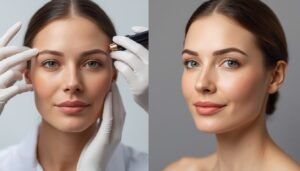
Botox is a brand commonly used to refer to botulinum toxin treatments. During treatment, very small amounts of botulinum toxin are injected into selected muscles.
The treatment temporarily reduces activity in those muscles. As a result, certain dynamic lines can become less noticeable.
The American Academy of Dermatology explains that botulinum toxin can temporarily relax targeted facial muscles, reducing the appearance of fine lines and wrinkles. Results commonly last around three to four months, although individual results can vary.
For more information about botulinum toxin, patients can also refer to the American Academy of Dermatology’s botulinum toxin information.
Botox May Be Considered for:
- Forehead lines
- Frown lines
- Crow’s feet
- Certain expression-related wrinkles
- Selected facial contouring concerns where muscle activity contributes to appearance
The important point is that Botox does not work by tightening loose skin. Its primary cosmetic action is related to targeted muscle activity.
Therefore, if your main concern is a forehead line that becomes more prominent when you raise your eyebrows, Botox may be something a dermatologist discusses with you.
What Is HIFU and How Does It Address Facial Ageing?
HIFU stands for High-Intensity Focused Ultrasound.
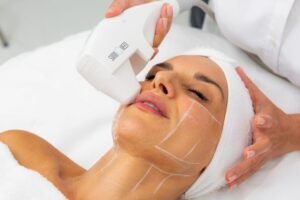
Unlike Botox, HIFU does not primarily work by relaxing facial muscles. Instead, focused ultrasound energy is delivered to selected tissue depths with the aim of producing controlled thermal effects and supporting tissue tightening and collagen remodelling.
Research on microfocused ultrasound has found improvements in facial skin tightening and rejuvenation, particularly in appropriately selected patients with mild-to-moderate skin laxity.
A systematic review published in 2023 found evidence of facial skin tightening following microfocused ultrasound treatment, while also noting differences in treatment protocols and the need for additional research.
Read the PubMed systematic review on microfocused ultrasound for facial skin tightening.
HIFU May Be Considered for:
- Mild facial skin laxity
- Early jowling
- Reduced jawline definition
- Mild neck laxity
- Loss of facial firmness
- Selected lifting and tightening concerns
HIFU is therefore fundamentally different from Botox.
A simple way to remember the distinction is:
Botox → targeted muscle activity and dynamic wrinkles
HIFU → selected skin-laxity and tightening concerns
Botox vs HIFU: What Is the Difference?
| Feature | Botox | HIFU |
|---|---|---|
| Main approach | Temporarily reduces targeted muscle activity | Uses focused ultrasound energy |
| Common concern | Dynamic wrinkles | Skin laxity and loss of firmness |
| Forehead expression lines | Commonly considered | Not the primary target |
| Frown lines | Commonly considered | Not the primary target |
| Crow’s feet | Commonly considered | Not the primary target |
| Mild sagging | Not its primary purpose | May be considered |
| Early jowling | Not its primary purpose | May be considered |
| Jawline definition | Selected muscle-related concerns | May help when laxity contributes |
| Treatment type | Injectable | Non-invasive energy-based |
| Results | Generally appear within days | Develop progressively |
| Duration | Commonly around 3–4 months | Varies by patient and treatment |
Neither treatment is designed to address every form of facial ageing.
Can Botox Address Forehead Lines?
Yes, Botox is commonly used for dynamic forehead lines.
These lines can become more noticeable when facial muscles repeatedly contract during expressions such as raising the eyebrows.
By temporarily reducing activity in selected muscles, botulinum toxin can soften the appearance of these lines.
However, treatment needs to be carefully planned because facial muscles also contribute to normal expressions and brow position.
The American Academy of Dermatology notes that dermatologists aim to weaken targeted muscles sufficiently to improve wrinkles while maintaining natural facial expressions.
Can HIFU Address Sagging Skin?
HIFU may be considered when mild-to-moderate skin laxity is a major concern.
A systematic review and meta-analysis involving 477 participants reported improvements in facial rejuvenation and tightening after microfocused ultrasound treatment, although the authors also called for larger and better-standardised studies.
View the PubMed meta-analysis on microfocused ultrasound for facial rejuvenation and tightening.
HIFU is not equivalent to a surgical facelift, and results vary according to the individual, treatment area, device, treatment settings and degree of laxity.
This makes patient selection particularly important.
Botox vs HIFU for Crow’s Feet
Crow’s feet are fine lines that develop around the outer corners of the eyes and often become more prominent when smiling or squinting.
Because muscle movement can contribute significantly to these wrinkles, Botox may be considered when dynamic movement is the primary factor.
HIFU works differently. It is primarily associated with tissue tightening rather than temporarily relaxing the muscles responsible for facial expressions.
Therefore, a dermatologist may recommend a different approach depending on whether the concern is mainly muscle movement, skin laxity or a combination of factors.
Botox vs HIFU for Jawline Definition
A less-defined jawline can have several causes.
These may include:
- Skin laxity
- Early jowling
- Changes in facial volume
- Fat distribution
- Muscle bulk
- Natural facial anatomy
HIFU may be considered when mild skin laxity contributes to a softer jawline.
Botulinum toxin may be used for selected lower-face concerns when specific muscle activity or muscle bulk contributes to the appearance.
This is why an individual assessment is more useful than choosing a procedure solely because it is currently popular.
Can Botox and HIFU Be Used Together?
In selected cases, a dermatologist may consider using different treatments to address different aspects of facial ageing.
For example:
HIFU may be considered for selected skin-tightening concerns.
Botox may be considered for dynamic expression lines.
Other treatments may be considered if the primary concern involves volume loss, pigmentation, skin texture or other conditions.
This approach recognises that facial ageing can involve multiple tissues and mechanisms.
However, combining treatments should not be viewed as automatically better. A qualified medical professional should determine whether combination treatment is appropriate for an individual patient.
Which Treatment Shows Results Faster?
Botox and HIFU have different mechanisms, so their timelines are also different.
According to the American Academy of Dermatology, many people begin seeing botulinum toxin results within approximately 3–7 days, with effects commonly lasting around three to four months.
HIFU results generally develop more gradually as the treated tissue undergoes a remodelling process.
This means someone looking for improvement in dynamic wrinkles may have a different treatment timeline from someone undergoing a skin-tightening procedure.
How Long Do Botox and HIFU Results Last?
The duration of cosmetic results varies between individuals.
For Botox, the American Academy of Dermatology reports that results commonly last about three to four months, although they can sometimes last longer.
HIFU longevity is more variable and depends on factors such as:
- Degree of skin laxity
- Age
- Skin quality
- Treatment area
- Device and treatment settings
- Individual response
- Natural ageing
Therefore, clinics should avoid promising exactly the same duration or outcome to every patient.
Is HIFU Suitable for Everyone?
No cosmetic treatment is automatically appropriate for everyone.
HIFU may be more relevant to selected patients with mild-to-moderate skin laxity. Research has also identified differences in outcomes depending on patient characteristics and treatment protocols.
A dermatologist should evaluate:
- Your degree of skin laxity
- Facial anatomy
- Skin quality
- Treatment area
- Previous cosmetic treatments
- Your expectations
HIFU should also not be presented as a guaranteed alternative to a surgical facelift when significant skin laxity is present.
Is Botox Suitable for Everyone?
Botox is a medical treatment and should be administered by an appropriately qualified professional.
Before treatment, the clinician should consider your facial anatomy, muscle activity, medical history, treatment area and desired outcome.
Temporary redness, swelling or bruising can occur following injections. More serious complications are uncommon but possible, which is another reason why appropriate medical assessment and technique matter.
Botox or HIFU: Which One Should You Consider?
Rather than asking which treatment is universally better, consider which sign of facial ageing you want to address.
Botox may be discussed when your primary concern is:
- Forehead expression lines
- Frown lines
- Crow’s feet
- Other selected dynamic wrinkles
- Certain muscle-related facial concerns
HIFU may be discussed when your primary concern is:
- Mild skin laxity
- Early jowling
- Reduced facial firmness
- Less-defined jawline caused partly by laxity
- Selected neck-laxity concerns
Another treatment may be discussed when your main concern is:
- Significant volume loss
- Pronounced sagging
- Pigmentation
- Uneven skin texture
- Acne scars
- Other skin conditions
The correct treatment therefore depends on the underlying cause rather than simply the number of wrinkles visible in the mirror.
Botox and HIFU in South Delhi
If you are searching for Botox in South Delhi, HIFU in South Delhi, or treatments near Defence Colony and Lajpat Nagar, Dermedico Clinic provides cosmetic dermatology services for a range of skin and facial concerns.
The clinic’s treatment options include Botox and HIFU, along with other dermatological and aesthetic procedures.
You can explore the clinic’s dedicated treatment information before scheduling a consultation.
Frequently Asked Questions
1. Can Botox and HIFU address different signs of facial ageing?
Yes. Botox primarily targets muscle activity associated with dynamic wrinkles, while HIFU is generally used for selected skin-tightening and laxity concerns.
2. Is Botox better for forehead wrinkles?
Botox is commonly used for dynamic forehead lines because these wrinkles can be strongly influenced by repeated facial muscle movement.
3. Is HIFU good for sagging skin?
HIFU may be considered for selected patients with mild-to-moderate skin laxity and loss of firmness.
4. Can HIFU replace Botox?
No. HIFU and Botox work through different mechanisms and address different concerns.
5. Can I have Botox and HIFU together?
Some patients may be suitable for a combination approach, but treatment should be planned by a qualified medical professional.
6. Does Botox tighten loose skin?
Botox is not primarily a skin-tightening treatment. It works mainly by temporarily reducing targeted muscle activity.
7. Can HIFU treat forehead lines?
HIFU does not primarily target the muscle activity that creates dynamic forehead lines. If muscle movement is the main cause, Botox may be considered.
8. Which treatment gives faster visible results?
Botox generally produces visible changes sooner, while HIFU results develop progressively.
9. How long does Botox last?
Botulinum toxin effects commonly last around three to four months, although individual results vary.
10. How long do HIFU results last?
The duration varies depending on the patient, treatment area, device, treatment parameters and natural ageing process.
11. Is HIFU painful?
Some patients experience warmth, tingling or discomfort during HIFU. Published research has reported moderate discomfort in some studies.
12. Is Botox painful?
Botox involves small injections and may cause brief discomfort. Temporary redness, swelling or bruising can occur.
13. Is HIFU a surgical facelift?
No. HIFU is a non-surgical energy-based treatment. It should not be presented as equivalent to surgical facelift procedures.
14. Does facial ageing only mean wrinkles?
No. Facial ageing can involve wrinkles, skin laxity, changes in facial volume, jowling, changes in jawline definition and alterations in skin quality.
15. Should I choose Botox based on my age?
Age alone should not determine treatment. Your specific concerns, facial anatomy, muscle movement, skin condition and treatment goals are more relevant.
Final Thoughts
Botox and HIFU can address different signs of facial ageing because they work in different ways.
Botox is primarily associated with dynamic wrinkles caused or influenced by facial muscle activity, including forehead lines, frown lines and crow’s feet.
HIFU is primarily associated with non-invasive skin tightening and may be considered for selected cases of mild-to-moderate laxity, early jowling and loss of firmness.
If you have several signs of facial ageing, you may not need to choose a treatment based on a simple Botox-versus-HIFU comparison. A dermatologist can evaluate the underlying causes of your concerns and develop an appropriate treatment plan.
If you are considering Botox or HIFU treatment in Defence Colony, Lajpat Nagar or South Delhi, consult a qualified dermatologist for an individual assessment before deciding on a procedure.