Table of Contents
HIFU Treatment a Good Alternative?
If you are noticing sagging skin, early jowls, a less defined jawline or loose skin around your neck, you may be wondering: Is HIFU treatment a good alternative to a surgical facelift?
HIFU, or High-Intensity Focused Ultrasound, has become a popular non-surgical treatment for facial skin tightening and lifting. Unlike a traditional facelift, HIFU does not involve incisions, stitches or a lengthy surgical recovery period. Instead, focused ultrasound energy is delivered to selected tissue depths to support tightening and collagen remodelling.
However, HIFU and a surgical facelift are not identical treatments. A facelift physically repositions tissues and removes excess skin, while HIFU is designed to provide gradual tightening and lifting.
So, can HIFU really replace a facelift? The answer depends on your degree of skin laxity, facial anatomy, expectations and treatment goals.
At Dermedico Clinic, HIFU is offered as a non-surgical facial lifting and skin-tightening treatment in Defence Colony, South Delhi.
What Is HIFU Treatment?
HIFU stands for High-Intensity Focused Ultrasound. It is a non-invasive aesthetic treatment that uses focused ultrasound energy to target specific depths beneath the skin.
The controlled energy creates thermal effects in the targeted tissue, which can stimulate a wound-healing response and collagen remodelling.
Collagen is an important structural protein responsible for skin firmness and elasticity. As we age, collagen production and organisation change, contributing to wrinkles, loss of firmness and skin laxity.
HIFU is therefore primarily considered for people looking for:
- Mild to moderate facial skin laxity
- Early jowling
- Reduced jawline definition
- Loose neck skin
- Loss of facial firmness
- Certain brow-area laxity
- A subtle lifting effect without surgery
Clinical research supports the use of microfocused ultrasound for facial tightening, although the degree of improvement varies between patients and treatment protocols. A systematic review found that microfocused ultrasound can improve mild-to-moderate facial skin laxity, while also noting that results tend to be more limited when skin laxity is excessive.
How Does HIFU Work?
One of the main differences between HIFU and traditional facial treatments is where the energy is delivered.
HIFU uses focused ultrasound energy at selected tissue depths rather than simply treating the surface of the skin.
The treatment is designed to:
- Deliver focused ultrasound energy to targeted tissue layers.
- Create controlled thermal effects.
- Stimulate the body’s healing response.
- Encourage collagen remodelling.
- Gradually improve firmness and the appearance of skin laxity.
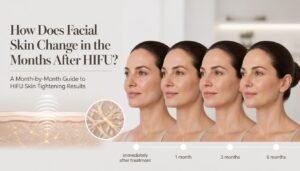
Because collagen remodelling takes time, HIFU results are not usually immediate.
Some patients may notice an initial improvement, but the lifting and tightening effect generally develops progressively.
According to Dermedico Clinic’s current information, collagen remodelling can continue for several months after treatment, with visible results developing gradually.
Is HIFU the Same as a Surgical Facelift?
No.
Although HIFU is sometimes called a “non-surgical facelift,” this phrase should not be interpreted as meaning that HIFU performs the same procedure as surgery.
A surgical facelift can involve repositioning deeper facial tissues and removing excess skin. HIFU does not remove skin or surgically reposition facial structures.
Instead, HIFU aims to improve the appearance of lax skin through focused ultrasound energy and collagen remodelling.
This distinction is extremely important when deciding whether HIFU is right for you.
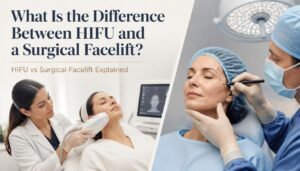
HIFU vs Surgical Facelift: What Is the Difference?
| Feature | HIFU Treatment | Surgical Facelift |
|---|---|---|
| Surgery | No | Yes |
| Incisions | No | Yes |
| Stitches | No | May be required |
| Downtime | Usually minimal | Longer recovery |
| Results | Gradual | More significant structural correction |
| Skin removal | No | May be performed |
| Tissue repositioning | No | Yes |
| Best for | Mild to moderate laxity | Significant sagging and excess skin |
| Anaesthesia | Generally not required | Usually required |
| Maintenance | May require repeat treatment | Results are longer-lasting but ageing continues |
The right option depends on the individual rather than simply choosing the newest or least invasive procedure.
Is HIFU a Good Alternative to a Facelift?
For the right patient, HIFU can be a good non-surgical alternative to a surgical facelift.
It can be particularly appealing if you have early signs of ageing but are not ready for surgery.
HIFU may be worth considering if you want to improve:
1. Mild Facial Sagging
If your skin has started losing firmness but you do not have significant excess skin, HIFU may provide a tightening effect.
2. Early Jowling
Early jowls can make the lower face look less defined. HIFU may help improve the appearance of laxity around the lower face.
3. Jawline Definition
When mild skin laxity is contributing to a less defined jawline, skin-tightening treatment may help create a firmer-looking contour.
4. Loose Neck Skin
HIFU can be used in selected facial and neck treatment protocols for skin laxity.
5. A Non-Surgical Approach
Some people simply do not want surgery, incisions or significant downtime. HIFU provides a non-invasive option for appropriately selected patients.
Dermedico Clinic currently describes HIFU as a non-surgical facial lifting option for concerns including jowls, neck laxity and brow lifting.
When Is a Surgical Facelift Better Than HIFU?
HIFU is not a replacement for a facelift for everyone.
If you have substantial skin excess, advanced facial sagging or significant changes in facial structure, a surgical facelift may provide a more noticeable correction.
A facelift can physically reposition tissues and remove excess skin. HIFU cannot perform these surgical steps.
You may therefore be a better candidate for a surgical consultation if you have:
- Significant loose or hanging facial skin
- Advanced jowling
- Extensive excess skin around the neck
- Major lower-face sagging
- Expectations of dramatic lifting
- Structural changes that cannot be corrected through skin tightening alone
The best way to determine the appropriate treatment is through an examination by a qualified dermatologist or plastic surgeon.
What Results Can You Expect From HIFU?
One of the most important things to understand about HIFU is that results are gradual rather than equivalent to a surgical facelift.
A 2023 systematic review and meta-analysis involving 13 studies and 477 participants found that microfocused ultrasound produced improvement and patient satisfaction following treatment, but the researchers also noted the need for larger and better-designed studies.
More recent research continues to support HIFU’s potential for skin tightening while highlighting differences in treatment protocols and the need for additional high-quality research.
Your result can depend on:
- Age
- Degree of skin laxity
- Skin quality
- Facial anatomy
- Treatment area
- Device and treatment protocol
- Energy settings
- Individual collagen response
- Lifestyle and ageing
Therefore, be cautious of clinics promising a surgical-level facelift result from one HIFU session.
How Long Do HIFU Results Last?
HIFU results are not permanent because the natural ageing process continues.
Dermedico Clinic currently states that HIFU results may last approximately 12–18 months, although individual results vary and maintenance treatment may be considered.
For a detailed explanation, read our guide on How Long Do HIFU Results Last?.
Is HIFU Painful?
HIFU is generally tolerated by many patients, but it is not completely sensation-free.
Depending on the device, treatment area and individual sensitivity, you may experience:
- Warmth
- Tingling
- Pressure
- Brief discomfort
- Tenderness after treatment
Clinical studies have reported varying pain scores, and individual experiences differ.
Dermedico Clinic states that patients may experience mild warmth or tingling during HIFU treatment and that temporary tenderness can occur afterward.
Is There Downtime After HIFU?
One of the biggest advantages of HIFU compared with surgery is the generally limited downtime.
Some patients may experience temporary:
- Redness
- Swelling
- Tenderness
- Tingling
- Sensitivity
These effects typically improve with time.
However, non-invasive does not mean risk-free. Treatment should be performed using appropriate technology, correct settings and proper medical supervision.
A systematic review of microfocused ultrasound reported that transient swelling, redness and pain were among the more commonly observed effects, while significant complications were uncommon in the published literature.
Is HIFU Safe?
HIFU has been studied extensively as a non-invasive skin-tightening technology.
A systematic review and meta-analysis of HIFU for facial and neck rejuvenation found moderate improvement and generally favourable short-term safety, although the researchers highlighted limitations including inconsistent treatment protocols and limited long-term follow-up.
That is why choosing a qualified medical professional is important.
Before treatment, your dermatologist should assess your skin, degree of laxity, facial anatomy, previous procedures and expectations.
HIFU vs Botox: Which Is Better?
Although both treatments can help improve the appearance of facial ageing, HIFU and Botox work in different ways.
HIFU treatment is primarily used for skin tightening and lifting by stimulating collagen remodelling. It may be suitable for concerns such as mild skin laxity, early jowling and reduced jawline definition.
Botox, on the other hand, temporarily relaxes targeted facial muscles and is commonly used to reduce dynamic wrinkles such as forehead lines, frown lines and crow’s feet.
The better option depends on your specific concern. If skin laxity and loss of firmness are your main concerns, HIFU may be considered. For wrinkles caused by repeated muscle movement, Botox may be more appropriate.
For example:
- Mild sagging → HIFU may be considered
- Early jowling → HIFU may be considered
- Loose neck skin → HIFU may be considered
- Forehead expression lines → Botox may be considered
- Frown lines → Botox may be considered
- Crow’s feet → Botox may be considered
Read our detailed guide: HIFU vs Botox: Which Treatment Is Better for Facial Ageing?.
HIFU vs Dermal Fillers

Dermal fillers work differently from HIFU.
Fillers may be used to restore or enhance volume in selected areas, while HIFU is primarily associated with skin tightening.
If facial ageing is related to volume loss rather than skin laxity, fillers may sometimes be discussed instead of—or alongside—other treatments.
You can learn more about Dermal Fillers in Delhi as part of your treatment research.
The appropriate treatment depends on your facial anatomy and the specific cause of the ageing concern.
Who Is a Good Candidate for HIFU?
HIFU may be suitable for adults with mild to moderate skin laxity who want a non-surgical treatment.
You may be a potential candidate if:
- Your skin has started becoming less firm.
- You have early jowls.
- Your jawline has become less defined.
- You have mild neck laxity.
- You want a non-surgical option.
- You prefer minimal downtime.
- You understand that results are gradual.
However, HIFU may not be ideal for people with substantial excess skin or expectations of a dramatic surgical facelift.
A consultation is therefore essential before treatment.
Why Choose a Dermatologist for HIFU?
The machine alone does not determine the quality of a treatment.
Patient selection, treatment depth, energy settings, facial anatomy and technique all matter.
A dermatologist can determine whether the concern is primarily caused by:
- Skin laxity
- Volume loss
- Muscle movement
- Excess fat
- Skin texture
- A combination of ageing changes
This can prevent you from choosing a treatment simply because it is popular.
Dermedico Clinic in Defence Colony, New Delhi, provides HIFU under dermatological supervision and lists multiple aesthetic treatment options.
HIFU Treatment in Defence Colony and South Delhi
If you are searching for HIFU treatment in Defence Colony, Lajpat Nagar or South Delhi, Dermedico Clinic is located at D-95, Defence Colony, New Delhi.
The clinic currently lists HIFU treatment for facial skin tightening and non-surgical lifting and provides treatment planning according to individual concerns.
You can explore HIFU Treatment in Delhi to learn more about the treatment and arrange a consultation.
For patients exploring other anti-ageing options, Dermedico also provides treatments such as Botox, dermal fillers, PRP and other cosmetic dermatology procedures.
Frequently Asked Questions About HIFU vs Facelift
1. Can HIFU completely replace a surgical facelift?
No. HIFU can be a useful non-surgical alternative for selected patients with mild to moderate skin laxity, but it cannot remove excess skin or surgically reposition facial tissues.
2. Is HIFU better than a facelift?
Neither is universally better. HIFU offers a non-surgical approach with generally minimal downtime, while a facelift can provide more substantial correction of significant sagging.
3. How quickly does HIFU work?
HIFU results develop gradually because collagen remodelling takes time. Visible improvement may continue to develop for several months.
4. How long does HIFU last?
Dermedico currently states that results may last around 12–18 months, although longevity varies between individuals.
5. Does HIFU remove loose skin?
HIFU can improve the appearance of mild skin laxity, but it does not surgically remove excess skin.
6. Can HIFU tighten the jawline?
HIFU may help improve the appearance of a less-defined jawline when skin laxity is a contributing factor.
7. Can HIFU treat neck sagging?
HIFU may be considered for selected patients with mild to moderate neck skin laxity.
8. Does HIFU have downtime?
Downtime is generally limited compared with surgery, although temporary redness, swelling, tenderness or sensitivity may occur.
9. Is HIFU permanent?
No. HIFU does not stop natural ageing. Results vary and maintenance may be recommended depending on the individual.
10. Should I choose HIFU or a facelift?
The decision should be based on the degree of sagging, amount of excess skin, facial anatomy and your desired result. A professional consultation can help determine which option is appropriate.
Final Verdict: Is HIFU a Good Alternative to a Surgical Facelift?
Yes—but only for the right patient.
HIFU can be an excellent option for people with mild to moderate facial skin laxity who want a non-surgical facelift-like effect without incisions and significant downtime.
It can help improve the appearance of early jowling, jawline definition, loose neck skin and general facial firmness.
However, HIFU should not be marketed as a complete replacement for surgery. If you have severe sagging or significant excess skin, a surgical facelift may provide a more appropriate and noticeable correction.
The best treatment is therefore not necessarily the most aggressive or the least invasive. It is the treatment that matches your skin condition, facial anatomy and expectations.
If you are considering HIFU in South Delhi, a consultation with a qualified dermatologist can help you understand whether HIFU, Botox, dermal fillers, another treatment—or no procedure at all—is appropriate for you.
Explore: HIFU Treatment in Delhi | All Treatments at Dermedico Clinic
Medical Disclaimer
HIFU is a medical/aesthetic procedure and results vary between individuals. The information in this article is for educational purposes and should not be considered a substitute for an in-person medical consultation. Treatment suitability, expected results, contraindications, potential side effects and costs should be discussed with a qualified medical professional before treatment.
References:
- PubMed — HIFU systematic review:HIFU skin tightening systematic review
- PubMed — MFU facial rejuvenation meta-analysis:Microfocused ultrasound meta-analysis
- PubMed — HIFU face and neck systematic review:HIFU face and neck systematic review
- PubMed — MFU-V safety review:MFU-V effectiveness and safety review