Table of Contents
What Age Is Ideal for Starting HIFU Treatment?
If you have started noticing mild skin laxity, early jowling, a less-defined jawline or loose-looking skin around your neck, you may be wondering: What age is ideal for starting HIFU treatment?
The answer is not simply a particular number.
HIFU, or High-Intensity Focused Ultrasound, is a non-surgical aesthetic treatment that uses focused ultrasound energy to target selected tissue depths and stimulate collagen remodelling. It may help improve the appearance of mild-to-moderate skin laxity and create a gradual lifting and tightening effect.
For this reason, your skin condition and treatment goals are generally more important than your exact age.
Some people may begin considering HIFU in their 30s when early laxity becomes noticeable, while others may not need it until their 40s, 50s or later. Younger people without actual skin laxity may not benefit simply because they have reached a particular age.
At Dermedico Clinic in Defence Colony, South Delhi, HIFU treatment is planned according to the individual’s skin laxity, facial anatomy and aesthetic goals. The clinic’s current HIFU information describes the treatment primarily for concerns such as sagging skin, early jowling, reduced jawline definition and neck laxity.
Is There a Specific Age to Start HIFU Treatment?
No. There is no universal age at which everyone should start HIFU.
A better question is:
“Do I have a skin concern that HIFU is designed to address?”
Non-invasive ultrasound skin tightening is generally considered for people who have some degree of skin laxity and want gradual tightening without surgery. The American Academy of Dermatology notes that ultrasound-based skin tightening can produce gradual, modest lifting and tightening, with results developing over months.
Therefore, two people of the same age may have completely different treatment needs.
For example:
- One person in their early 30s may have good skin firmness and may not need HIFU.
- Another person in their 30s may have noticeable early laxity and may be suitable for assessment.
- Someone in their 40s may benefit from HIFU for mild-to-moderate laxity.
- Someone in their 50s or 60s may also be considered, depending on skin condition and the degree of sagging.
- A person with significant excess skin may require a different treatment approach.
This is why a consultation is more useful than choosing treatment based purely on age.
What Is HIFU Treatment?
HIFU stands for High-Intensity Focused Ultrasound.
In cosmetic applications, focused ultrasound energy is delivered to selected tissue depths. The controlled thermal effect can stimulate collagen production and remodelling, which may gradually improve the appearance of skin firmness and laxity. Mayo Clinic describes cosmetic HIFU as an ultrasound-based approach that can tighten and lift loose skin by stimulating collagen.
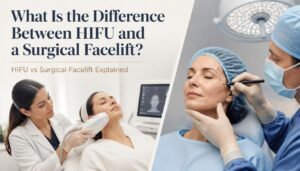
Unlike a surgical facelift, HIFU does not require surgical incisions or removal of excess skin.
It is therefore often considered by people who want a non-surgical approach to concerns such as:
- Mild facial sagging
- Early jowling
- Reduced jawline definition
- Loose neck skin
- Loss of facial firmness
- Certain brow-area laxity
- Early signs of facial ageing
Dermedico Clinic currently lists HIFU for facial and neck skin laxity, jawline definition, jowls, brow lifting and related concerns.
What Age Is HIFU Usually Considered?
Instead of using age as a strict rule, it can be more helpful to think about different stages of skin ageing.
HIFU in Your 20s
Most people in their 20s have relatively good skin elasticity and collagen production.
If you do not have noticeable skin laxity, there may be little reason to undergo HIFU simply as a preventive treatment.
Some aesthetic practices may offer HIFU to younger adults for preventive purposes, but treatment should still have a clear clinical or aesthetic rationale. Cleveland Clinic notes that ultrasound skin tightening can be considered even by some people under 30, but suitability depends on the individual’s concerns and professional assessment.
For most younger adults, protecting the skin from ultraviolet exposure, maintaining a consistent skincare routine and addressing specific skin concerns may be more relevant than undergoing an unnecessary procedure.
HIFU in Your 30s
For some people, the 30s can be the stage when early changes in skin firmness become more noticeable.
You might observe:
- Slight loss of jawline definition
- Mild cheek laxity
- Early jowling
- Fine lines
- Less firm-looking neck skin
- Changes in facial contour
However, not everyone in their 30s needs HIFU.
If there is no meaningful skin laxity, treatment may not provide a significant benefit. If early laxity is present, a dermatologist can determine whether HIFU or another treatment is more appropriate.
The 30s can therefore be an age when some people start discussing HIFU—not an age when everyone should start it.
HIFU in Your 40s
The 40s are often when changes in skin firmness and facial contour become more noticeable.
Some individuals may experience:
- More visible jowling
- Reduced jawline definition
- Loose skin around the neck
- Decreased skin elasticity
- More prominent fine lines
- Gradual loss of facial firmness
For people with mild-to-moderate laxity, HIFU may be one treatment option to discuss with a dermatologist.
Clinical evidence supports the use of focused ultrasound for skin tightening, although outcomes vary between individuals and treatment protocols. A 2025 systematic review examined 45 clinical trials and cohort studies involving HIFU for skin tightening and body contouring.
HIFU in Your 50s and Beyond
Being over 50 does not automatically make you unsuitable for HIFU.
The more important considerations include:
- Degree of skin laxity
- Amount of excess skin
- Skin quality
- Facial anatomy
- Treatment area
- Overall expectations
- Whether the desired result is achievable without surgery
HIFU may be considered when the concern is mild-to-moderate laxity and the person wants a non-surgical approach.
However, if there is significant excess skin or advanced sagging, HIFU may not provide the same degree of correction as a surgical facelift.
The American Academy of Dermatology also notes that non-invasive skin-tightening treatments generally provide more modest lifting than surgical procedures and may be less helpful when there is substantial sagging.
So, What Is the Ideal Age to Start HIFU?
There isn’t one ideal age.
A more useful way to think about it is:
Start considering HIFU when you have a genuine concern that HIFU can address—not simply when you reach a certain birthday.
For some people, that may be their 30s.
For others, it may be their 40s or 50s.
And for some people, HIFU may not be necessary at all.
A qualified dermatologist can evaluate your skin and determine whether HIFU is appropriate.
What Are the Signs That You May Be Ready for HIFU?
Age alone should not determine whether you need treatment.
You may consider a professional HIFU assessment if you are noticing:
1. Early Jowling
The lower face may begin to look less sharply defined as skin and supporting tissues change.
2. A Less-Defined Jawline
If your jawline appears softer than it previously did, skin laxity may be one contributing factor.
3. Loose Neck Skin
The neck can show early signs of laxity as collagen and elastin change with age.
4. Mild Facial Sagging
HIFU may be considered for selected patients with mild-to-moderate laxity.
5. Loss of Skin Firmness
You may notice that your skin does not feel or appear as firm as it did previously.
6. Desire for a Non-Surgical Treatment
Some people prefer a treatment that does not involve surgical incisions or a lengthy recovery period.
Dermedico Clinic’s current HIFU treatment information lists facial laxity, jowls, jawline concerns, neck laxity and brow-area concerns among the treatment indications.
Does Starting HIFU Earlier Give Better Results?
Not necessarily.
Starting a cosmetic procedure earlier does not automatically mean that you will get better results.
If your skin is already firm and you do not have a concern that HIFU is designed to address, there may be little reason to undergo treatment.
HIFU works by stimulating a biological response in targeted tissue. Therefore, the potential benefit depends on factors such as:
- Skin laxity
- Facial anatomy
- Collagen response
- Treatment area
- Device and treatment settings
- Practitioner technique
- Individual healing response
- Realistic expectations
A 2025 systematic review found promising evidence for HIFU in skin tightening but also highlighted variation across studies and the need for further standardised research.
Can HIFU Prevent Ageing?
HIFU should not be thought of as a way to stop the natural ageing process.
It may help address certain existing signs of skin laxity, but it does not prevent future ageing.
Factors such as genetics, sun exposure, smoking, hormonal changes, lifestyle and natural changes in collagen and elastin continue to affect the skin.
The American Academy of Dermatology recommends discussing non-invasive skin-tightening options with a qualified dermatologist to understand what a treatment can realistically achieve.
How Does HIFU Work on Ageing Skin?
As we age, collagen production and organisation change, contributing to changes in firmness and elasticity.
HIFU delivers focused ultrasound energy to selected tissue depths.
The treatment creates controlled thermal effects, which can stimulate the body’s wound-healing response and encourage collagen remodelling.
Over time, this process may lead to:
- Improved firmness
- A tighter-looking appearance
- Better jawline definition
- Reduced appearance of mild laxity
- Gradual facial lifting
The results are not generally equivalent to a surgical facelift.
Instead, HIFU is designed to provide a gradual, non-surgical improvement in selected patients.
How Long Does It Take to See HIFU Results?
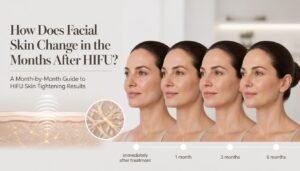
HIFU results develop gradually because collagen remodelling takes time.
Dermedico Clinic currently states that visible results can develop over approximately 3–6 months, depending on the individual and treatment plan.
The American Academy of Dermatology similarly notes that ultrasound skin-tightening results generally appear gradually, with modest lifting and tightening developing over approximately 2–6 months.
This means you should not judge your final result immediately after treatment.
Is HIFU Better Than a Facelift?
HIFU and a surgical facelift are different treatments.
HIFU is a non-surgical approach that may provide gradual tightening for selected patients with mild-to-moderate laxity.
A facelift is a surgical procedure that can reposition tissues and address significant excess skin.
Therefore, HIFU should not be presented as a complete replacement for surgery.
If your concern is mild laxity and you want a non-surgical option, HIFU may be worth discussing.
If you have significant excess skin or advanced sagging, your dermatologist or plastic surgeon may discuss other options.
Is HIFU Safe?
HIFU is a non-invasive treatment when used for cosmetic skin tightening, but non-invasive does not mean completely risk-free.
Possible temporary effects can include:
- Redness
- Swelling
- Tenderness
- Tingling
- Warmth
- Mild discomfort
- Bruising in some cases
Mayo Clinic lists possible cosmetic HIFU effects including skin colour changes, mild swelling, tingling, bruising, tenderness, irritation, burns and nerve irritation.
This is why treatment should be performed following appropriate patient assessment and with suitable equipment and treatment settings.
Why a Dermatologist Consultation Matters Before HIFU
Before deciding that you are “old enough” for HIFU, it is better to determine whether HIFU is actually appropriate for your skin.
During a consultation, a dermatologist can assess:
- Skin laxity
- Facial anatomy
- Jawline definition
- Neck skin
- Degree of sagging
- Skin quality
- Your aesthetic goals
- Whether another treatment may be more appropriate
At Dermedico Clinic, HIFU treatment is performed under the care of Dr. Pallavi Chandna Rohatgi, MD Dermatologist, with treatment planning based on individual concerns and skin assessment.
HIFU Treatment in South Delhi
If you are searching for HIFU treatment in South Delhi, Dermedico Clinic is located in Defence Colony and offers HIFU as part of its aesthetic dermatology services.
The clinic’s current treatment page lists HIFU for concerns including facial sagging, jowls, jawline definition, loose neck skin and brow-area laxity.
You can also explore:
- All Skin & Cosmetic Treatments at Dermedico Clinic
- HIFU Treatment in South Delhi: How to Know Whether You Actually Need It?
- How Long Do HIFU Results Last?
- Is HIFU Treatment a Good Alternative to a Surgical Facelift?
- What Is HIFU Treatment and How Does It Tighten Sagging Skin?
- HIFU Treatment Near Lajpat Nagar
- HIFU Treatment in Defence Colony
HIFU Near Lajpat Nagar and Defence Colony
People searching for HIFU treatment near Lajpat Nagar may also consider clinics in nearby Defence Colony.
Dermedico Clinic’s current website states that its Defence Colony location is accessible from Lajpat Nagar and other parts of South Delhi.
The important consideration, however, should be the quality of assessment and whether the treatment is appropriate for your individual concern—not simply the distance from your home.
Frequently Asked Questions About the Ideal Age for HIFU
1. What is the best age to start HIFU treatment?
There is no universal best age. HIFU is generally considered based on skin laxity, facial anatomy, treatment goals and expectations rather than age alone.
2. Can I get HIFU in my 20s?
Some younger adults may undergo ultrasound skin tightening, but reaching your 20s does not automatically mean you need HIFU. A professional assessment can determine whether there is a suitable concern to treat.
3. Is 30 too early for HIFU?
Not necessarily, but HIFU should not be used simply because someone has turned 30. If there is genuine mild skin laxity or another suitable concern, a dermatologist can assess whether treatment is appropriate.
4. Is HIFU suitable in your 40s?
HIFU may be considered for selected people in their 40s who have mild-to-moderate skin laxity, early jowling, reduced jawline definition or loose neck skin.
5. Can people over 50 have HIFU?
Yes, age alone does not automatically rule out HIFU. Suitability depends on skin condition, degree of laxity, facial anatomy and treatment expectations.
6. Does HIFU work better when started early?
Starting early does not automatically guarantee better results. Treatment should be based on an actual concern and whether HIFU is appropriate for that concern.
7. Can HIFU prevent wrinkles?
HIFU is primarily used for selected skin-tightening and lifting concerns. It should not be considered a guaranteed method of preventing future wrinkles or stopping the ageing process.
8. Can HIFU replace a facelift?
No. HIFU and surgical facelift procedures work differently. HIFU may be suitable for selected mild-to-moderate laxity, while surgery can address more significant tissue repositioning and excess skin.
9. How quickly does HIFU show results?
Results develop gradually. Dermedico Clinic currently states that visible results may develop over approximately 3–6 months.
10. How long can HIFU results last?
The duration varies between individuals and depends on factors such as ageing, skin condition and treatment response. Dermedico currently states that results may last around 12–18 months, although individual outcomes vary.
11. Is HIFU painful?
Some people experience warmth, tingling, pressure or discomfort during treatment. Individual experiences vary.
12. Is there downtime after HIFU?
HIFU is generally associated with little downtime compared with surgery, although temporary redness, swelling, tenderness or other effects can occur.
13. Can HIFU treat a double chin?
HIFU may help selected cases where skin laxity contributes to the appearance beneath the chin. However, a double chin can also involve fat distribution and facial anatomy, so assessment is important.
14. Can HIFU tighten neck skin?
Yes, HIFU can be used for selected cases of neck skin laxity. Dermedico Clinic lists loose neck skin among the concerns for which HIFU may be considered.
15. Can HIFU improve the jawline?
HIFU may help selected patients with mild laxity and reduced jawline definition. Results depend on individual anatomy and the cause of the concern.
16. Who should avoid HIFU?
Suitability depends on the type of HIFU and the individual’s medical and skin circumstances. Anyone considering treatment should discuss relevant health conditions, pregnancy status, medications and skin problems with their healthcare provider.
17. Should I get HIFU every year?
Not everyone needs annual HIFU. The appropriate treatment interval depends on your skin condition, previous response and treatment plan.
18. Is HIFU suitable for men?
HIFU can be considered for suitable male and female patients. Facial anatomy and skin laxity matter more than gender.
19. Is HIFU suitable for all skin types?
Skin type alone does not determine suitability. A dermatologist should assess your skin, anatomy, treatment area and medical history.
20. Should I choose HIFU based only on age?
No. Age should be considered alongside skin laxity, facial anatomy, treatment goals and realistic expectations.
Final Takeaway: When Should You Start HIFU?
There is no single ideal age for starting HIFU treatment.
For some people, HIFU may be considered in their 30s when early skin laxity becomes noticeable. Others may consider it in their 40s, 50s or later.
The most important question is not:
“Am I old enough for HIFU?”
It is:
“Do I have a skin concern that HIFU can appropriately address?”
If you are noticing early jowling, reduced jawline definition, mild facial sagging or loose neck skin, a consultation with a qualified dermatologist can help determine whether HIFU is appropriate for you.
If you are considering HIFU treatment in South Delhi, Defence Colony or near Lajpat Nagar, you can explore the HIFU services available at Dermedico Clinic and discuss your concerns with a dermatologist before making a treatment decision.
Explore HIFU Treatment at Dermedico Clinic
Medical Disclaimer
This article is intended for general educational purposes and does not replace an individual medical consultation, diagnosis or treatment recommendation. HIFU suitability, expected results, risks and treatment frequency vary from person to person. Consult a qualified dermatologist or healthcare professional before undergoing cosmetic treatment.