Table of Contents
Hair PRP vs Hair Growth Treatments
Hair thinning and excessive hair fall can be frustrating, especially when you are unsure which treatment is actually suitable for your condition. With options such as Hair PRP, minoxidil, prescription medicines, mesotherapy, supplements and other hair growth treatments, choosing the right approach can feel confusing.
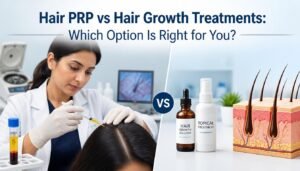
So, Hair PRP vs hair growth treatments — which option is right for you?
The answer depends on the cause, pattern and severity of your hair loss.
Hair PRP (Platelet-Rich Plasma) is a procedure that uses a concentrated component of your own blood and is commonly studied for androgenetic alopecia, also known as male or female pattern hair loss. Research suggests PRP can improve hair density in some patients, although studies vary considerably in their protocols and the quality of evidence is not uniform.
Other hair growth treatments, including topical minoxidil and prescription options, work through different mechanisms and may be more appropriate depending on the diagnosis.
This guide explains the differences between Hair PRP and other hair growth treatments, their potential benefits, limitations and how a dermatologist can help determine the most appropriate treatment plan.
What Is Hair PRP?
Hair PRP, or platelet-rich plasma therapy, is a minimally invasive procedure in which a small amount of the patient’s blood is collected and processed to concentrate platelets.
The platelet-rich component is then injected into selected areas of the scalp.
Platelets contain various growth-related substances that researchers believe may influence the environment around hair follicles. PRP has therefore been investigated as a treatment for androgenetic alopecia and other forms of hair thinning.
At Dermedico Clinic, Hair PRP is offered for selected hair-loss concerns including androgenetic alopecia, diffuse hair thinning and early pattern baldness. Treatment is planned following assessment by a dermatologist.
You can learn more about the clinic’s PRP Therapy in Delhi and the available Hair PRP treatment.
What Are Hair Growth Treatments?
“Hair growth treatment” is a broad term rather than one specific procedure.
Depending on the underlying cause of hair loss, treatment may include:
- Topical minoxidil
- Prescription medications
- Nutritional correction where a deficiency is identified
- Treatment of scalp inflammation or underlying medical conditions
- Low-level light-based treatments
- Hair PRP
- Mesotherapy
- Microneedling-based approaches
- Hair transplantation for selected advanced cases
A systematic review of androgenetic alopecia treatments found that several topical, oral and procedural approaches may have a role in hair-loss management, supporting the importance of an individualized treatment strategy.
This is why simply choosing the most popular hair treatment may not always be the right approach.
Hair PRP vs Hair Growth Treatments: What’s the Difference?
The biggest difference is that PRP is a specific procedure, while “hair growth treatments” refers to a much broader category.
| Feature | Hair PRP | Other Hair Growth Treatments |
|---|---|---|
| Treatment type | Injectable procedure | Medicines, procedures or supportive treatments |
| Main approach | Uses concentrated platelet-rich plasma | Depends on the treatment |
| Common use | Selected pattern hair loss and thinning | Depends on diagnosis |
| Requires dermatologist assessment | Yes | Recommended |
| Treatment schedule | Usually involves multiple sessions | Varies considerably |
| Results | Can vary between individuals | Depends on treatment and cause |
| Evidence | Promising but heterogeneous | Varies by treatment |
| Suitable for everyone | No | No |
The important point is that PRP does not necessarily have to compete with every other hair-loss treatment.
In some patients, a dermatologist may consider PRP as one component of a broader treatment plan.
How Effective Is Hair PRP for Hair Loss?
Research on PRP has produced encouraging but not completely uniform results.
A 2024 systematic review examining PRP for androgenetic alopecia included eight randomized controlled trials and one prospective cohort study involving 291 participants. Several studies reported improvements in hair density or hair count, but the authors also noted methodological limitations, heterogeneity between studies and moderate risk of bias.
Another meta-analysis of randomized trials found that PRP was associated with increased hair density at three and six months compared with placebo, although improvements in hair count and diameter were less consistently different from placebo.
A more recent 2024 meta-analysis also reported an increase in hair density with PRP but classified the evidence as low quality because of substantial study differences and publication bias.
Therefore, it is better to think of Hair PRP as a potential treatment option for appropriately selected patients, rather than a guaranteed cure for hair loss.
Hair PRP vs Minoxidil
Minoxidil is one of the best-known medical treatments for pattern hair loss.
The American Academy of Dermatology notes that topical minoxidil can reduce hair loss, stimulate hair growth and strengthen existing hairs in people with male pattern hair loss. However, response varies, and continued treatment is generally necessary to maintain the benefit.
PRP works differently.
Hair PRP
- Uses the patient’s own blood-derived platelet-rich plasma
- Involves injections into the scalp
- Usually requires a series of treatment sessions
- May be considered for selected pattern hair-loss patients
- Results can vary
Minoxidil
- Is a topical medication
- Can be used at home
- Requires regular application
- Has evidence for pattern hair loss
- Response differs between individuals
A 2025 systematic review and meta-analysis comparing PRP with topical minoxidil found no significant difference in some measures of hair density, while several other outcomes showed similar results between the treatments. The authors included nine randomized controlled trials involving 451 participants.
This does not mean one treatment is universally better. It highlights why treatment selection should be based on the patient’s diagnosis and circumstances.
Hair PRP vs Mesotherapy
Mesotherapy for hair involves introducing selected substances into the scalp through small injections.
PRP is different because the injected material is prepared from the patient’s own blood.
Both approaches have been studied for hair thinning, but the evidence and treatment protocols differ.
Dermedico also provides information about Mesotherapy for Hair in Delhi.
If you are considering mesotherapy or PRP, a dermatologist can assess whether either procedure is appropriate for your particular type of hair loss.
Who May Be a Candidate for Hair PRP?
There is no single checklist that guarantees that someone is a good candidate for PRP.
A dermatologist may consider factors such as:
- Type of hair loss
- Duration of hair thinning
- Pattern of hair loss
- Hair density
- Age
- Scalp condition
- Family history
- Previous treatments
- Current medications
- Medical history
- Treatment expectations
PRP has been studied particularly in androgenetic alopecia, commonly called male or female pattern hair loss.
However, hair shedding caused by an underlying medical issue, nutritional deficiency, hormonal problem, medication or scalp disease may require a different approach.
That is why diagnosing the cause should come before selecting a procedure.
When Should You Consider Other Hair Growth Treatments?
Other treatments may be considered when the cause of hair loss points toward a different intervention.
For example, if a dermatologist identifies pattern hair loss, medication such as minoxidil may form part of the treatment plan.
If a nutritional deficiency is identified, correcting the deficiency may be more relevant than undergoing PRP.
If the scalp has an inflammatory or dermatological condition, treating the underlying condition may be necessary.
For advanced permanent hair loss, a dermatologist may also discuss hair transplantation where appropriate.
In other words:
The treatment should follow the diagnosis — not the other way around.
Can Hair PRP Be Combined With Other Hair Treatments?
In some cases, PRP may be incorporated into a broader hair-loss management plan.
A dermatologist may consider combining different approaches depending on:
- The cause of hair loss
- Severity of thinning
- Previous treatment response
- Scalp health
- Patient preferences
- Expected benefits and risks
Dermedico’s PRP information describes Hair PRP as one of several treatment options available for hair and scalp concerns.
However, combining treatments should be medically planned rather than simply adding multiple procedures together.
How Many Hair PRP Sessions Are Needed?
There is no universal PRP schedule that applies to every patient.
The number and frequency of sessions may depend on the diagnosis, degree of thinning, treatment response and the protocol selected by the dermatologist.
Clinical studies have used different PRP preparation methods, injection techniques and treatment schedules, which is one reason why research results are difficult to compare directly.
Rather than asking only, “How many PRP sessions do I need?”, ask:
- Why is this number of sessions recommended?
- What improvement should I realistically expect?
- How will progress be monitored?
- When should the results be reassessed?
- Could another treatment be more appropriate?
- Is maintenance treatment necessary?
How Long Does Hair PRP Take to Show Results?
Hair growth is gradual, so PRP should not be viewed as an instant hair-regrowth solution.
Research has evaluated PRP outcomes at different intervals, including approximately three and six months.
The actual response can vary depending on:
- The underlying diagnosis
- Stage of hair loss
- Baseline hair density
- Treatment protocol
- Individual response
- Whether other treatments are being used
Taking standardized photographs during treatment can help your dermatologist monitor changes over time.
Hair PRP in Defence Colony and South Delhi
If you are searching for Hair PRP in Defence Colony, Hair PRP near Lajpat Nagar or Hair PRP in South Delhi, treatment should be selected based on medical assessment rather than location alone.
Dermedico Clinic is located at D-95, Defence Colony, New Delhi, and provides dermatologist-guided PRP treatment. The clinic’s website identifies Dr. Pallavi Chandna Rohatgi as an MD Dermatologist and lists Hair PRP among its hair and dermatology services.
You can also read:
- Hair PRP in Defence Colony: 9 Things to Know Before Your Consultation
- Hair PRP Near Lajpat Nagar: What Should You Know Before Treatment?
- Hair PRP in South Delhi: What Makes a Personalised Treatment Plan Important?
- Hair Shedding vs Hair Loss: When Should You Consider PRP?
These related resources can help readers understand the difference between temporary shedding, progressive thinning and treatment options.
How to Choose Between Hair PRP and Other Hair Growth Treatments
Instead of choosing a treatment based solely on advertisements or before-and-after photographs, consider these five factors.
1. Identify the Cause
The first step is understanding why your hair is falling or becoming thinner.
2. Consider the Stage of Hair Loss
Early thinning may have different treatment options from advanced hair loss.
3. Understand the Evidence
Ask what research supports the recommended treatment and what its limitations are.
4. Discuss Long-Term Maintenance
Some hair-loss treatments need ongoing use or periodic maintenance.
5. Set Realistic Expectations
No hair-loss treatment should be presented as guaranteed to restore all lost hair.
A dermatologist can help you understand which options are appropriate for your particular condition.
Hair PRP vs Hair Growth Treatments: Quick Decision Guide
You may discuss Hair PRP with a dermatologist if:
- You have diagnosed pattern hair loss
- You have early or moderate thinning
- You are interested in a minimally invasive procedure
- You understand that results vary
- You are willing to attend follow-up sessions
You may need another or additional hair-loss treatment if:
- Your hair loss has an identifiable medical cause
- You have nutritional deficiencies
- You have an inflammatory scalp condition
- Medication is clinically appropriate
- Hair loss is advanced
- Your dermatologist identifies another underlying cause
The right choice depends on the diagnosis rather than simply choosing PRP because it is popular.
Frequently Asked Questions
Is Hair PRP better than other hair growth treatments?
There is no single treatment that is better for every person. PRP has shown potential for improving hair density in selected patients with androgenetic alopecia, while other treatments such as minoxidil have established roles in pattern hair loss. The appropriate option depends on the diagnosis and individual circumstances.
Is PRP good for hair loss?
PRP may benefit some people with androgenetic alopecia and other selected hair-thinning concerns. However, research results vary and PRP is not a guaranteed cure for every type of hair loss.
Is Hair PRP permanent?
PRP should not be described as a permanent cure for hair loss. Hair-loss progression and the need for maintenance depend on the underlying condition and individual response.
Can PRP stop hair fall completely?
No treatment can guarantee that hair fall will stop completely. The underlying cause needs to be identified first.
How many PRP sessions are required for hair loss?
The number varies between patients. Treatment schedules used in research are not completely standardized, so your dermatologist should determine the appropriate schedule after assessing your condition.
Is PRP painful?
PRP involves injections into the scalp, so some temporary discomfort may occur. A clinic may use appropriate numbing measures to improve comfort.
Can women undergo Hair PRP?
Yes. PRP has been studied for androgenetic alopecia in women as well as men, although suitability depends on the individual’s diagnosis.
Can PRP be combined with minoxidil?
In some cases, a dermatologist may include PRP and medication in the same overall hair-loss management plan. Whether that combination is appropriate depends on the patient’s condition.
Is Hair PRP safe?
PRP uses the patient’s own blood-derived material, but it is still an injectable medical procedure and can have temporary side effects. A dermatologist should assess whether it is appropriate for you.
How soon can I see PRP results?
Hair growth takes time. Clinical studies have assessed PRP outcomes at intervals such as three and six months, but individual responses vary.
What is the difference between PRP and minoxidil?
PRP is an injectable procedure using concentrated platelet-rich plasma, while minoxidil is a medication applied to the scalp. They work differently and may have different roles in a treatment plan.
Can PRP regrow completely bald areas?
PRP should not be promoted as a guaranteed way to regrow hair in completely bald areas. The extent of potential improvement depends on the condition of the hair follicles and the underlying cause of hair loss.
Should I get PRP without a diagnosis?
It is better to have persistent or progressive hair loss assessed by a dermatologist before starting treatment. Similar-looking hair loss can have different causes.
Final Takeaway: Hair PRP vs Hair Growth Treatments
So, Hair PRP vs hair growth treatments — which option is right for you?
There is no universal answer.
Hair PRP may be a useful option for selected patients, particularly those with certain forms of pattern hair loss. At the same time, treatments such as minoxidil, prescription medicines, nutritional correction or other procedures may be more appropriate depending on the cause of hair loss.
Current research suggests that PRP can improve hair density in some patients, but the evidence has important limitations, including differences in treatment protocols and study quality.
The most useful first step is therefore not choosing a treatment — it is finding out what is causing your hair loss.
If you are experiencing persistent shedding, thinning, a widening hair part, crown thinning or a receding hairline, consider consulting a qualified dermatologist for an individualized assessment.
For patients looking for Hair PRP in Defence Colony, Lajpat Nagar or South Delhi, Dermedico Clinic provides dermatologist-guided hair and PRP services.
Medical Disclaimer: This article is intended for general educational purposes and should not replace an examination, diagnosis or personalized medical advice from a qualified healthcare professional.