Table of Contents
HIFU Improve Jawline Definition
A well-defined jawline can enhance facial contours and create a firmer, more balanced appearance. However, ageing, reduced skin elasticity, facial fat distribution and genetics can gradually affect the shape of the lower face. If you want a more defined jawline without undergoing surgery, you may have come across HIFU treatment.
But can HIFU improve jawline definition without surgery? The answer is yes, in selected individuals. High-Intensity Focused Ultrasound (HIFU) is a non-invasive aesthetic treatment that delivers focused ultrasound energy beneath the skin to stimulate tissue remodelling and support skin tightening. It may help improve mild to moderate skin laxity around the jawline and under the chin.
However, HIFU does not produce the same results as a surgical facelift, and it is not suitable for every cause of a poorly defined jawline.
At DerMedico Clinic, understanding your skin condition, facial anatomy and aesthetic goals is an important first step in choosing an appropriate non-surgical treatment.
What Is HIFU Treatment?
HIFU stands for High-Intensity Focused Ultrasound. It is a non-surgical cosmetic treatment that uses focused ultrasound energy to target specific tissue layers beneath the skin’s surface.
The energy produces controlled thermal effects in the targeted tissue, which can stimulate the body’s natural healing response and collagen remodelling. Collagen is a structural protein that helps support skin firmness and elasticity.
As the skin’s collagen framework changes over time, selected patients may notice gradual improvements in skin tightness and facial contours.
Unlike a surgical facelift, HIFU does not involve incisions, stitches or the surgical removal of excess skin. It is therefore an option worth discussing with a qualified dermatologist if you want to address early signs of skin laxity without surgery.
However, the outcome depends on the device used, treatment technique, skin condition and individual anatomy.
Can HIFU Improve Jawline Definition Without Surgery?
Yes, HIFU may improve the appearance of jawline definition when loose skin or mild sagging is a major contributing factor.
As collagen production and skin elasticity change with age, the lower face may gradually appear less firm. The jawline can look softer, and early jowls may become more noticeable.
HIFU may help by targeting selected tissue layers and supporting gradual skin tightening. Depending on the individual, this can create a firmer-looking lower face and a more defined transition between the jaw and neck.
The important distinction is that HIFU improves the appearance of skin laxity rather than reshaping the jawbone.
If your jawline concern is primarily caused by excess fat, prominent chewing muscles, facial volume changes or your natural bone structure, HIFU alone may not deliver the desired result.
A professional skin and facial assessment can help determine whether HIFU is an appropriate option.
How Does HIFU Work for Jawline Tightening?
HIFU uses focused ultrasound energy to create controlled thermal points at selected depths beneath the skin. These effects trigger a healing response that can support collagen remodelling.
The treatment may help improve the appearance of loose skin around the lower face, jawline and selected areas beneath the chin.
Here is how the process generally works:
1. Focused Ultrasound Energy
The device delivers ultrasound energy to targeted tissue layers without intentionally treating the skin in the same way as a surface-based procedure.
2. Controlled Thermal Effects
The focused energy creates controlled heating in the intended treatment zones. Proper treatment depth and technique are important for both safety and effectiveness.
3. Collagen Remodelling
The body’s healing response can stimulate changes in collagen over the following weeks and months.
4. Gradual Improvement in Skin Firmness
As remodelling develops, some patients notice firmer-looking skin and improved definition around the jawline.
Results are not immediate or identical for everyone. The degree of improvement depends on the amount of skin laxity, the treatment protocol and individual response.
What Jawline Concerns Can HIFU Help Address?
HIFU may be considered for selected concerns involving mild to moderate skin laxity.
Early Jowls
Jowls develop when the lower cheeks begin to sag around the jawline. When mild skin laxity contributes to their appearance, HIFU may help improve the look of firmness in the treated area.
Significant sagging or excess skin may require a different approach.
Loose Skin Beneath the Chin
Some people notice loose skin below the chin that softens the angle between the jaw and neck. HIFU may help selected individuals when skin laxity is an important factor.
However, a double chin can also result from submental fat or natural facial anatomy. A dermatologist should identify the main cause before recommending treatment.
Reduced Lower-Face Firmness
Changes in collagen and skin elasticity can make the lower face appear less firm. HIFU may help improve the appearance of mild laxity in appropriately selected patients.
Mild Neck Skin Laxity
Because the jawline and neck contribute to the overall facial profile, loose neck skin may affect how defined the jawline appears. Depending on the device and treatment plan, HIFU may be considered for selected neck-tightening concerns.
Who Is a Good Candidate for HIFU Jawline Treatment?
HIFU may be suitable for adults who want a non-surgical approach to improving mild or moderate skin laxity.
You may benefit from a consultation if you:
- Notice early sagging around the lower cheeks.
- Have mild jowling or reduced jawline definition.
- Want to improve the appearance of loose skin beneath the chin.
- Prefer a non-surgical treatment with little recovery time.
- Understand that results develop gradually and may be modest.
- Have realistic expectations about the outcome.
HIFU may be less suitable if you have substantial excess skin, significant fat-related fullness or a jawline concern primarily caused by facial structure.
It is also important to discuss relevant medical conditions, previous cosmetic procedures, implanted devices and any active skin problems with your treating clinician. Your suitability depends on the device instructions and an individual clinical assessment.
How Long Does HIFU Take to Show Jawline Results?
HIFU results develop gradually rather than appearing as a dramatic overnight transformation.
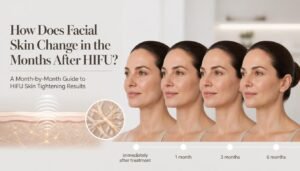
Some people notice an early change in skin firmness, but the more meaningful effects of collagen remodelling may become apparent over approximately two to three months and continue developing for several months.
The exact timeline varies according to the device, treatment settings, treatment area and individual healing response.
It is important to avoid judging the final outcome immediately after treatment. Your dermatologist can advise when to assess your results and whether further treatment is appropriate.
How Long Do HIFU Jawline Results Last?
HIFU results are not permanent because the skin continues to age naturally.
The duration of improvement varies depending on age, skin quality, lifestyle, the degree of laxity and the treatment protocol. Some patients may maintain visible improvement for a year or longer, while others may notice a shorter-lasting effect.
There is no single timeline that applies to every patient.
Your dermatologist can help you understand what to expect and whether maintenance treatment is appropriate. Repeated sessions should be based on clinical assessment and the specific device’s instructions, rather than a fixed schedule for everyone.
Is HIFU for Jawline Definition Safe?
HIFU is a non-invasive procedure, but that does not mean it is completely risk-free.
Temporary redness, swelling, tenderness, tingling or discomfort can occur after treatment. Depending on the device, treatment technique and circumstances, less common complications can include burns, altered sensation, nerve-related symptoms or unwanted changes in facial tissue.
Safe treatment depends on using an appropriate device, selecting suitable patients, understanding facial anatomy and applying the correct treatment technique.
Before proceeding, ask your dermatologist about:
- The device being used and its intended indications.
- Their qualifications and experience with the procedure.
- Potential side effects and how complications are managed.
- Whether your skin and facial anatomy are suitable.
- The expected degree of improvement in your particular case.
Do not choose a treatment solely because it is advertised as painless, risk-free or suitable for everyone.
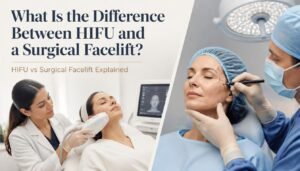
HIFU vs Surgical Facelift: What Is the Difference?
Both treatments may aim to improve the appearance of facial sagging, but they work differently and are intended for different levels of concern.
| Feature | HIFU treatment | Surgical facelift |
|---|---|---|
| Approach | Non-invasive ultrasound procedure | Surgical procedure |
| Incisions | No | Yes |
| Recovery | Usually minimal | Requires surgical recovery |
| Results | Gradual, often modest | Can produce more significant lifting |
| Excess skin removal | No | Can remove excess skin |
| Best suited for | Selected mild to moderate laxity | More significant sagging in suitable candidates |
HIFU may be an option if you have early skin laxity and prefer to avoid surgery. A surgical consultation may be more appropriate if you have substantial sagging or excess skin.
Neither treatment is automatically the best choice for everyone. Your anatomy, health, expectations and desired outcome should guide the decision.
HIFU vs Other Non-Surgical Jawline Treatments
Not every concern about jawline definition is caused by loose skin. Different treatments address different underlying issues.
HIFU: May help improve the appearance of selected areas of skin laxity and mild sagging.
Dermal fillers: May be considered when facial volume or contour contributes to a less-defined jawline. Results and suitability depend on individual anatomy.
Botulinum toxin: May be appropriate in selected cases where prominent masseter muscles contribute to a wider lower-face appearance. It is not a treatment for loose skin.
Fat-reduction treatments: May be considered when localised fat is the main concern, depending on the treatment, anatomy and clinical suitability.
Surgical options: May be considered for significant excess skin or structural concerns that non-surgical treatments cannot adequately address.
These options are not interchangeable. A qualified practitioner should identify the primary cause of the concern before recommending a procedure.
What Happens During a HIFU Consultation at DerMedico Clinic?
A personalised consultation helps establish whether HIFU is suitable for your jawline goals.
At DerMedico Clinic, you can discuss your concerns and explore available treatment options with the clinical team.
A typical consultation may involve:
- Assessment of facial contours: Reviewing the jawline, lower cheeks, neck and under-chin area.
- Evaluation of skin laxity: Determining whether loose skin is a significant contributor to the concern.
- Discussion of expectations: Explaining the potential degree of improvement and the gradual nature of results.
- Treatment planning: Selecting an appropriate approach based on your anatomy, suitability and the device being used.
- Aftercare guidance: Understanding what to expect after treatment and when to seek medical advice.
The goal is to choose an evidence-informed treatment that fits your needs rather than assuming HIFU is the right solution for every jawline concern.
To learn more about the clinic’s approach, visit the HIFU treatment page at DerMedico Clinic.
How Can You Maintain Jawline Definition After HIFU?
Although no skincare routine can stop the natural ageing process, a consistent approach to skin health may help support your overall results.
- Use broad-spectrum sunscreen: Protect your skin from ultraviolet damage with an appropriate SPF 30 or higher sunscreen.
- Follow a consistent skincare routine: Use gentle cleansing and moisturising products suited to your skin.
- Avoid smoking: Smoking can adversely affect skin health and the body’s normal repair processes.
- Maintain a stable, healthy lifestyle: General health and stable weight may help avoid additional changes in facial contours.
- Follow professional aftercare: Use the instructions provided by your treating clinician.
- Attend follow-up appointments when advised: Your clinician can assess your response and discuss further options if needed.
These measures support skin health but do not guarantee a specific HIFU outcome.
Frequently Asked Questions About HIFU for Jawline Definition
1. Can HIFU improve jawline definition without surgery?
Yes. HIFU may improve the appearance of jawline definition in selected individuals when mild to moderate skin laxity is a major concern. Results are generally gradual and vary from person to person.
2. Is HIFU effective for sagging jowls?
HIFU may help improve the appearance of mild jowling associated with skin laxity. More significant sagging or excess skin may require another treatment.
3. Can HIFU remove a double chin?
HIFU should not be considered a universal double-chin removal treatment. It may help selected patients with skin laxity, but fat-related fullness requires a separate assessment.
4. How many HIFU sessions are needed for jawline tightening?
The number of sessions depends on the device, treatment area, degree of laxity and individual response. Some protocols involve a single session followed by assessment, while others may differ. Follow your clinician’s recommendation and device-specific guidance.
5. Is HIFU painful?
Sensation varies. Some people experience warmth, tingling, tenderness or brief discomfort during treatment. Ask your clinician about comfort measures before the procedure.
6. When will I see results after HIFU?
Results develop over weeks to months as collagen remodelling takes place. Improvement may become more apparent over two to three months, although the timeline varies.
7. Can HIFU replace a surgical facelift?
No. HIFU is not a substitute for surgery when significant excess skin or substantial facial sagging is present. It may be an option for selected patients with milder concerns.
8. Is HIFU suitable for everyone?
No. Suitability depends on your skin condition, facial anatomy, medical history, treatment goals and the device’s instructions. A qualified clinician should assess you before treatment.
9. Does HIFU permanently define the jawline?
No. HIFU does not permanently reshape the jawbone or stop ageing. Any improvement in skin firmness can diminish over time.
10. Where can I learn more about HIFU treatment at DerMedico Clinic?
Visit the DerMedico Clinic HIFU treatment page to learn more about the procedure and arrange a consultation if appropriate.
Final Thoughts
So, can HIFU improve jawline definition without surgery? It can help selected individuals achieve a firmer-looking jawline when mild to moderate skin laxity is the main concern. Its benefits develop gradually, and the degree of improvement varies according to facial anatomy, skin quality and treatment technique.
HIFU cannot remove significant excess skin, permanently reshape the jawbone or guarantee a sharply defined jawline. Understanding the cause of your concern is therefore essential before choosing a treatment.
If you are considering HIFU, consult a qualified dermatologist to discuss your goals, suitability, possible risks and realistic outcomes.
Explore HIFU treatment at DerMedico Clinic to learn more about non-surgical skin tightening and the available treatment options.
Medical disclaimer: This article is for educational purposes only and does not replace an individual medical consultation, diagnosis or treatment recommendation.